

The current decline in real interest rates largely reflects a major shift in investor expectations for future inflation and economic growth. In January investors fled the bond market, pushing up long-term yields some 50bps, and signaled that we were for a sustained period of rapid growth and accompanying rising prices. The call went out for the Federal Reserve to act “sooner than later” and raise its rates to get ahead of the curve. Those anticipating a major uplift in economic growth should pay heed to the steady decline in the real long-term interest rates. The Treasury Inflation-Protected Securities (TIPS), a market measure of real rates, has dropped into further negative territory (Figure 1). The real yield on 10-year US TIPS fell further below zero as growing anxiety over the outlook for economic growth added fuel to a recent rally in bond market.
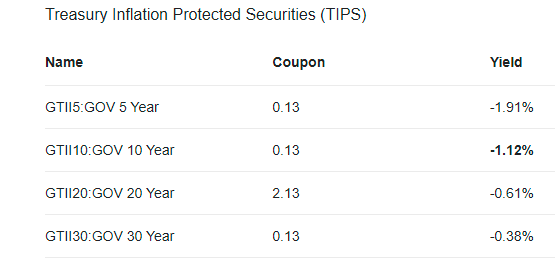
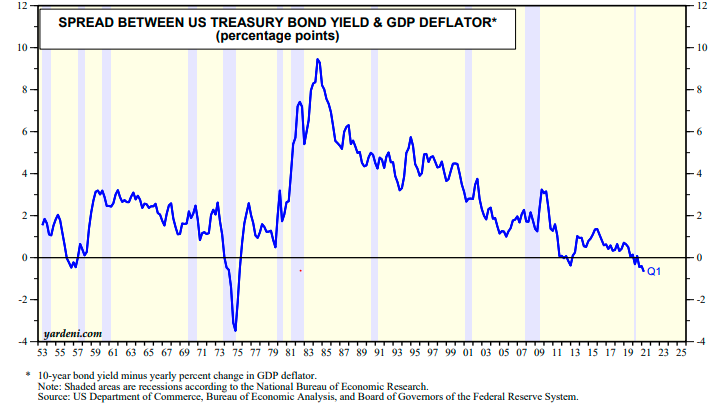
The yield on a TIPS bond is equal to the yield on a nominal Treasury bond minus the expected inflation rate. Put differently, TIPS are purchased by investors to protect against future inflation whereby their return equals the real rate plus the amount of the consumer inflation experienced in the past year. Consequently, when a standard Treasury bond is trading below expected inflation----as has been the case since 2010---then TIPS yield fall below zero. Real interest rates have been on a quarter-century decline, starting in the mid -1980s when inflation began its long-term decline. (Figure 2).
Figure 2 Spread between Treasuries and GDP Deflator
Another way to interpret TIPS is to calculate the “break- even rate”—the gap between real yields and nominal yields. This gap measures what investors expect inflation to average over the next decade. So, given today’s nominal 10-yr rate of 1.23% and the TIPS rate of minus 1.12%, investors anticipate inflation to average out at 2.35 % for the coming decade; earlier this year the expected inflation rate was slightly above 2.5%.
Depending on an investor’s needs, negative real rates can create a huge problem or can be a very welcome development. Pension funds have struggled to reach their investment targets for fixed income assets. Equity investors, by comparison, have enjoyed outsize returns due to the relatively high P/E multiples along with a surge in commodity prices---- the so-called “buy everything” rally we have experience since the low point in March 2020.
But negative real rates tell a quite different story, one that provides no cheer for equity investors in the longer run. There has clearly been a re-examination of the optimistic growth prospects featured earlier this year. There is no mistaking that the Delta virus poses a threat to global growth. Traders have clearly modified their inflation expectation, signified by the reduction in the break-even figure. Incoming data has fallen short of what many expected to be a boom once COVID-induced restrictions are lifted. Unemployment or its opposite measure--- job growth—both have been largely disappointing so far. Consumer prices have spiked in specific instances, but there continues to be a running debate whether we are experiencing a temporary surge or the beginning of a longer stretch of ever-increasing consumer prices. Nominal bond yields have fallen dramatically from their highs this past winter. Real yields are even lower than those experienced in the 2008 crisis. Milton Friedman warned central banks against zero interest rates. His position was clear: long-term negative real rates are an indication that future growth will be continue to be very low and deflation will be the biggest threat.



Comments
Log in or sign up to join the conversation.