

Image Source: Pixabay
This week is likely to offer little relief to an already battered bond market, even if US housing could eventually turn into a drag on growth and inflation. EUR rates are also on the rise but markets don’t expect ECB hikes to materially tighten financial conditions just yet, judging by low real rates and a steep yield curve
No relief for bonds with the focus still on inflation
This week’s event calendar offers a few opportunities for markets to question the macro and financial environment that has brought higher interest rates across developed markets. One exception is tomorrow’s public appearances from no less than the European Central Bank (ECB), Bank of England (BoE), and Fed head Christine Lagarde, Andrew Bailey, and Jerome Powell. This early in their cycles, with higher energy prices front and center of investors’ minds, we doubt they will move to cool down hawkish expectations. On the contrary, by running well ahead of hikes, markets are doing some of the central banks’ work for them. The one possible exception is Bailey who has recently struck a more cautious tone than his peers, being already three hikes into the BoE’s cycle.
Investors won’t assume any turning point before seeing actually slower inflation
So far this week, US housing data trumped fears of an abrupt slowdown in housing market activity but faster housing starts and building permits both points at a market about to swing from excess demand to excess supply. The near parabolic rise in mortgage rates is another hint. Whilst medium-term concerns about the housing market’s health increasingly enter the public’s consciousness, the focus remains firmly on near-term inflation. We would venture that, given the market’s recent track record of underestimating CPI readings, investors won’t assume any turning point before seeing actually slower inflation.
Markets are pricing a less aggressive ECB
The path is thus clear for higher rates in the near term. EUR rates seem to have less upside than their USD peers given less hot inflation dynamics there, still mostly driven by energy prices, and given the greater growth risks posed by the war in Ukraine. Still, traded EUR rate rises have often outpaced their USD peers in recent weeks, and not only on days with obvious EUR-centric event risks like ECB meetings. Part of the explanation lies in the fact that EUR rates are effectively catching up to the move seen in the US, with European markets assuming that the ECB will be forced into as aggressive and hawkish U-turn as the Fed.
EUR real rates remain low despite the bond sell-off
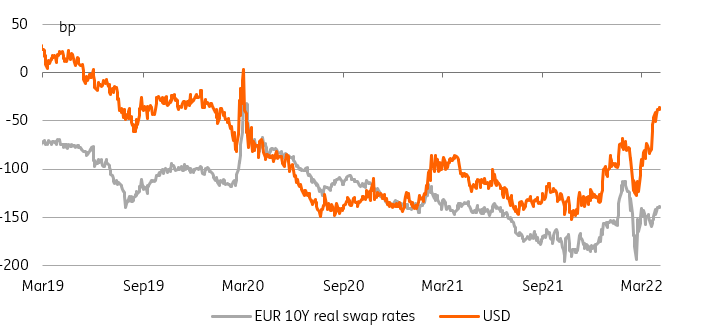
Image Source: Refinitiv, ING
Looking under the hood, it appears EUR rates have a lower conviction that their domestic central bank will step in aggressively to stop inflation. The most obvious indicator is real rates, the difference between expected inflation and nominal interest rates. Unlike the US where most of the bond sell-off was driven by higher real rates, EUR real rates remain deeply negative. This is a clear hint that, compared to future economic expectations, the ECB is still perceived to be relatively dovish, or that the outlook isn’t as rosy as hike expectations would suggest.
A steeper EUR curve indicates the ECB will be more gradual

Image Source: Refinitiv, ING
The second hint comes from the shape of the curve. Unlike its US equivalent, the EUR term structure has steepened in the latest sell-off. This also indicates that the ECB is not expected to be done with its hiking cycle as early as the Fed. Even if the forwards' curve is not showing any more hikes after 2023, it at least isn’t showing any cuts, unlike its USD equivalent. To us, this is mostly a matter of timing. The Fed hiking in 50bp increments in the next few meetings is bound to keep the curve flat or inverted. Contrasting with the ECB’s more gradual approach, we have a straightforward rationale for diverging curve dynamics.
Today’s events and market view
Eurozone industrial production and trade balance make up this morning’s economic calendar.
Olli Rehn and Joachim Nagel, sitting at opposite ends of the ECB’s dove-hawk spectrum, are due to speak. The market’s hawkish read on the last ECB meeting should in theory make dovish comments more impactful, but we think investors’ conviction will be hard to shake.
Primary markets will see the sale of 24Y and 20Y bonds from Germany and the US respectively.
From the Fed, Mary Daly, Charles Evans, and Raphael Bostic are scheduled to make public appearances. Markets will be looking for views on possible 75bp hike increments after Bullard raised the possibility last weekend.
The US economic calendar also features existing homes sales, hot on the heels of yesterday’s housing starts and building permits.
In the European evening, the French presidential debate will pit incumbent Emmanuel Macron against Marine Le Pen, with the run-off to take place on Sunday.



Comments
Log in or sign up to join the conversation.