


Oil and inflation dominate near-term direction for rates. But on a longer view, real rates highlight a backdrop, where better growth hopes and record bond supply keep long-end pressure intact. Recession fears are the clear risk to that. But in the absence of recession, inflation expectations are arguably benign and real rates have little need to fall
US Treasuries still holding at just under 4.5%, and still sticky
In the past number of weeks, we've been opining on long-dated real rates as a factor of significance for bond markets. Primarily, here. There is a link, even if seemingly tenuous, with the ongoing technical and productivity revolution being discounted in the risk asset space. It's not easy to glean this from the ups and downs in bond yields through business cycles, but it's certainly there. Below we update similar from a eurozone perspective. And we assert further that this is a factor of global influence.
But note, at the same time, that such talk is all very well while economies are doing okay. Face into a recession, and real rates will fall, regardless. Notwithstanding that, they should be higher than normal, and certainly well above the ultra-low real rates seen post the GFC / pandemic periods. It's a key focus to be cognisant of, rather than a simple Strait-induced hyper-focus on inflation expectations.
In fact, longer term inflation expectations are reasonably well contained (the European 10yr inflation breakeven is 2.2%, and the US version is 2.4%). In fact, these are likely too benign, and risk underestimating medium-term inflation risks. Either way, it leaves long tenor rates sticky at elevated levels.
Keep an eye on real rates as structural forces cannot be ignored
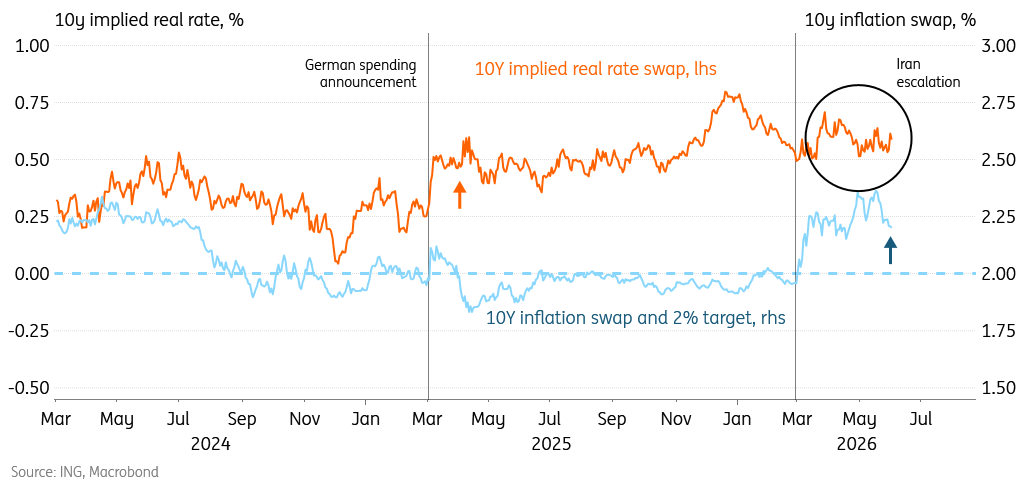
Inflation is clearly the current driving force behind euro rates, but the dynamics behind real rates should also not be forgotten when looking over a longer horizon. When we look at the 10Y euro implied real rate, we are close to the starting point from before the rise in oil prices. But when we take a longer view, we see that 10Y real rates have risen significantly since 2024. The German spending announcement was an important event, triggering an immediate jump of c.25bp.
Part of the real rate story can be explained by improving growth expectations in the eurozone, whereby a fiscal boost can help reduce the chance of returning to secular stagnation. In the US, the AI story seems to be feeding a growth narrative most recently. Whilst 10Y euro real rates traded sideways over the past few months, US real rates actually rose significantly.
But the big elephant in the room is the record bond supply hitting markets, which can also have an upward impact on longer-dated real rates. With the ECB continuing to reduce their bond portfolio, investors have increasingly more interest rate risk to absorb, increasing the term premium. And in the US, a worrisome large fiscal deficit is also adding to the global bond supply, keeping curves steeper.
Whilst oil prices dominate daily moves, in the background we could see a continuation of upward pressure on global real rates. This could change, however, if growth worries start mounting. Both the US and eurozone economies have their weaknesses and any talk about recession risks would quickly turn the direction of real rates.
Recent dynamics focused on inflation, but structural factors in real rates still important
Wednesday's events and market view
In the eurozone, we will get the final services PMIs for May and the producer prices for April. The ECB’s Elderson and Cipollone are slated to speak.
After job openings data significantly beat expectations on Tuesday, the US data is likely to be more influential for markets. Up for release are the May ADP employment growth and then the services ISM. Here the market is again looking for a confirmation of US resilience with the ISM expected to tick slightly higher. Later in the day the Fed will release its Beige Book summarising the anecdotal evidence on current economic conditions in its districts. The only Fed speakers on Wednesday are Barr and Logan.
In primary markets, the UK will auction £1.6bn in 9y inflation-linked gilts.



Comments
Log in or sign up to join the conversation.