

Sentiment remains shaky. There have been signs of spreads tightening when sentiment deteriorates but we think it is too early for Italy to fully benefit. Today's German tax update should boost borrowing expectations. Central bank speakers from the Fed, the ECB and the BOE are keeping stimulus hopes alive, but with no negative rates for the US.

Too early for spreads to tighten on rates rallies
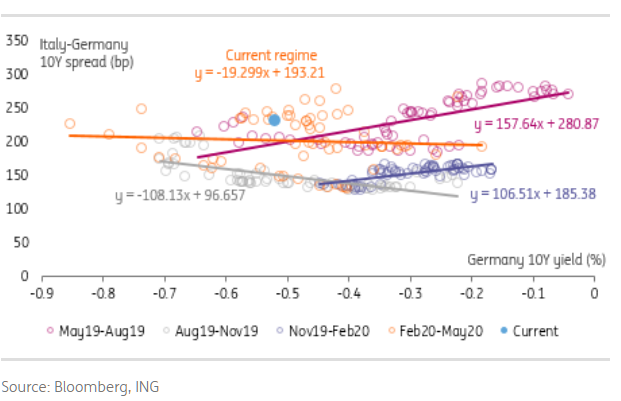
We wrote yesterday that, ironically, a deterioration in sentiment would help investors to absorb the flood of debt being issued by governments, corporates, and financial institutions. We should probably have been more specific about how exactly we think this could happen. As often, the answer is central bank credibility. As long as investors have confidence in central banks’ willingness and ability to lean against any spike in rates volatility, and against any material widening of credit spreads, we could see instances of bull-tightening of spreads: spread tightening when rates move lower.
Price action yesterday suggested markets could be moving in that direction. In our view, transition to that regime is only warranted when central bank action has been forceful enough. There is a case to be made that this point as been reached in a number of jurisdictions. In the Eurozone, nagging doubts about QE parameters after the German Constitutional Court’s (BverfG) ruling, and its inability to meaningfully dent Italy-Germany spreads since PEPP was launched, lead us to think it is too early to treat spread products like higher-beta rate products.
Yesterday evening, Italy approved a much discussed €55bn stimulus package. We think the measures are already priced in BTP markets, given how long the bill took to pass (it was originally dubbed the April package). Merkel's comments that the BverfG ruling will be used to drive further European economic integration are also helpful to sentiment but unlikely to move markets much in light of the difficulties in agreeing a common EU coronavirus policy response.
Italian spreads tightened on rates rally in two of the past four quarters.
Germany tax shortfall should signal further financing needs
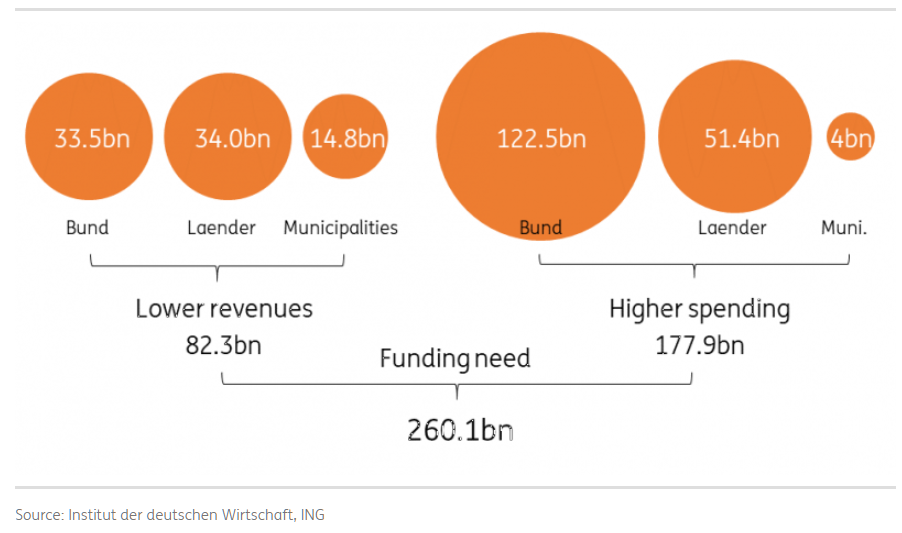
Germany should present new tax estimates today - and they will likely show a record decline. As the Handelsblatt reported last week they could see a drop of €100bn for 2020 and another drop of €40-50bn for 2021. In its supplementary budget for 2020, the government already calculated a decline of €82bn though, €33bn of which from a drop in central government tax revenues. Here, a 20% add on to that figure should probably be covered by leeway already foreseen in the supplementary budget.
In June government deliberations for another potential €50bn stimulus package are set to begin, while 2021 could see another drop of €20bn in central government tax income. Other uncertainties for the government's budget stem from potential future aid granted to local municipalities and from any decisions regarding the social security system which is seeing its buffers dwindle. In short, more German bond supply is still likely.
The current estimate for German financing needs may still be too optimistic.
Today's events: central bank speakers
The ECB's economic bulletin and public comment by De Guindos should be the opportunity to repeat that the central bank stands ready to do more if necessary. Hot on the heels of Powell's speech yesterday, Kashkari, Bostic, and Kaplan are all due to speak. Fed speakers have been unanimous in their recent rejection of negative rates, in spite of Trump still pushing for this.
From the BOE, governor Bailey will also be on the wires. In overnight comments he acknowledged market expectations are for an increase in QE. As we have written ahead of the last MPC meeting, this would avoid a 'cliff effect' for Gilts when purchases run out, probably by early July.



Comments
Log in or sign up to join the conversation.