

Markets are left to guess where the middle ground might be between two diametrically opposed proposals for a new EU recovery fund. The Commission will reveal its own plan tomorrow setting the starting point for negotiations. Forceful ECB buying has supported markets, but a strong reaction to the plans could be seen as reducing the likelyhood for more QE.
Competing plans for the EU recovery fund
Trading days are set to get busier again not only with the US and UK returning from a long weekend. Markets will have a chance to ponder the competing plans for an EU recovery fund in coming days. The Macron-Merkel proposal for a €500bn recovery fund that would make money available in grants was greeted with praise at the start of last week, even as some preliminary analysis conducted by the ZEW institute suggests that the net transfers could be relatively small.
In contrast, the reaction to the counter proposal of the ‘frugal four’ presented over the weekend has been very muted - both in terms of market reaction as well as public echo. Finnish and Estonian officials expressed sympathy for the principles of the counter proporal. It suggests help should be provided solely in the form of loans with conditions attached. While no concrete figure for the size of the fund was given, it is also expected to be financed by EU issuing debt. But the aim of the proposal is foremost to stake out a position opposite to that of the Macron-Merkel plan before heading into the negotiations in coming weeks - if not months.
The positions at both ends of the spectrum are now known. Still missing is the European Commission's (EC) own proposal, which it is set to publish tomorrow. And it should set a starting point for negotiations towards a compromise that eventually no EU member state objects to. Some rough outlines of the EC plans are known already. The Commission sees financial help “mainly” provided via grants. It sees a recovery fund of €500bn on top of the EU budget - or multiannual fiscal framework (MFF) - of €1tr for 2021-2027. Alongside issuing debt, the Commission also proposes new own resources, such as income from emissions trading or a digital tax.
ECB keeps up a fast QE pace - will it still be needed?
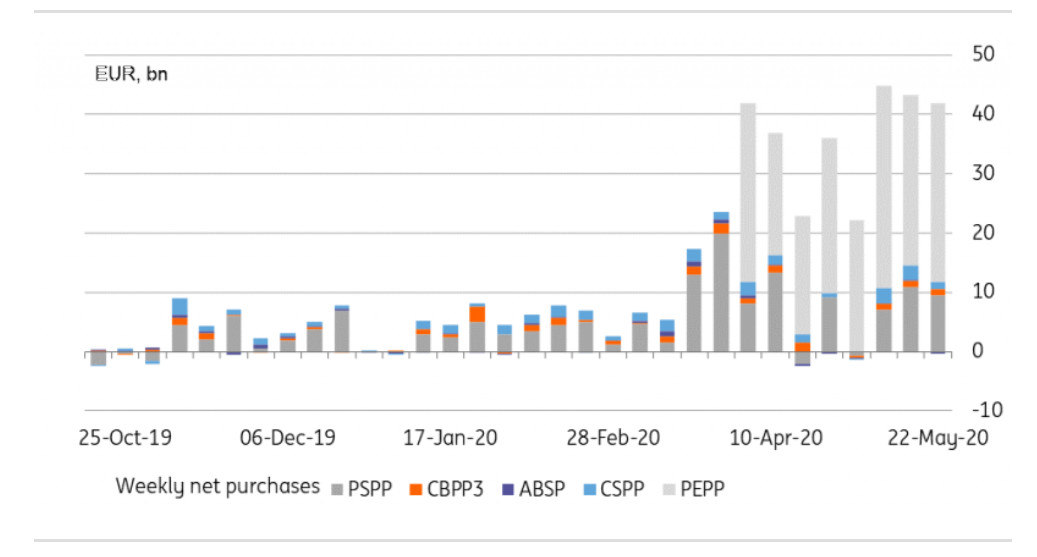
The ECB has maintained a fast pace of asset purchases with the QE portfolios growing by more than €40bn for the third week in a row. Of the €41.4bn net increase over the last week the public sector purchase program (PSPP) contributed €9.5bn. The pandemic emergency purchase programme (PEPP) accounted for €30.1bn. Next week’s monthly data should provide a breakdown by asset class also for the PEPP, though the suspicion is that interventions in the public sector, in particular Italian bonds, over the past weeks made up a good part here as well.
Extrapolating the current average weekly buying would see the €750bn PEPP envelope exhausted before November. But the current pace might no longer be needed when the outlines of the EU recovery fund become clearer. We have argued that a strong market reaction to the EC’s plan could be perceived as reducing the odds of more QE.
Currently, an increase of the PEPP envelope as early as at next week’s ECB meeting appears to be priced in with a significant degree of probability, with the strong hints in the meeting minutes last Friday hardly causing any market reaction. Banque de France's Villeroy, one of the most dovish members of late, said the ECB 'willvery probably' need to ease further and that PEPP was its preferred instrument.
ECB buys more than €40bn for the third straight week
Today's events: US data, ECB's Lane, new core government bonds
The data of note today comes from the US in the form of housing data and the conference board consumer confidence release. In Europe, ECB Chief Economist Lane's appearance will receive more attention with the next monetary policy meeting drawing closer. The ECB will also publish its financial stability review today.
In primary markets Germany will auction a new 2Y Schatz for €5bn. The highlight will be the auction of a new 7Y DSL 0% Jan27 for €3-5bn by the Netherlands. The Dutch state aims to bring the new bond to a size of €15bn within 12 months. Italy will reopen a 10Y inflation linked bond and sell a new 2Y zero coupon bond for a combined total of €4-5bn.


Comments
Log in or sign up to join the conversation.