

US payroll numbers are likely to stay above 100k, which means US rates are finding little excuse to test lower. A potential increase in the Minimum Reserve Requirements for eurozone banks could tighten liquidity conditions.
The ECB has revived the minimum reserves discussion to cut its losses
Reuters reported yesterday that the ECB was considering raising the amount of reserves banks are required to hold at the ECB on average – not immediately, but potentially in autumn. Crucially, this Minimum Reserve Requirement (MRR) is not remunerated, unlike reserves parked at the deposit facility, which currently earns banks 2.25% in interest. Doubling the MRR is estimated to save the ECB close to €4bn annually, and more if interest rates were to be increased further.
The original purpose of the MRR was to create a liquidity deficit in a system where the ECB is the sole supplier of liquidity – via this monopoly, the ECB had a means to implement its monetary policy stance in the market via its liquidity operations. But the MRR no longer serves that purpose in a time when the ECB has injected multiples of the MRR as excess liquidity into the banking system via quantitative easing. Market rates are determined by the interest earned in the deposit facility, where banks park their excess liquidity.
With excess liquidity currently at €2.2tr, the impact of a €174bn one-off reduction, which the doubling of the MRR would effectively result in, could be expected to be marginal. It would push us closer to a level of excess liquidity where funding rates are anticipated to react more sensitively to any changes, though. And we saw market expectations of Euribor/OIS spreads already nudge slightly higher on the back of the headlines.
But going deeper into potential knock-on effects, it is important to note that required reserves do not count towards banks' Liquidity Coverage Ratios. And that excess liquidity is not distributed equally.
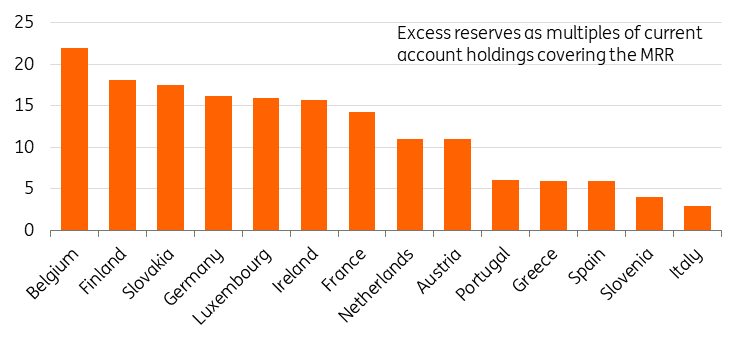
On a country level, we can see that Italy, Spain and Portugal hold excess liquidity to the tune of 3 to 6 times their respective MRR, whereas we are looking for multiples close to 15 for e.g. France and Germany. One could argue that redistribution of liquidity within the Eurosystem is currently happening relatively smoothly, but certainly some jurisdictions would feel a greater squeeze.
Liquidity is also not distributed proportionally across banks, as had been pointed out in the discussions when the ECB first floated the idea of increasing the MRR, back then by even more than just doubling it. Crucially, those banks that hold the excess liquidity are not necessarily the ones holding deposits, which ultimately serve as a basis for the calculation of a bank’s MRR. And those banks holding disproportionally larger deposits tend to be smaller banks that would then be penalised.
The ECB’s endgame remains to get to a situation where the banking system operates with lower levels of excess reserves, at levels determined by banks themselves in a self-balancing manner, with the ECB liquidity operations seen becoming an integral part of banks’ liquidity planning. The result is higher short-term market funding rates closer to the MRO as we see more reliance on the ECB's liquidity operations. The more structural liquidity needs would be covered by long-term liquidity operations and a bond portfolio (but substantially smaller than now).
The desire to cut losses and get to that situation more quickly is understandable. There is a review this year of the operational framework changes that were introduced in 2024, which can explain the timing of the headlines. But we doubt it is worth the risks of disrupting the gradual path toward the envisaged way of conducting monetary policy that the ECB has worked so hard to keep in the background.
Excess reserves are not distributed equally
US rates content with OK-ish jobs numbers
The US payrolls number is expected to come in at 115k, which might not be great, but is good enough to keep upward pressure on US rates. This would be the fourth consecutive reading above 100k, which comforts markets about a stabilising jobs market. One could argue the replacement rate is closer to 150k, but the slowing immigration story helps markets accept a lower breakeven point. And with inflation still hot, US rates are not finding any excuses to test lower levels in the near term.
Market optimism and a dovish sentiment are helping the US curve steepen and also contribute to a steeper euro curve. Fed Chair Warsh took a more benign view on inflation during the last day of the Sintra conference, triggering a move lower in 2Y. A new low for oil helped the dovish mood. The long end of the curve is stickier, however, and we continue to see the 10Y EUR swap rate anchored around 3%. Unless we see the macro outlook worsening or equities turning more pessimistic, we see little downside potential for longer rates.
Thursday’s events and market views
US nonfarm payroll numbers from June will be the highlight, with consensus eyeing a 115k reading, below the big 172k figure from last month. The unemployment rate is expected to remain constant at around 4.3%.
Spain will auction 5y SPGB, 8y SPGB, 10y SPGB and 10y SPGBei for a total of €6.75bn. France will auction a 10y OAT, 10y OAT, 15y OAT and 20y OAT for a total of €14bn. The UK will auction £3.25bn of a 11y Green Gilt.



Comments
Log in or sign up to join the conversation.