

Typical of President Trump's approach to negotiations is to threaten all hell will break loose unless you agree to my terms. Except, of course, when he backs away at the last minute, knowing he does not have the cards needed to win. This pattern is best exemplified in the state of negotiations between Canada and the US, held at the time of writing. Deadlines have been extended by the President at the eleventh hour, new issues have been introduced and speculation is ripe as to what was agreed upon and what remains unresolved. Both the President and Prime Minister Mark Carney have indicated a tentative deal has been reached, yet it appears that lots of further negotiations are needed, especially in critical sectors .
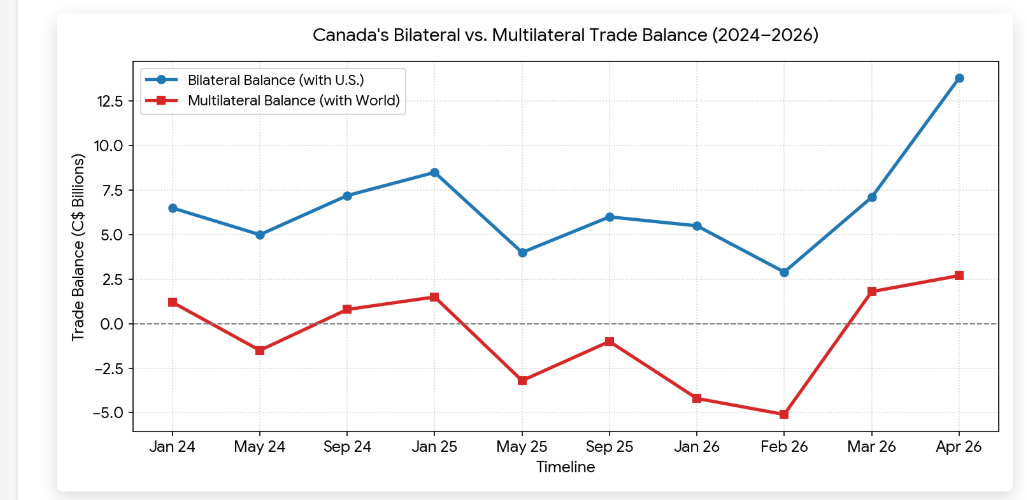
It is important to put the major issues into perspective, especially after the latest threat to impose 50% tariffs on US$ 20 billion of imports. In terms of its overall significance, the impact on bilateral trade of this tariff affects only 5% of total bilateral trade and will have no discernible impact on the Canadian trade surplus which continues to widen. Canada is just another example of the failure of tariffs to reduce US trade deficits with its major trade partners, including Mexico and China. Negotiations currently underway are a prelude to the renegotiations of the North American free trade deal, US-Mexico-Canada- Agreement (USMCA).
Areas of dispute currently under discussions are :
Trade Issues:
Agricultural Supply Management. Canada manages its dairy industry by issuing quotas to suppliers which favour Canadian and European suppliers; Quebec, the second largest province, is the largest beneficiary of this program; on purely domestic grounds, it is highly unlikely that the Carney government will concede to the American demands;
Provincial ban on US alcohols. Canadian provincial liquor boards removed American wines and spirits from retail shelves in the early days of the trade war; there is widespread support for this ban in Canada; Ontario, the largest importer of US product has led the way, and the Federal government can only coax the province into releasing the ban; meanwhile, the impact on US wine and spirit producers has been substantial, and Washington has made the full restoration of U.S. alcohol distribution across all Canadian provinces a non-negotiable condition for tariff relief;
Automotive Sector: The most confusing of tariff policies fall on the highly Integrated North American auto supply chains; vehicles; the industry on both sides of the border want these rollbacked;
Steel, Aluminum, and Softwood Lumber: Canada’s top economic priority is securing significant reductions or exemptions from existing the 50% tariffs on steel and aluminum imports; the entire US manufacturing sector has been impacted by paying more for Canadian exports. The softwood lumber dispute has been ongoing since the 1990s, and is unlikely to be resolved, given that the US has not abided by tribunal and court decisions in the past in support of Canada.
Non-trade issues
Keystone XL & Energy Integration: In a last minute effort, President Trump introduced the long-dormant Keystone XL pipeline project; this is strange, since the failure to get approvals reside solely in the US; key states, Nebraska and Kansas, refused to issue permits and continue to oppose its construction and the Federal government is up against strong opposition;
Critical Minerals: The US is desperate to get guaranteed access to Canadian reserves of critical minerals (such as lithium, nickel, and cobalt) and reduce its dependence on China;and
Defense Spending & Aerospace: Canada is upgrading its defense hardware, and the US is looking to sell its weaponry, including the F-35 fighter jets.
These non-trade issue only muddy the waters for those who are looking for basic rollback on tariffs and a return to more liberalized trade conditions.
These negotiations are really a warm up for the formal renegotiations of the USCMA. Trump refused to automatically renew the agreement and it now moves into a series of annual reviews and renegotiations. Here again, the President faces considerable domestic pressure to continue with USCMA. Nine US states, mostly in Republican strongholds, have anywhere from 25%-40% of their exports headed to Canada. The Wall Street Journal reports many red states have benefited from integrated manufacturing under Nafta and the USMCA. The main reason that US car makers have stayed competitive with Asian and European companies is that both Mexico and Canada have helped reduce costs and boost efficiencies.
No doubt President Trump’s bravado will show up and he will declare a victory in these continental negotiations. But the truth lies in the fact that both Canada and Mexico have significant leverage in the areas of deep concern to the US. We should know shortly on the outcome of these negotiations.


Comments
Log in or sign up to join the conversation.