


Inflation rose to 1.7% in July as expected by the market, as government measures to mitigate the impact of higher oil prices at fuel stations came to an end. Meanwhile, food prices continued to fall on both a monthly and annual basis. Core inflation likely remained unchanged, despite the persistent strength in services prices.
Higher energy prices partly offset by lower food prices
Czech inflation came in as expected at 1.7% YoY in July, with the general price level adding 0.6% from the previous month. Headline inflation was driven by an increase in fuel prices, related to the end of the government’s regulation of margins at fuel stations and reduced excise duty on diesel.
Food prices remained the main drag, falling again in July and staying firmly in annual decline. Goods prices also continued to fall on both a monthly and annual basis.
Goods prices behave, but services remain stubborn
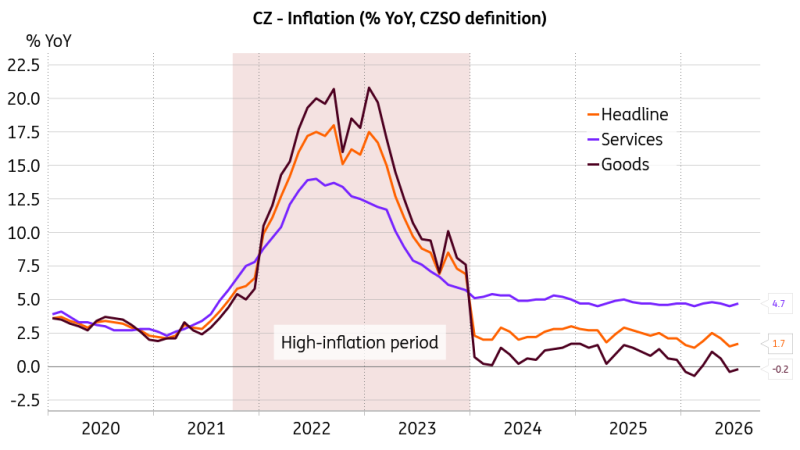
In contrast, annual price growth of services quickened to 4.7% in July from 4.5% previously, likely due to a seasonal increase in package holidays. That said, last July's increase in holiday prices was slightly softer than the July average, helped by lower oil prices despite recovering consumer demand.
This year, stronger energy costs and robust demand for travel point to the opposite outcome, with a mild base effect also contributing. As a result, core inflation likely remained at 2.8% in July, although a slight increase cannot be ruled out.
Adverse effects on economic performance still to come
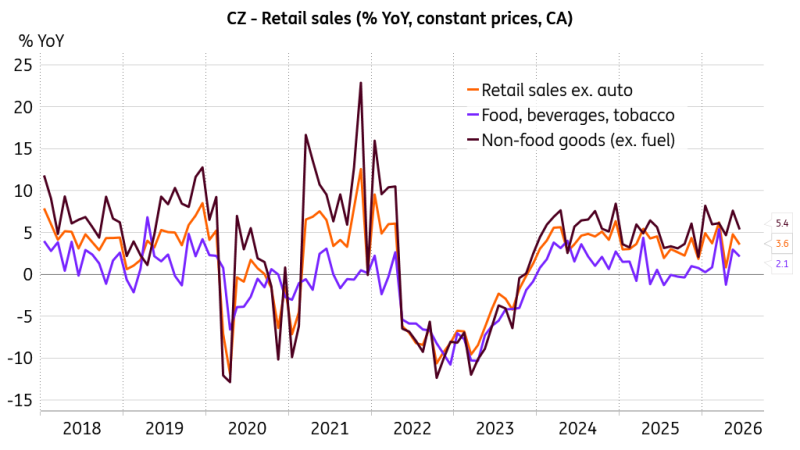
Real retail sales growth slowed to 3.6% YoY in June, yet the sales dynamic of non-food goods remained strong at 5.4% annually. People continue to spend, but we think the ongoing conflict in the Middle East will further weigh on economic activity, pressure the profitability of firms, and potentially put a lid on the ability to raise wages and ultimately end prices.
We expect headline inflation to average 2% this year and 2.6% in 2027, depending on the reopening of the Strait of Hormuz and oil prices. Core inflation is set to average 2.8% this year and 2.5% the next, which is below the panic zone.
Spending appetite still strong in June
The adverse impacts of the protracted Hormuz conflict on global economic activity remain to be seen. The Middle East represents an expanding market for many Czech manufacturers. Skoda Auto, for instance, officially entered the market in Saudi Arabia and Oman only in 2025. Any extension of the turmoil will likely somewhat dampen the near-term expansion prospects not only for the car manufacturer but for many other Czech exporters as well.
We take the position that the current situation still carries downward risks to future economic performance and demand across the globe, which potentially implies dampening secondary effects on prices in the non-energy segments. Overall, today’s Czech inflation data reinforces our view that keeping interest rates unchanged remains the appropriate policy stance, despite persistent price pressures in the services sector.

Comments
Log in or sign up to join the conversation.