

The PPI jumped a revised 1.1 percent in April and another 1.1 percent in May.
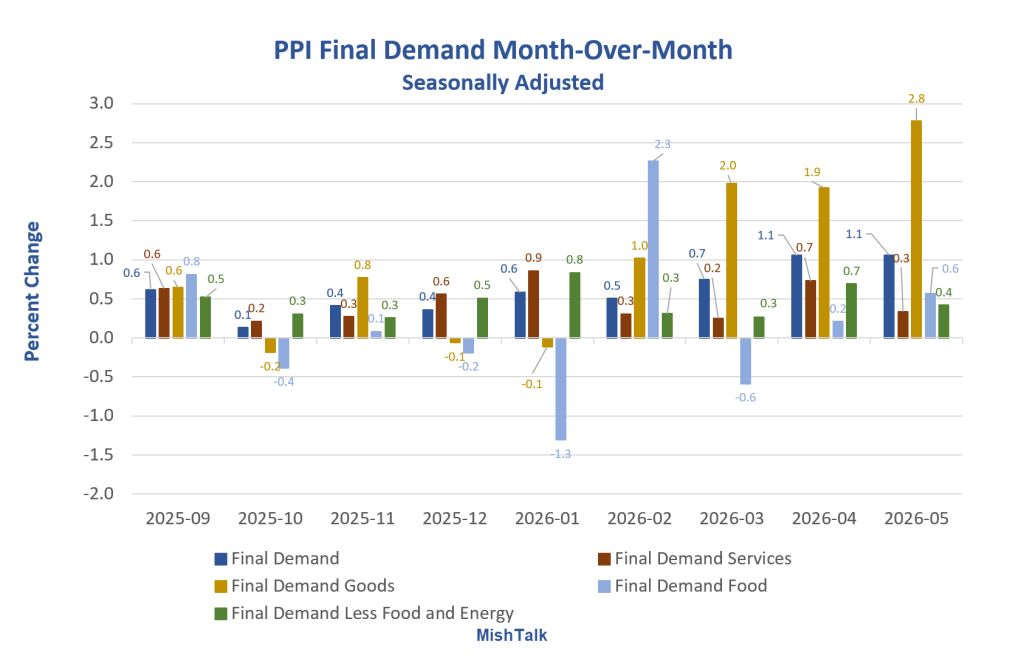
Biggest Leap in PPI since 2022
Please consider the BLS Producer Price Report for April 2026.
The Producer Price Index for final demand rose 1.1 percent in May, seasonally adjusted.
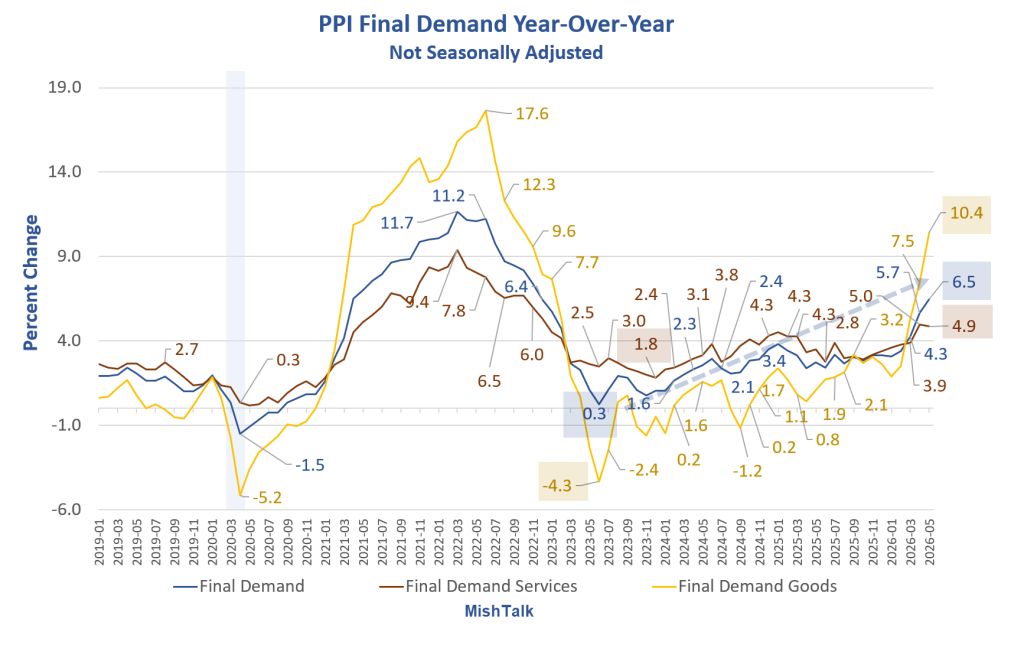
On an unadjusted basis, the index for final demand increased 6.5 percent for the 12 months ended in May, the largest 12-month rise since moving up 7.4 percent in November 2022.
Nearly 80 percent of the May advance in final demand prices is attributable to a 2.8-percent increase in the index for final demand goods. Prices for final demand services moved up 0.3 percent.
The index for final demand less foods, energy, and trade services rose 0.8 percent in May, the largest advance since increasing 0.9 percent in March 2022.
For the 12 months ended in May, prices for final demand less foods, energy, and trade services moved up 5.1 percent, the largest 12-month rise since jumping 5.5 percent in October 2022.
PPI Final Demand Month-Over-Month Details
Final Demand: 1.1 percent in May, 1.1 percent in April
Final Demand Goods: 2.8 percent in May, 1.9 percent in April
Final Demand Services: 0.3 percent in May, 0.7 percent in April
Final Demand Food: 0.6 percent, 0.2 percent in April
Final Demand Less Food and Energy: 0.4 percent in May, 0.7 percent in April
Final Demand Synopsis
Final Demand Services: The index for final demand services moved up 0.3 percent in May following a 0.7-percent advance in April. Leading the May increase, prices for final demand services less trade, transportation, and warehousing rose 0.7 percent. The index for final demand transportation and warehousing services moved up 2.6 percent. Conversely, margins for final demand trade services decreased 1.1 percent. (Trade indexes measure changes in margins received by wholesalers and retailers).
Services Detail: Over 40 percent of the May advance in the index for final demand services can be traced to a 4.8-percent rise in prices for portfolio management. The indexes for truck transportation of freight; securities brokerage, dealing, investment advice, and related services; chemicals and allied products wholesaling; food wholesaling; and airline passenger services also increased. In contrast, margins for machinery and equipment wholesaling fell 1.9 percent. The indexes for fuels and lubricants retailing and for residential real estate loans (partial) also moved lower.
Final Demand Goods: The index for final demand goods moved up 2.8 percent in May, the largest increase since data were first calculated in December 2009. Eighty percent of the broad-based advance can be traced to a 10.7-percent jump in prices for final demand energy. The indexes for final demand goods less foods and energy and for final demand foods also rose, 0.8 percent and 0.6 percent, respectively.
Goods Detail: Over half of the May advance in prices for final demand goods is attributable to a 23.4-percent increase in the index for gasoline. Prices for diesel fuel, jet fuel, plastic resins and materials, industrial chemicals, and natural gas liquids also rose. In contrast, the index for pork fell 10.1 percent. Prices for residential electric power and for sanitary paper products also declined.
PPI Final Demand Year-Over-Year
PPI Final Demand Notes
Final Demand: 6.5 percent, highest since 6.4 percent in December 2022
Final Demand Goods: 10.4 percent, highest since 10.5 percent in October 2022
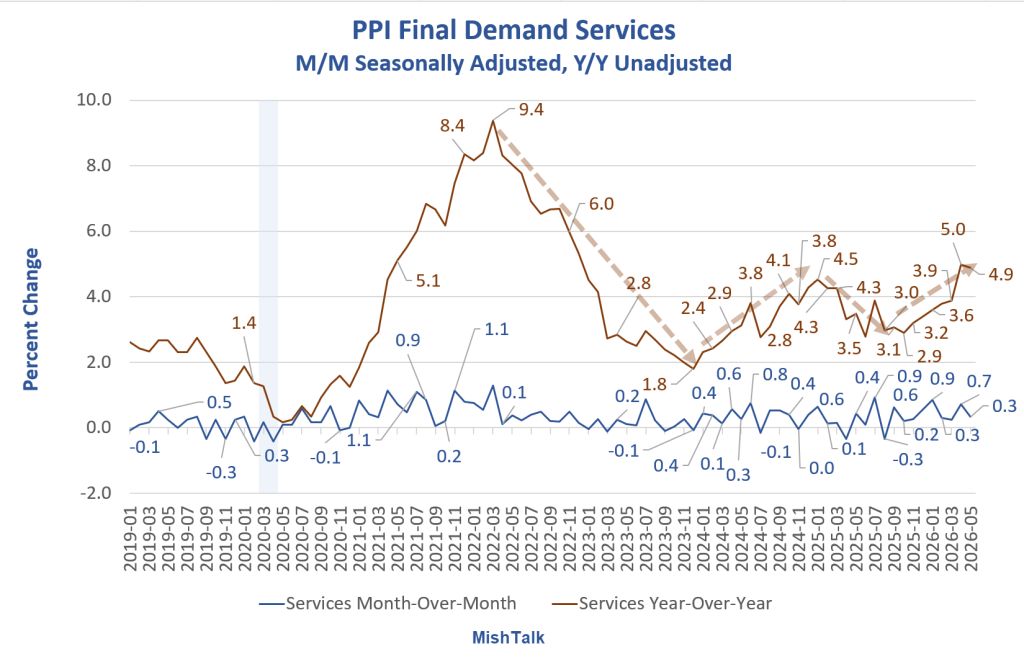
Final Demand Services: 4.9 percent, last month’s 5.0 percent was the highest since 7.4 percent in November 2022
PPI Final Demand Services
Services Key Points
Services represent a dominant portion of the Producer Price Index (PPI) for final demand, accounting for approximately 68% to over 70% of total PPI coverage as of early 2026.
Services are often the primary driver of PPI inflation, significantly outweighing goods.
The trend in services is now ominous. Year-over-year services PPI is up 4.9 percent.
Intermediate Demand
Processed Goods for Intermediate Demand: The index for processed goods for intermediate demand rose 3.5 percent in May, the largest advance since moving up 3.5 percent in March 2021. Over 60 percent of the broad-based May increase can be attributed to a 10.4-percent jump in prices for processed energy goods. The indexes for processed materials less foods and energy and for processed foods and feeds also moved higher, 1.8 percent and 0.7 percent, respectively. For the 12 months ended in May, prices for processed goods for intermediate demand advanced 13.3 percent, the largest 12-month rise since increasing 14.3 percent in August 2022.
Processed Goods Detail: Nearly a quarter of the May increase in the index for processed goods for intermediate demand can be attributed to a 15.7-percent rise in prices for diesel fuel. The indexes for gasoline, industrial chemicals, jet fuel, plastic resins and materials, and lubricating oil base stocks also advanced. Conversely, prices for pork declined 10.1 percent. The indexes for asphalt and for particleboard and fiberboard also moved lower.
Unprocessed Goods for Intermediate Demand: Prices for unprocessed goods for intermediate demand moved up 4.9 percent in May following a 1.5-percent advance in April. Half of the broad- based May increase can be attributed to a 6.9-percent jump in the index for unprocessed energy materials. Prices for unprocessed foodstuffs and feedstuffs and for unprocessed nonfood materials less energy also rose, 4.8 percent and 2.6 percent, respectively. For the 12 months ended in May, the index for unprocessed goods for intermediate demand moved up 22.2 percent, the largest 12-month advance since increasing 29.2 percent in September 2022.
Unprocessed Goods Detail: More than two-thirds of the May increase in prices for unprocessed goods for intermediate demand can be traced to an 11.8-percent advance in the index for crude petroleum. Prices for corn; slaughter cattle; raw milk; aluminum base scrap; and hay, hayseeds, and oilseeds also rose. In contrast, the index for natural gas decreased 18.2 percent. Prices for slaughter barrows and gilts and for high-grade recyclable paper also declined.
The Intermediate Demand (ID) Producer Price Index (PPI) measures price changes for goods, services, and construction sold to businesses as inputs for production, excluding capital investment.
Uses of the Data
Inflation Indicator: Highlights input price pressures that may lead to future changes in final consumer prices.
Contract Escalation: Businesses use these indices to adjust long-term supply contracts.
Economic Analysis: Helps economists and businesses measure changing input costs and profit margins.
Except for one-time increases or random fluctuations, intermediate price pressures tend to eventually find their way into final demand cost increases.
What’s happening now is neither temporary nor random. Price pressures will persist as long as the strait is closed.
Fed Behind the Curve?
Q: Is the Fed behind the curve?
A: Yes, obviously.
Q: Why?
A: The Fed still has an easing bias with three dissents.
At a minimum, the Fed’s bias should be towards hiking, not cutting rates. Inflation is clearly not under control.
This of course presumes the Fed can do anything realistic about this. But to be internally consistent, discussion of cutting rates seems ridiculous.
Meanwhile, Trump keeps making matters worse not only with Mideast policy but with tariff policy.
Looking Ahead
This PPI report is probably as bad as it gets for a while. The price of gasoline and crude have been falling.
However, more tariffs are in the pipeline as Trump keeps doubling down with the courts. The new tariffs are higher than the reciprocal tariffs the Supreme Court negated.
Tariffs will filter through to higher prices and destroy jobs.
CPI Highest in Over Three Years
Yesterday, I commented Consumer Price Index CPI Highest in Over Three Years, Another Disaster
Over the last 12 months, the CPI increased 4.2 percent the most since April 2023.
Trump Loves the Inflation
In case you missed it, please note Trump Says “I Love the Inflation”, Literally
In response to a question about the CPI Trump responded “I love the Inflation”
Q&A on Inflation
When asked if he is concerned about the latest inflation numbers that came out this morning [June 10], President Trump responded, “No, I love it. The numbers were great. You know what I really love? I love the inflation.”
Trump keeps giving democrats sound bites for the election. “I love the inflation” is one hell of a sound bite. And it’s in context.
Comments
Log in or sign up to join the conversation.