

Despite global headwinds stemming from the energy shock triggered by the conflict in the Middle East, Poland’s economic conditions improved in the second quarter and GDP accelerated. Inflation also remains within the central bank target. Monetary policymakers are likely to keep rates on hold for the rest of 2026, but 2027 may bring cuts
Stronger GDP growth in 2Q26
Although the second quarter of 2026 saw an outbreak of military conflict in the Middle East, which triggered a spike in oil and natural gas prices, Poland's economic performance improved as construction and industrial activity rebounded following a difficult first quarter, when adverse weather conditions weighed on growth.
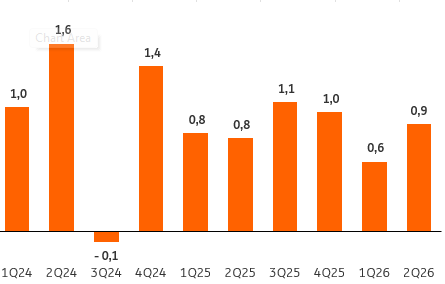
According to the flash estimate, GDP growth accelerated to 3.8% YoY from 3.5% YoY in 1Q26, as stronger investment activity more than offset a further slowdown in private consumption. Seasonally adjusted data suggest that the economy gained momentum, with growth accelerating to 0.9% QoQ from 0.6% QoQ in 1Q26.
Polish economy accelerates in 2Q26
GDP growth, QoQ SA
The Statistical Office will publish the detailed GDP breakdown at the end of the month, but we estimate that consumption growth slowed further as pressure on household budgets intensified. Wage growth continued to moderate, while rising petrol and diesel prices left less room for other spending.
At the same time, investment activity gained momentum as the absorption of EU funds, including resources from the Recovery and Resilience Facility (RRF), accelerated. We remain confident in our forecast of 3.4% GDP growth in 2026.
Inflation up, but price pressure still contained
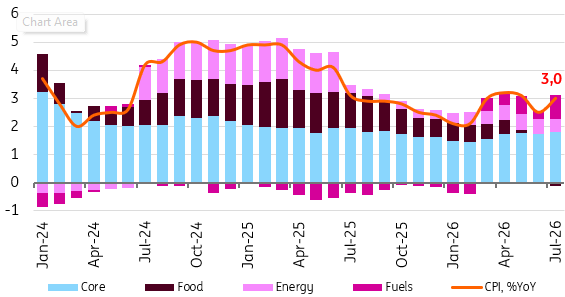
The final reading of July CPI inflation confirmed that consumer price growth accelerated to 3.0% YoY from 2.5% YoY in June. However, the increase was driven almost entirely by a renewed surge in fuel prices following the restoration of the standard 23% VAT rate from the temporarily reduced 8% rate and the removal of the fuel price cap at the beginning of July. Combined with higher oil prices after the collapse of the Memorandum of Understanding (MoU) between the US and Iran, this pushed retail petrol and diesel prices in Poland up by 15.8% MoM. As a result, annual fuel price inflation accelerated to 7.0% YoY in July from 1.3% YoY in June, contributing around 0.5-0.6 percentage points to headline CPI inflation.
Fortunately, price pressures remain subdued elsewhere in the basket. Housing energy inflation eased slightly, reflecting lower prices of liquid fuels compared with June, while food price inflation continued to decline. In the food category, disinflationary pressures appear broad-based, with another month of MoM declines in the prices of meat, livestock products, fruit and vegetables.
In addition, fierce competition among Poland's leading retail chains continues to exert downward pressure on consumer prices.
Inflation up mainly on the back of fuel prices
CPI inflation, % YoY, perc. points.
We estimate that core inflation excluding food and energy edged up by 0.1pp to 3.1% YoY in July from 3.0% YoY in June, but we see no signs of broad-based upward pressure on prices. Annual inflation in the information and communication category increased slightly, driven by higher prices for computers, data storage devices and mobile phone services. However, this appears to reflect the global AI boom rather than higher energy costs.
Elsewhere, month-on-month price increases were either directly linked to higher fuel costs, such as the jump in air fares, or were largely seasonal in nature, including air conditioners, recreational vehicles and caravans.
Headline inflation remains within the central bank's target range of 2.5% ±1 percentage point despite the increase in fuel prices, and we believe that neither the current inflation picture nor the outlook warrants a monetary policy response. In our view, underlying price pressures remain contained, supported by moderating wage growth and a cooler labour market.
Central bank rates to stay on hold in 2026 but room for cuts in 2027
In the coming months, we expect inflation to continue rising at a moderate pace, which should lead to the National Bank of Poland (NBP) keeping interest rates unchanged at the current level of 3.75%. Although NBP Governor Adam Glapiński indicated in July that the central bank might be prepared to ease monetary policy after the summer, the remaining members of the Monetary Policy Council (MPC) have been considerably more cautious in this regard.
We do not expect NBP interest rate cuts until mid-2027, when inflation may fall below the central bank's target. Our baseline scenario assumes two 25bp rate cuts in May and June, bringing the reference rate down to 3.25%.

Comments
Log in or sign up to join the conversation.