


Peace Headlines
Markets trade narratives the way desert travellers chase water on the horizon, and yesterday the tape suddenly convinced itself the oasis was real. Renewed optimism surrounding a possible Iran agreement hit the market like a circuit breaker on fear itself, sending crude tumbling, Treasury yields sliding, the dollar unravelling, and every momentum-driven risk asset from the S&P (SPX) to Bitcoin (BTC.X) catching a violent relief bid. Forgive the cynicism, but traders have heard this soundtrack before. We have been down this road of “final stages,” “finishing touches,” and “framework agreements” enough times to know the market often falls in love with the headline long before it meets the reality. Yet this time the machines bit hard. Oil dropped like someone pulled the emergency hatch on the inflation narrative, and once crude cracked lower, the entire macro chessboard instantly reordered itself. Bond yields followed energy south, the dollar lost altitude, and equities suddenly rediscovered their appetite for leverage, beta, and anything remotely connected to growth duration.
President Donald Trump once again reminded traders that jawboning oil may be one of the most powerful unofficial policy tools in modern macro markets. One comment suggesting the United States and Iran were in the “final stages” of talks was enough to detonate the crude complex. WTI collapsed back below $100 as traders rushed to price out worst-case supply scenarios tied to the Strait of Hormuz. The remarkable thing is not simply that oil sold off, but how aggressively cross-asset positioning reacted. Markets have spent weeks largely ignoring the inflationary implications of crude prices because the AI liquidity boom kept overwhelming everything else. Still, yesterday the oil market finally grabbed the steering wheel. Once energy rolled over, equity traders immediately interpreted it as permission for rates to fall, for financial conditions to ease, and for the soft-landing fantasy to regain oxygen.
Still, from thirty thousand feet, the physical market tells a far less comforting story. Beneath the relief rally sits an oil market that continues to tighten like a coiled spring hidden beneath a casino floor. Iranian loadings have effectively collapsed toward zero, Kharg Island storage utilization continues to climb, and global inventories continue to draw down at an accelerating pace as the world burns reserves to offset the effective shipping blockade through the Strait of Hormuz. The front end of the Brent curve continues to scream scarcity even while flat price traders temporarily celebrate peace headlines. That disconnect matters. Financial markets may trade tomorrow morning's headlines, but physical energy markets trade the molecule shortage six weeks from now. The world is still draining inventories faster than replacement barrels can be produced, and only about 41% of the lost Persian Gulf crude and condensate exports are currently being offset elsewhere. That is not a fully repaired system. That is a temporary patch job holding together a leaking pipeline with duct tape and optimism.
The irony is that the algos no longer seem to care about traditional relationships anyway. We have entered a bizarre phase where oil up means stocks up because nominal growth survives, while oil down also means stocks up because inflation fears fade. The market has effectively become a hall of mirrors where every macro outcome somehow reflects into bullish equity positioning. Yesterday was a perfect example. As oil cracked lower, short squeezers immediately stormed back into the tape. Small caps (IWM) exploded higher, the Nasdaq (QQQ) caught fire again, and the Dow (DIA) clawed back above 50,000 as if the previous weeks of bond market stress had never happened. The move was broad-based, too, which is important. This was not merely another Magnificent Seven levitation act. The S&P 493 finally joined the party; airlines surged on so-called peace-trade positioning; consumer cyclicals ripped higher; rate-cut beneficiaries caught a bid; and even lower-income consumer names suddenly looked investable again. The market was behaving like a city reopening after a hurricane warning gets cancelled at the last minute.
What makes the move even more fascinating is how skeptical professional positioning still appears underneath the surface. Hedge funds continue to sell equities month to date, macro products remain heavily short, and index and ETF short exposure has climbed back toward levels typically associated with genuine stress. Retail traders, meanwhile, continue behaving like tourists at a casino buffet where the food never runs out. There has barely been a negative retail-imbalance day since late March; leveraged ETFs remain fully engaged, and volatility skews continue to reflect relentless upside speculation. The emotional divide between institutional caution and retail euphoria is becoming one of the defining fault lines of this entire cycle. Professionals see fragility beneath the surface, while retail sees every dip as another AI-sponsored buying opportunity.
Rate markets also revealed something important overnight. Treasury yields collapsed almost in lockstep with oil as traders rapidly priced out the probability of further inflation escalation. The entire curve shifted lower, though the long end remains dangerously elevated from an equity valuation perspective. Thirty-year yields above 5.10% continue hovering like storm clouds over risk assets. Equity traders may have enjoyed the relief rally yesterday, but the structural tension inside bonds has not disappeared. Bond volatility remains the hangover nobody at the party wants to talk about. Markets are increasingly recognizing that this is not a fiscal panic story. It is an inflation-psychology story tied directly to energy-disruption risk. That distinction matters enormously for the dollar, rates, and equities.
In many ways, the bond market is now trapped between three competing exits. One path requires a genuine resolution in the Middle East that restores energy flows and crushes inflation fears. Another path depends on economic data suddenly weakening enough to pull the Fed back toward easing territory. The third path is valuation itself, where yields eventually become so attractive that capital finally steps in aggressively to buy duration. Until one of those doors opens decisively, the market remains stuck in an uncomfortable holding pattern, with equities continuing to celebrate. In contrast, credit markets quietly grind their teeth in the background.
The dollar reflected that confusion perfectly. Yesterday's sharp reversal erased much of the previous session’s surge, as lower yields and renewed optimism over peace crushed the greenback. The dollar story remains far more complicated than the market currently appreciates. Unlike earlier phases of dollar weakness driven by fiscal concerns, this recent yield surge has been overwhelmingly inflation-driven, which has historically been dollar-supportive. That is why every supposed peace breakthrough becomes so critical. Traders are desperately searching for a catalyst that can pull yields lower without requiring an outright collapse in growth. The market effectively wants a clean disinflationary miracle in which oil falls, the Fed eventually cuts rates, earnings remain strong, and consumers keep spending. That is an extraordinarily narrow runway for landing such a large macro aircraft.
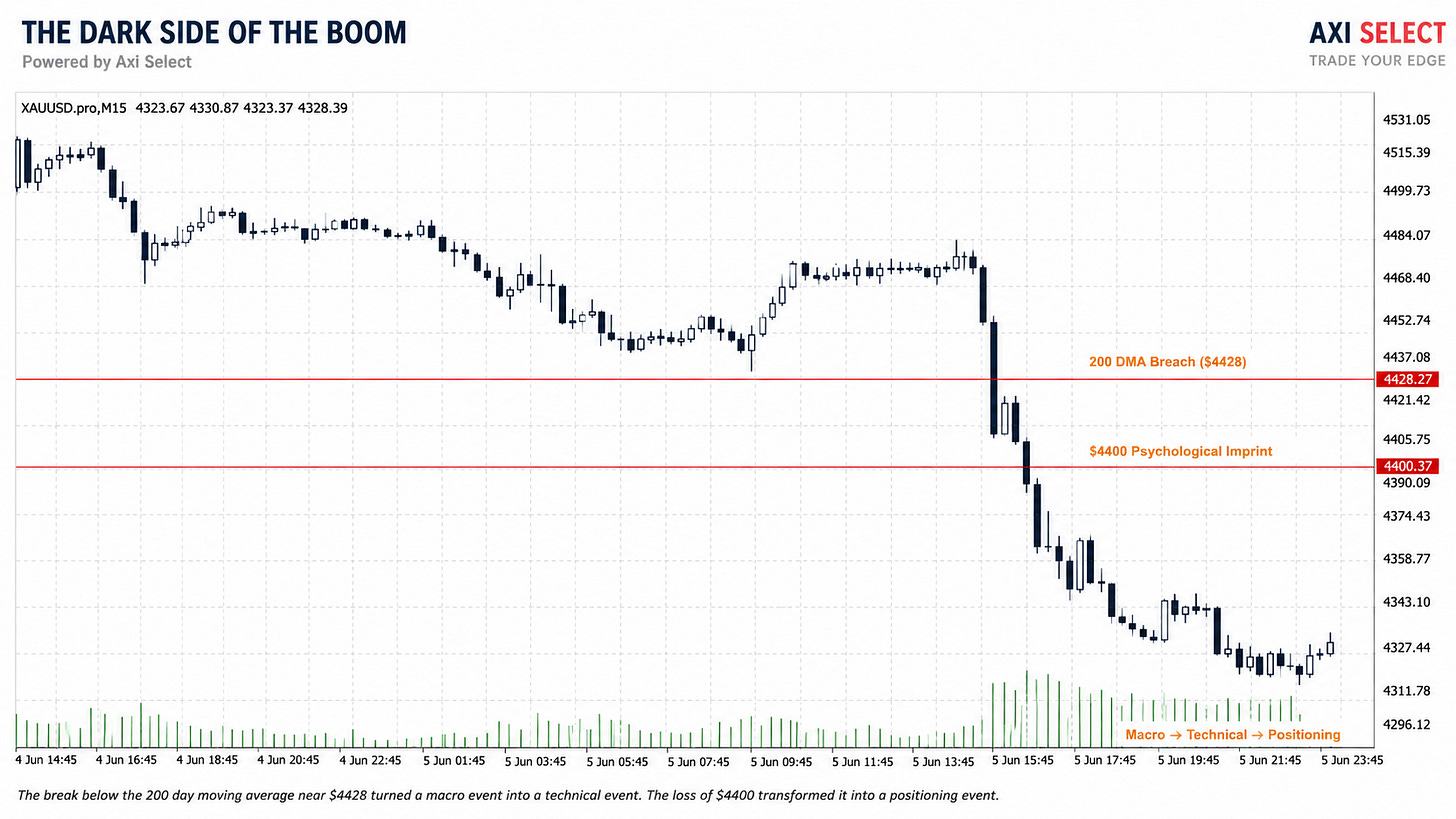
Gold managed to reclaim ground above $ 4,500 as investors quietly acknowledge that the structural instability beneath the global system has not actually disappeared. Gold no longer trades purely as an inflation hedge. It trades as a trust hedge against a world where supply chains, shipping routes, reserve systems, and political alliances all feel increasingly unstable. Bitcoin followed equities higher as expected, but gold’s resilience is arguably the more important signal because it suggests the market still does not fully trust the peace narrative it spent all day celebrating.
That may ultimately be the biggest takeaway from this entire move. Markets are acting less like investors calmly discounting future cash flows and more like a crowd sprinting between emotional extremes inside a burning theatre. Every headline triggers a violent repositioning event because the underlying macro regime remains unresolved. Traders know a genuine peace breakthrough could unleash a massive relief rally across bonds and equities. But they also know that one failed negotiation headline, one renewed tanker incident, or one aggressive military escalation could instantly send crude ripping higher again and reawaken the inflation monster the market temporarily buried yesterday.
That is why this rally still feels more like a tactical repricing than a durable macro resolution. The tape is celebrating the possibility that the storm may pass while quietly ignoring the fact that the coastline is still flooded
Finally, the market’s other emotional anchor point arrived after the bell, and Nvidia (NVDA) once again reminded investors that it no longer trades like a semiconductor company but more like the central nervous system of the entire AI liquidity cycle. The numbers themselves were enormous. Revenue beat expectations, earnings crushed estimates, margins held near an almost surreal 75% despite the costly Blackwell ramp, and guidance pushed toward the low $90 billion range even without assuming meaningful China data center contribution. Free cash flow exploded higher, buybacks surged, and the company effectively confirmed that the AI factory buildout remains the largest infrastructure expansion of the modern era. Jensen Huang continues to sit in the middle of this spending supercycle like the sole toll collector on the digital highway powering hyperscalers, sovereign AI ambitions, agentic computing, and the next generation of industrial infrastructure.
But the stock reaction revealed something far more important about the psychology underneath this market. NVIDIA finished essentially unchanged after what most companies would consider a generational earnings report. That is usually the tape’s way of whispering that expectations had already become dangerously crowded before the first number even crossed the wire. The market did not need strong earnings. It needed transcendence. And while the headline numbers were strong, traders also noticed softer edges in the story. Compute revenue appeared slightly underwhelming relative to the most aggressive whispers, inventory ballooned as Nvidia aggressively secured future supply capacity, and the company quietly adjusted its reporting structure in ways that may make future growth more opaque. None of that breaks the AI boom narrative, far from it. But it does suggest the market is slowly transitioning from blind momentum worship into a more demanding phase where execution quality, margin durability, and infrastructure digestion rates begin mattering as much as raw growth itself.
In many ways, Nvidia now behaves less like a stock and more like a macro liquidity instrument tied directly to the broader boom loop driving global equities. As long as hyperscalers keep spending and capital markets remain willing to finance this extraordinary AI arms race, the story stays intact. But the easy phase of the melt-up increasingly feels behind us. When positioning becomes this saturated, earnings stop functioning as ignition fuel and instead serve as stress tests of how much perfection has already been prepaid into the tape.

Comments
Log in or sign up to join the conversation.