

Let’s discuss the Fed’s preferred measure of inflation and gasoline.
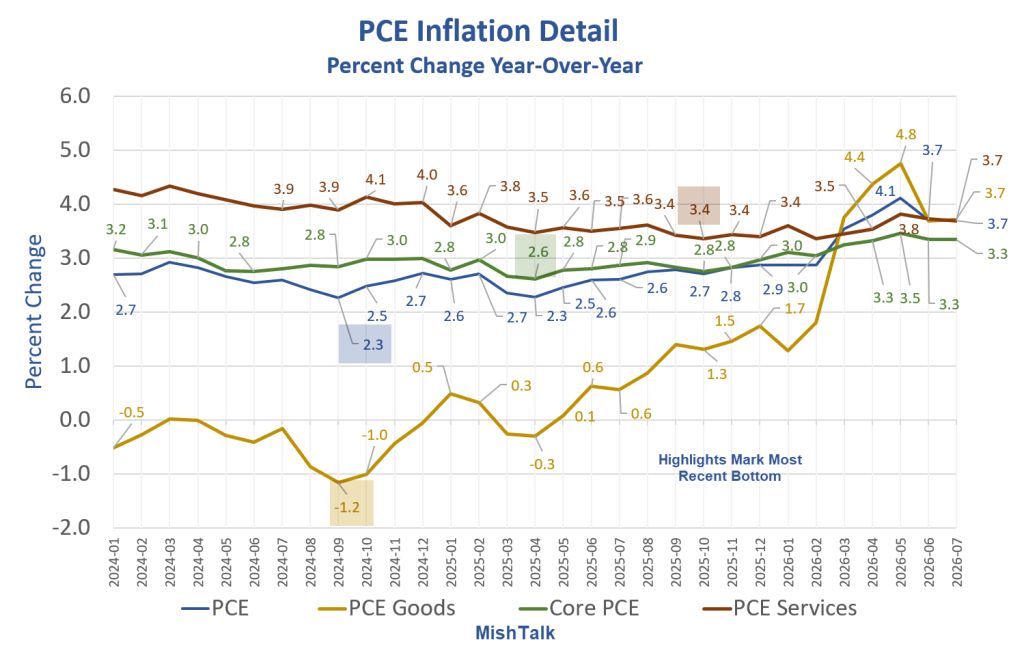
PCE Year-Over-Year Inflation, PCE, PCE Services, PCE Goods, Core PCE
PCE Year-Over-Year Inflation Details
PCE: 3.7 percent, bottomed at 2.3 percent in September 2024
PCE Goods: 3.7 percent, bottomed at -1.2 percent in September 2024
PCE Services: 3.7 percent, bottomed at 3.4 percent in October 2025
PCE Core: 3.3 percent, bottomed at 2.6 percent in April of 2025
I resolved the 4-way tie on the services bottom by calculating to three decimal places. PCE Services bottomed at 3.357 percent in October 2025
The “hot side” in the title is vs expectations. The Econoday consensus was 0.1 percent month-over-month and 2.6 percent year-over-year.
Actual data was higher.
Is 3.3 percent the new 2.0 percent? Given the wait-and-see cheerleading, it would see so.
PCE Month-Over-Month
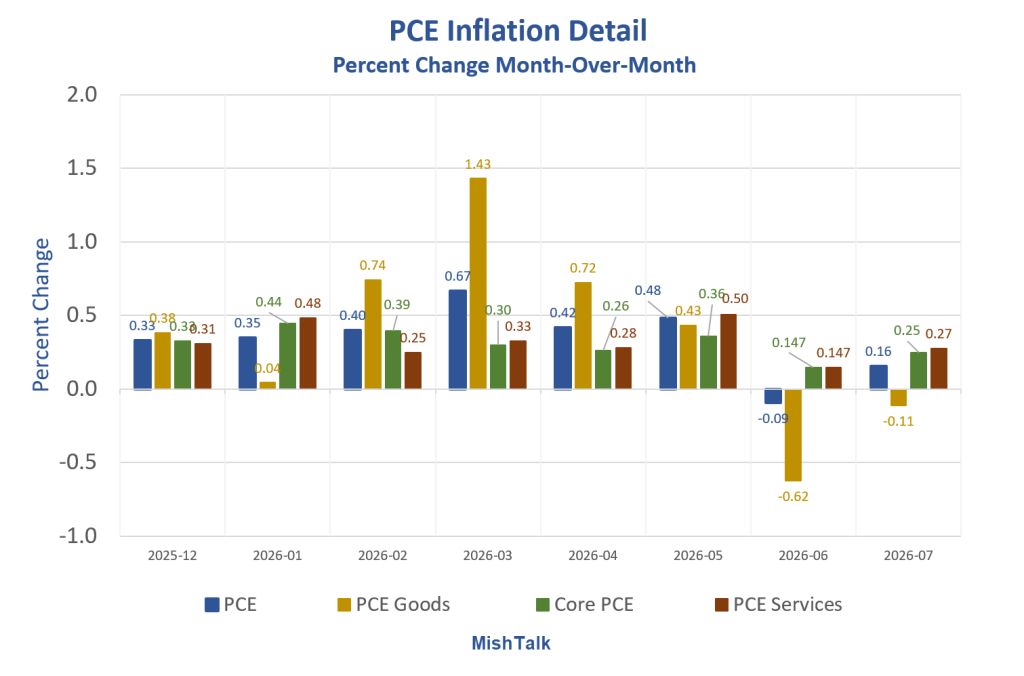
The BEA’s Price Details shows PCE inflation at 0.2 percent with goods at -0.11 percent
I calculate 0.16 percent to two decimal places, a bit better, but the reported goods inflation is suspect.
The BEA says the price of gasoline decline 2.7 percent in July following a 9.2 percent decline in June.
What Really Happened
If we look at the unadjusted pump prices from AAA Fuel Prices reports, gas prices did not experience a deep enough drop in early July to naturally offset the late-month surge:
July 2: $3.83
July 16: $3.94
July 23: $4.09
July 30: $4.09
The raw, unadjusted average of those weekly data points, July’s average price is roughly $3.98.
Compare that to June 2026, where the national average had crashed heavily from its $4.30 peak down to the $3.80s. June’s raw monthly average was roughly $3.96.
In terms of pure, unadjusted cash out of your wallet, gasoline actually rose by about 0.5% in July.
Question of the Day
Q: How does a +0.5% actual increase turn into a -2.7% decline?
A: It is entirely due to the Bureau of Labor Statistics’ (BLS) seasonal adjustment algorithm which the BEA also uses.
Most consumers don’t believe the price of gasoline fell 2.7 percent in July and neither do I.
PCE and CPI Inflation Details
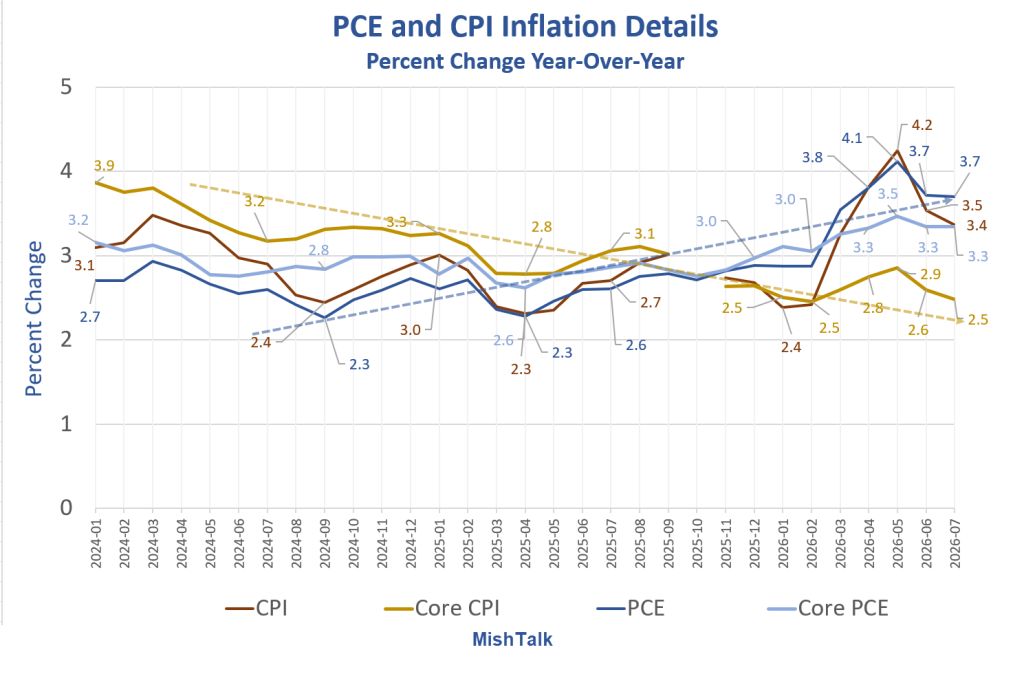
CPI vs PCE Inflation Year-Over-Year
CPI and PCE Inflation Year-Over-Year
CPI: 3.4 percent
CPI Core: 2.5 percent
PCE: 3.7 percent
PCE Core: 3.4 percent
PCE Above Fed’s Target
If you are a Trump or Fed apologist you are watching core CPI at a still high 2.5 percent and making excuses.
However, the PCE is the Fed’s preferred measure of inflation.
Year-over-Year PCE inflation has been over the Fed’s 2.0 percent target for 65 straight months since March 2021.
The Fed Will Get the Blame
No matter what happens now, the Fed is going to get the blame.
If the Fed hikes (as it should have long ago), and the stock market or economy tanks, the Fed will get the blame.
But an obvious AI bubble is brewing, and the Fed ignored that. It ignored the huge surge in credit fueling AI. And the Fed ignores off-balance sheet accounting that hides this debt and inflates earnings.
If the Fed does nothing, the bubble will keep brewing but will eventually pop. The Fed will get the blame for that too.
Meanwhile, the Fed, Fed apologists, and Trump apologists keep pretending everything is under control.
The Trump apologists want the Fed to cut rates. That’s ridiculous for two reasons, inflation and credit bubbles.
Related Posts
August 23, 2026: Diesel 21 Cents from Record High. What if Canada Shut Off Oil to the US?
Carney has a huge card, two if he chooses to play them.
August 25, 2026: Canada Retaliates and Trump Threatens to Rename Lake Ontario
Trump makes a threat he cannot even keep.
Trade wars do neither side any good. We have them because someone starts a trade war, Trump in this instance, and political necessity demand retaliation.
An overwhelming percentage of Canadians wants Carney to respond. So he did.
It is absurd to be in this spot, but here we are.
August 26, 2026: Americans Now Pay 75 Percent More for Aluminum than the Rest of the World
You can’t increase exports if you are the highest cost manufacturer.
Tariffs increase costs. Both the US and Canada are doing this.


Comments
Log in or sign up to join the conversation.