

Narratives Crack
Asia walks in under a cloud of doubt after a tech-led slide on Wall Street knocked the wind out of risk appetite, with the aftertaste of that move still lingering as traders size up what comes next. The weakness was not broad panic but something more surgical, a reassessment of the engine that has been doing most of the heavy lifting. Doubts are beginning to creep in around whether the scale of spending on artificial intelligence can deliver the returns the market has already priced in, and that question is arriving at the worst possible moment, right as a heavy slate of megacap earnings is about to hit the tape.
The tension is obvious. On one hand, the technology sector has been remarkably insulated from the disruption tied to the Iran conflict, operating almost in a parallel macro universe where compute demand and capital expenditure cycles matter more than oil flows through the Strait of Hormuz. That insulation has translated into extraordinary growth, with earnings expected to have expanded by around 41% in the first quarter. On the other hand, that strength has set a very high bar. When expectations are this elevated, it does not take a collapse to disappoint; it just takes results that fall short of perfection.
That leaves the market in a narrow corridor. Equities are leaning heavily on the largest names to validate the scale of AI investment, while contending with a less forgiving macro backdrop. Rising oil prices are starting to seep into inflation expectations, and that pressure is working its way through rate markets. Yields are already pushing higher, and there is a growing camp that sees the ten year drifting toward 4.40%, a level that tightens financial conditions just as equity valuations are being tested.
Put it together, and the setup is fragile. Stocks are capped by demanding earnings expectations at the top of the market, while bonds are pressured by a macro environment that refuses to cool. The result is not outright stress, at least not yet, but a market that is losing its margin for error. Asia inherits that tone not as a crisis but as a quiet shift in the balance, where conviction is thinner, and every data point matters a little more.
U.S. equities have been carrying the weight of perfection, with the S&P 500 sitting near record highs and a staggering 21% of the index's market cap set to report, including Amazon (AMZN), Alphabet (GOOGL), Meta Platforms (META), and Microsoft (MSFT). That is not just an earnings calendar; it is a stress test of the entire AI complex, and the market could feel it. Anxiety crept in early, but what tipped it over was a shift in tone from greed to doubt as positioning met reality, and FOMO gave way to a far more cautious mindset within hours.
The spark came from a crack in the very engine that has been pulling the tape higher. OpenAI failing to meet internal revenue and user growth targets hit the market like a misfire in a high-performance engine. When the machine that justifies the spend begins to wobble, everything downstream starts to reprice. The unwind was swift and clinical. AI inference beneficiaries, data center plays, memory, semis, and the leadership basket all came under pressure. High-beta momentum saw a violent reversal, moving deep into negative standard-deviation territory, marking one of the worst sessions of the year. This was not random selling; it was positioning, being forced to admit it had leaned too far over its skis. An 18-day run in semis and the strongest monthly performance since the dot-com era had left the market exposed, and today that exposure got called.
Flows confirmed what price was already saying. Long-only funds were better sellers across information technology, consumer discretionary, and macro products, while hedge funds joined the exodus, leaning heavily into supply in tech and communication services. Volumes told their own story, down meaningfully against recent averages, a thin tape where price moves faster, and air pockets form more easily. Even the systematic community stepped back. CTAs that had been reliable buyers flipped neutral, with downside supply now lurking if the tape weakens further. Month-end rebalancing added another layer, shifting weight away from equities toward bonds, just as a heavy IPO supply waits in the wings. The market was not just wobbling, it was structurally vulnerable.
In other words, it played out exactly as flow analysis had called it.
Layer on top a geopolitical backdrop where narratives began to fracture all at once, and the outcome was almost preordained. The idea that AI spend sits beyond scrutiny took its first real dent, while the market’s long-held habit of sidelining geopolitics broke down as oil forced its way back to center stage. When two dominant narratives crack at the same time, that oil can. be ignored over the short term, and that AI is unstoppable, the market stops debating which story matters most and starts stepping back from both at once.
Oil is quietly reclaiming its role as the market’s truth serum. Brent Crude pushed toward $110 while West Texas Intermediate held near $100, levels not seen since before ceasefire expectations briefly calmed the tape. The choke point remains the Strait of Hormuz, where flows of crude, gas, and refined products are still constrained by a blockade dynamic that is no longer theoretical. Physical tightness is building, and the market can feel it. Dated Brent, the price that actually clears barrels in the real world, is rising with urgency while front-month futures are racing to catch up. That convergence is not just technical; it is the paper market being forced to acknowledge physical scarcity.
Geopolitics is no longer background noise for stocks. The United States and Iran are locked in a negotiation that is being misread as chaos when, in reality, it is a slow grind toward a constrained outcome. Iran wants the blockade lifted and access to its flows restored. Washington holds that lever and is in no hurry to give it away without extracting value. Meanwhile, the longer this drags on, the more second-order effects start to bite. Storage pressure builds, production risks emerge, and the system begins to strain in ways that futures prices cannot ignore.
A surprise move by the OPEC member United Arab Emirates to step away from the group briefly offered the illusion of future supply relief, but that is a story for tomorrow. Today is still about restricted flows.
Rates heard the message loud and clear. Treasury yields moved higher, led by the front end, tracking oil as inflation risk crept back into the pricing. An ugly seven-year auction did not help, but the bigger driver was energy. The five-year inflation swap pushing above 2.7% signals that the market is beginning to reprice the medium-term inflation path. Rate cut expectations for 2026 have been pushed further out, with only a minimal chance of easing priced in. The bond market is not panicking, but it is shifting tone. Energy is setting the agenda again, and the curve is adjusting accordingly.
Credit, often treated as the early warning system, is less cooperative this time. Spreads are not leading the equity market lower in any meaningful way, reflecting structural changes that have muted its signalling power. Historically, credit has only consistently front run equity drawdowns in a handful of major dislocations. Today, that relationship is less reliable, leaving the equity market to navigate risk without its usual guide. That does not remove the risk; it just delays the signal.
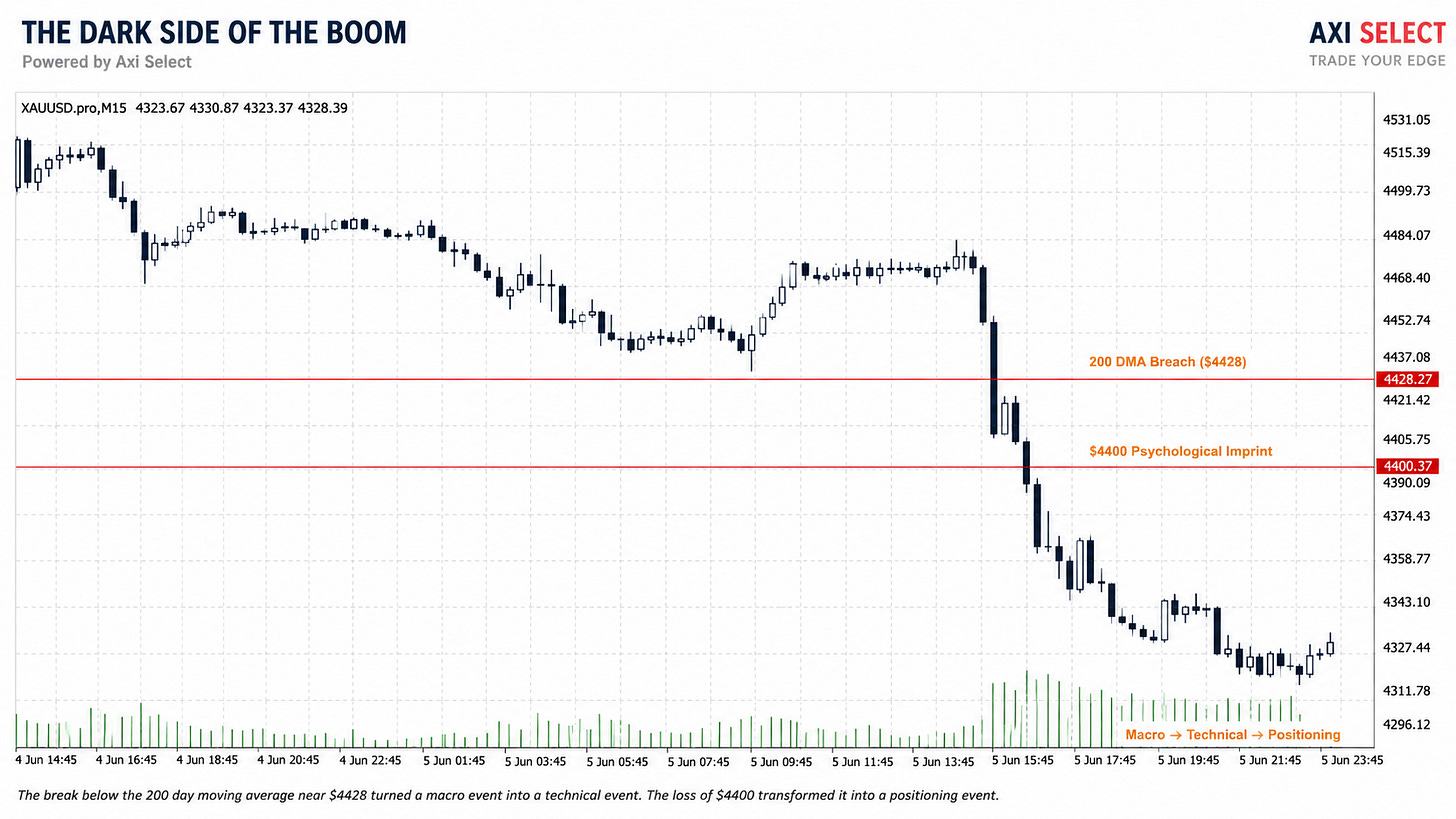
Across the rest of the tape, the pattern was consistent. The dollar found support as higher oil reinforced its inflation premium. Gold was hit hard, behaving less like a hedge and more like a funding source as emerging market stress dynamics reasserted themselves. Bitcoin (BTC.X) slid as speculative appetite cooled. Volatility, in typical fashion, refused to fully validate the move, drifting lower even as equities sold off, a reminder that this market still leans toward complacency until forced otherwise.
The real shift today was not in any single asset, but in the way the market is beginning to connect them. Oil is no longer isolated. It is feeding into rates, the dollar, equity risk tolerance, and the broader inflation narrative. At the same time, the AI trade, which has carried the tape almost single-handedly, is facing its first meaningful test of durability. When the two dominant forces in the market start to move in opposite directions, one tightening financial conditions and the other losing momentum, the margin for error shrinks quickly.
This is what a narrative reset looks like. Not a collapse, not yet, but a rebalancing of belief. The market is being forced to reconcile record equity valuations with rising energy costs, tighter financial conditions, and a geopolitical backdrop that is anything but resolved. That tension does not resolve cleanly. It grinds, it reprices, and it exposes where positioning has become too comfortable.

Comments
Log in or sign up to join the conversation.