


The Indian market is no longer trading purely on earnings, valuations, or domestic growth optimism.
It is now reacting to something far bigger, a simultaneous collision between geopolitics, currency stress, global capital reallocation, and artificial intelligence-driven disruption. That combination is creating a very different market environment from what investors were used to during the post-pandemic liquidity boom.
This is no longer a “buy every dip” macro cycle. This is a selective, psychologically fragile, globally interconnected market regime. And India sits right in the middle of it.
The Oil Shock Is Becoming A Currency Shock
The single biggest macro variable right now remains crude oil.
India, being one of the world’s largest oil importers, faces immediate external pressure whenever geopolitical tensions push energy prices higher. The ongoing Middle East uncertainty and fragile US-Iran negotiations have already triggered sharp volatility in crude prices and global bond markets.
The result is visible directly in the Indian rupee.
The rupee recently hit record lows near 97 against the dollar before aggressive RBI intervention stabilized the currency temporarily. RBI is prepared to do “whatever is required” to maintain orderly currency markets amid rising volatility.
What makes this cycle dangerous is the feedback loop:
Higher oil prices worsen India’s import bill
A weaker rupee raises imported inflation
Foreign investors pull money from equities and debt
Currency weakness accelerates further
RBI intervention drains liquidity
This becomes both an economic problem and a psychological problem. Markets begin pricing uncertainty faster than fundamentals.
Foreign Investors Are Sending A Clear Message
Foreign portfolio investors have already withdrawn more than ₹2.2 lakh crore from Indian equities this year, according to market reports.
That number matters not merely because of the capital outflow itself, but because of what it signals globally.
International capital today has become far more defensive.
Investors are no longer chasing only growth stories. They are chasing resilience, energy security, dollar strength, AI productivity, and geopolitical insulation.
Emerging markets that rely heavily on imported commodities and external capital are automatically facing greater scrutiny.
India remains one of the strongest structural growth stories globally, but in the short term, liquidity often dominates logic. And liquidity globally is becoming more selective.
AI Is Quietly Changing The Global Capital Allocation Model
One of the biggest underappreciated macro shifts underway is the transition from labor-heavy growth toward AI-heavy infrastructure spending.
Globally, companies are increasingly redirecting capital toward:
data centers
automation systems
AI infrastructure
cloud computing
semiconductor ecosystems
and productivity software
That trend is beginning to reshape employment, hiring models, and corporate cost structures across sectors.
Ironically, India stands at both ends of this transformation.
On one side, India benefits enormously from digital infrastructure demand. Microsoft’s (MSFT) largest India data center is expected to go live in mid-2026 as part of its massive AI expansion strategy.
On the other side, AI-led efficiency pressures could reshape traditional outsourcing, IT services, and white-collar employment globally.
This creates a strange paradox for Indian markets: India may benefit from AI infrastructure investments while simultaneously facing pressure on traditional labor-arbitrage business models.
That distinction is becoming increasingly important for investors.
RBI Now Has A Delicate Balancing Act
The Reserve Bank of India is currently balancing three conflicting objectives:
Protecting the rupee
Supporting growth
Managing inflation risks
That becomes extremely difficult when oil prices remain elevated while capital flows weaken.
Bond markets are already reacting.
Indian government bond yields have climbed amid fears that persistent inflationary pressure could eventually force tighter monetary conditions.
The RBI appears to be relying on intervention, liquidity operations, and forex management rather than aggressive rate action for now.
But markets understand something important:
Central banks can smooth volatility temporarily.
They cannot eliminate macro stress entirely.
Which Sectors Could Face Pressure?
Potentially Vulnerable Sectors
Aviation
Paints
Chemicals
OMCs
Consumption-heavy imports
Rate-sensitive sectors
Higher oil prices and a weaker rupee directly increase input costs for these industries.
IT services may also face near-term valuation pressure if global enterprises prioritize AI-led cost optimization over traditional outsourcing expansion.
Weak guidance from major IT firms had already weighed on Indian equities earlier this year.
Which Areas Could Still Benefit?
Potential Relative Winners
Energy producers
Defense-linked manufacturing
Utilities
Domestic infrastructure
Select banking names
Data center ecosystem plays
AI infrastructure suppliers
India’s longer-term manufacturing and digital infrastructure story remains intact despite near-term volatility. In fact, periods of macro stress often accelerate structural transitions. That is exactly what markets may be witnessing right now.
The Psychology Of This Market Matters More Than Ever
This is no longer a market where narratives stay isolated.
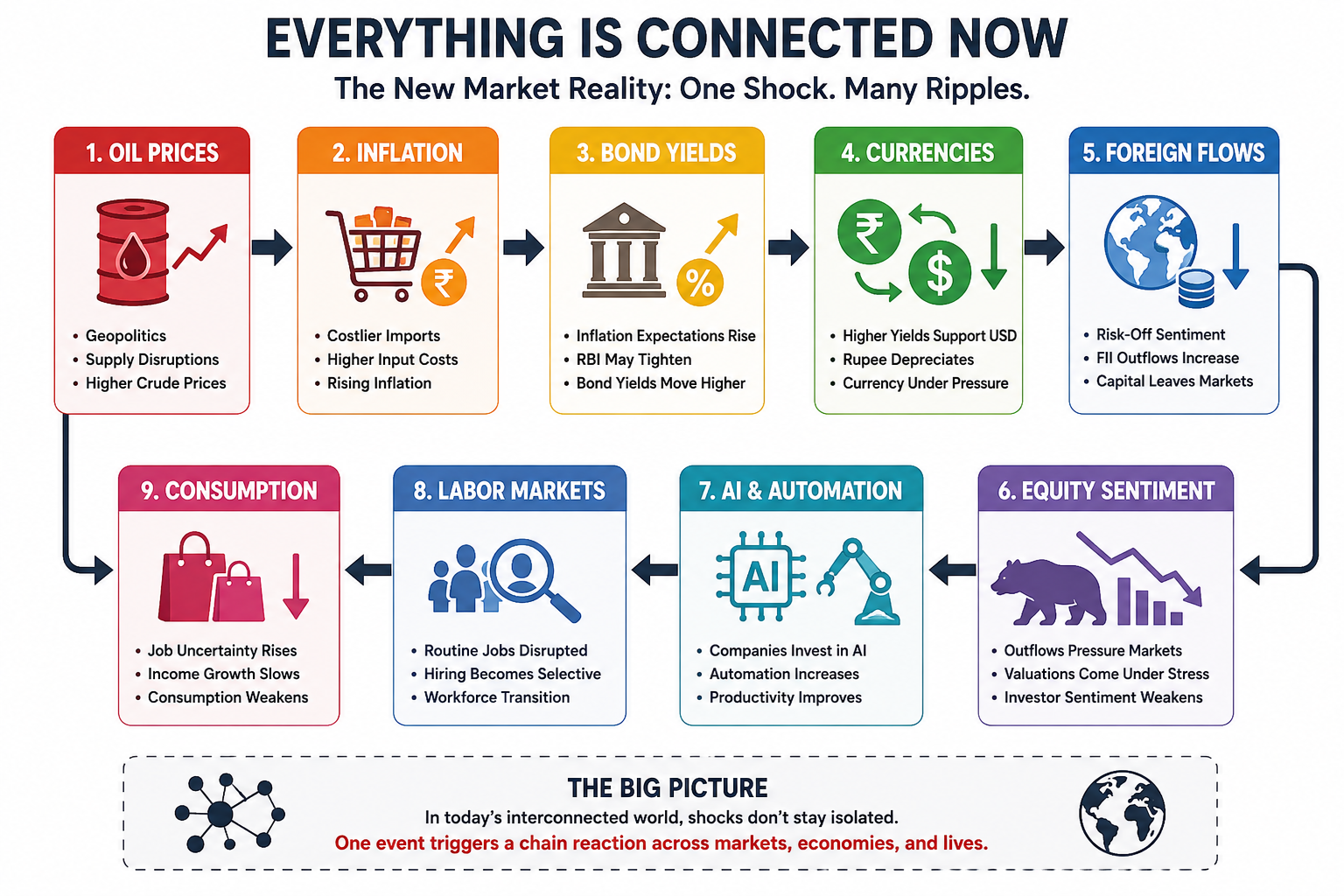
That interconnectedness is precisely why volatility feels sharper even when economic growth numbers remain relatively healthy.
Markets today are trading future uncertainty, not just present data, and that makes investor psychology one of the most important macro indicators to watch.
Final Thought
India is not facing a collapse narrative; it is facing a transition narrative.
The global economy is moving from:
cheap liquidity to selective capital
globalization to strategic blocs
labor abundance to AI productivity
and stable supply chains to geopolitical fragmentation
The countries, sectors, and companies that adapt fastest to this new environment will likely dominate the next decade.
For investors, the key challenge is understanding that this market cycle is not purely cyclical anymore. It is structural, and structural shifts rarely move in straight lines.

Comments
Log in or sign up to join the conversation.