

Nvidia's (NVDA) acquisition of ARM positions the company for massive growth opportunities by leading the new computing paradigm over the years ahead. The deal makes a lot of sense from both a strategic and financial perspective.
Regulatory hurdles will not be easy to overcome, and management needs to guarantee to ARM customers that neutrality will not be compromised with the acquisition. If this doesn't go well, the deal could be a major failure.
Those risk factors being acknowledged, this acquisition is an outstanding move by Nvidia, and it can deliver massive returns for investors if Nvidia plays its cards well.
Strategic Considerations
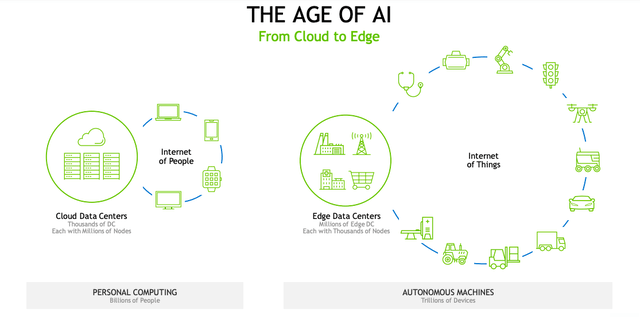
The internet is expanding from people to devices: Trillions of devices will be connected to millions of data centers in the years ahead, creating a new internet of things that is thousands of times bigger than today's internet of people.
In the words of Nvidia CEO Jensen Huang:
From smart retail to manufacturing and service robots, self-driving cars to smart streets and cities. Computing will extend from cloud data centers to every corner of the world. The software powering this new internet will not be written by humans, but by computers, learning from data. This is the new way of computing and it's called AI. The age of AI is driving a tremendous acceleration in the demand for computing, precisely at a time that Moore's Law has slowed.
With this acquisition, Nvidia is in the right position to become both a major driving force and a leading beneficiary from the new computing paradigm.
Source: Nvidia
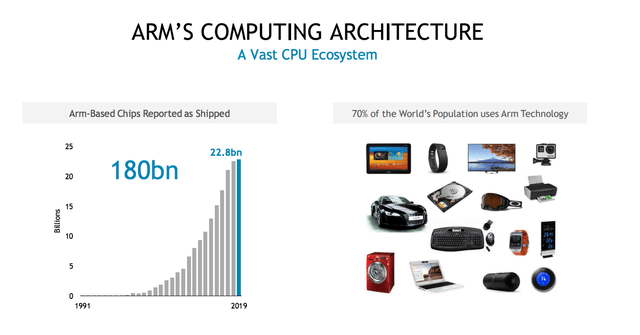
ARM has a spectacularly wide reach, the company's customers have shipped nearly 180 billion chips based on its technology, and ARM's technology is used by 70% of the world's population. This includes ubiquitous devices such as smartphones and PCs as well as more sophisticated technologies such as network infrastructures and supercomputers.
Source: Nvidia
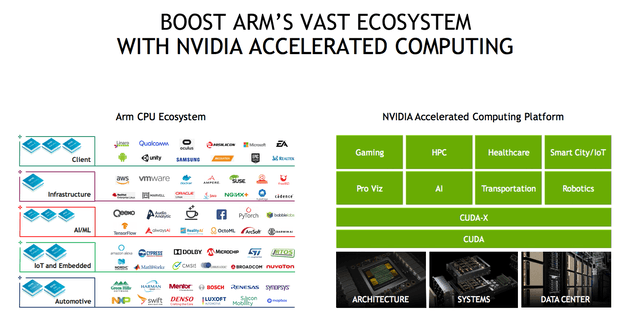
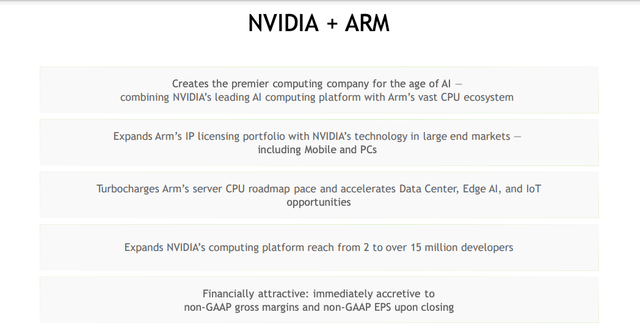
The acquisition combines Nvidia's leading AI computing platform with ARM's huge CPU ecosystem, positioning the company at the forefront of the industry in order to benefit for the next wave of computing into the age of AI.
The company can now bring Nvidia's GPU and AI Technology to massive markets such as mobile phones and PCs. Nvidia is also planning to turbocharge ARM's R&D in order to meet customers' demand for a higher velocity CPU and accelerating expansion into Data Center, Edge AI, and IoT.
Source: Nvidia
The expansion of the developer community is another key strategic advantage considering how crucial this is for companies in the sector. Nvidia, currently, has nearly 2 million developers using CUDA and other platforms. The acquisition will provide access to more than 15 million developers that are currently on ARM, a massive expansion of the developer base.
Source: Nvidia
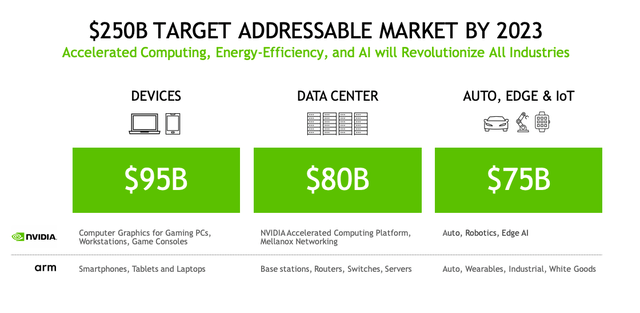
The acquisition will more than double Nvidia's addressable market to $250 billion by 2023. This includes areas such as computer graphics, smartphones, and other devices to data centers, automotive, Edge, and IoT.
Source: Nvidia
The Financial Side Of The Deal
The deal is sized at $40 billion, consisting of $21.5 billion in Nvidia stock and $12 billion in cash. The remainder of the transaction amount consists of $1.5 billion in equity to ARM employees and an additional potential $5 billion if ARM achieves certain performance targets.
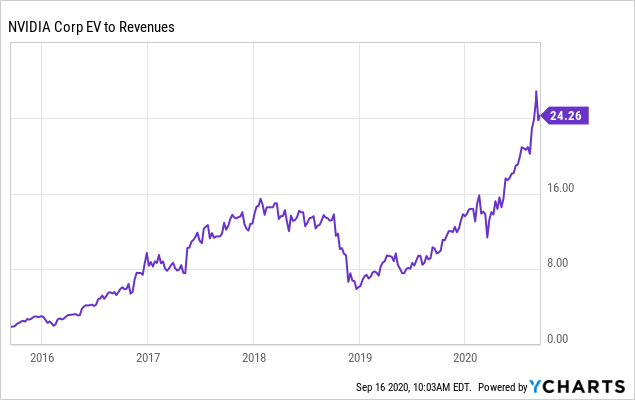
Nvidia, currently, has a market capitalization value of around $325 billion, so the share issuance is relevant even for such a large company. If you are an investor in Nvidia, you probably don't appreciate the share dilution.
However, it is important to consider that Nvidia is issuing shares at a time when valuation is at record levels. In a sense, Nvidia is leveraging on its past success over the years to make this acquisition, issuing shares at a high price and capitalizing on its strategic strengths to create more value after the transaction. Strength, generally, begets more strength in the business world.
Just to be clear, Nvidia has earned an expanding valuation by consolidating its leadership position in many of the most promising areas of the tech sector and delivering rock-solid performance over the years. I am not saying that the stock is necessarily overvalued at these levels, but it is priced for demanding growth expectations. If the company is going to issue more shares, it is always better to do it when those shares are trading at record valuation levels.
Data by YCharts
SoftBank (OTCPK: SFTBY) paid $32 billion for ARM in 2016, so the Japanese conglomerate is making a profit on the transaction, but not a particularly large one, especially when considering that valuations for tech stocks are through the roof right now. SoftBank is looking to strengthen its balance sheet, and not many companies in the world have the resources and strategic position to buy ARM and to potentiate it further such as Nvidia does. These factors probably explain why the valuation for the deal has remained within reasonable limits.
From a financial perspective, ARM has a very profitable business model. In the trailing 12 months period ended March, revenue for ARM was $1.8 billion with 94% gross margins and an adjusted EBITDA margin of approximately 35% of revenue.
Nvidia management said that the deal will be immediately accretive to Nvidia's gross profit margin and to earnings per share, which reinforces the idea that Nvidia is paying a reasonable price for such a transformative acquisition and that the move is also smart from a financial point of view.
The Big Picture
It makes sense for investors in Nvidia to be worried about the impact of share dilution, the regulatory hurdles, and all the implementation challenges that generally come with a deal of this size. ARM customers will clearly have their doubts about this transaction, so it is crucial for Nvidia to convince ARM's customers that they can still count on ARM's neutrality after the acquisition.
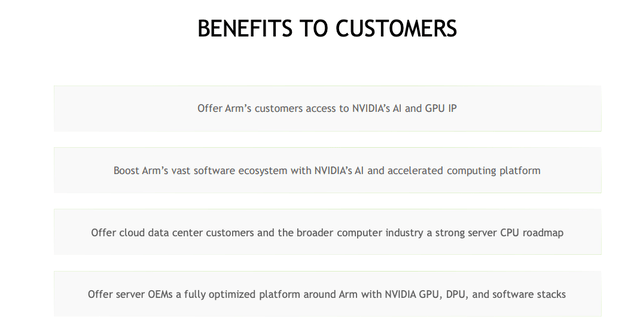
However, the task at hand is not impossible, especially if Nvidia can leverage on the advantages that the deal can generate to customers while also committing to the ARM existing licensing model and to preserve ARM's customer neutrality.
Source: Nvidia
If management can pull it off by convincing both regulators and customers, the benefits for shareholders would be enormous. This acquisition puts Nvidia in a position of strength to capitalize on massive growth opportunities by building the future of computing in the years ahead. The long-term bullish thesis in Nvidia stock looks stronger than ever if the ARM acquisition goes well.



Comments
Log in or sign up to join the conversation.