

Tomorrow's Norges Bank meeting is a tricky one to call. We suspect lingering trade tensions may tilt the balance in favor of keeping policy unchanged. But with energy-related investment increasing and oil prices now sharply higher, a rate hike this week certainly shouldn't be ruled out.

Norway has been a clear outlier in the global central bank arena so far this year. Where rates have fallen in other major economies, the Norges Bank has in fact raised interest rates twice since the start of 2019, and there's a chance it goes for a third move this week.
Much of this hawkishness has to do with oil-related investment. Firms are bullish about the prospects for energy spending in 2019, particularly given that current market pricing sits quite above break-even costs (around $10-35 per barrel according to Norges Bank). More generally, this should continue to translate into stronger domestic activity, including wage growth.
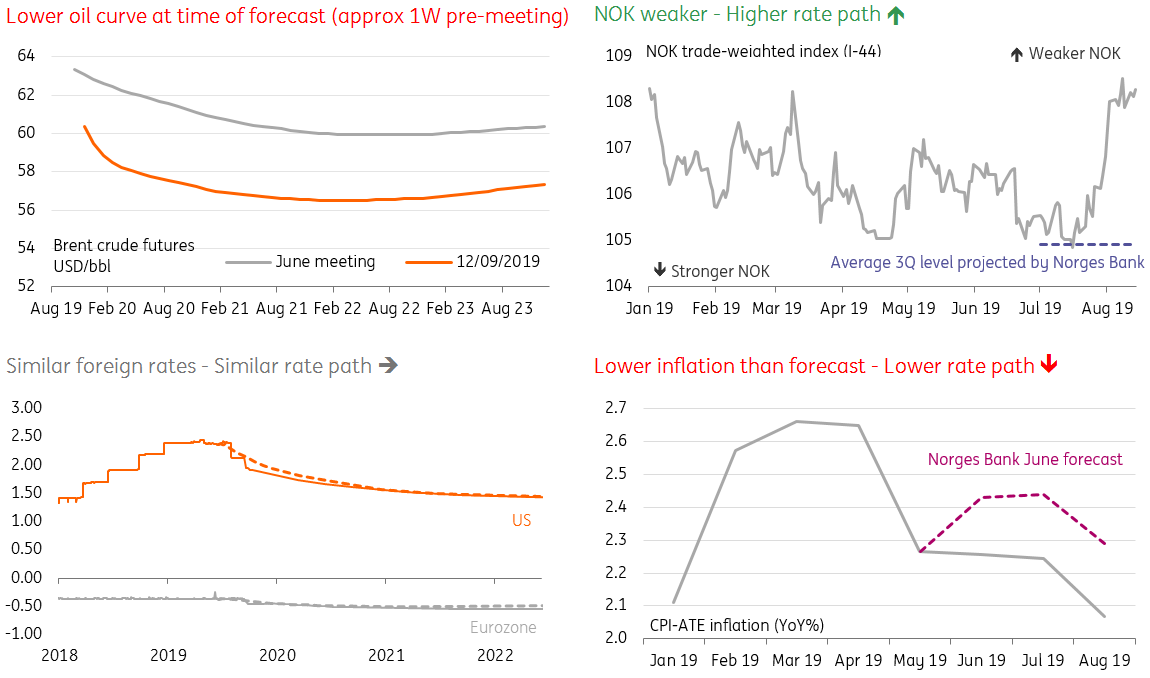
At the same time, the Norwegian krone has been consistently weaker than expected. At the time of its June meeting, the central bank forecasted that on a trade-weighted basis, the currency would on average be around 3% stronger than current levels.
How the latest interest rate projection could change compared to June
Source: Macrobond, Bloomberg, ING
So on this basis, will the central bank pull the trigger on another rate hike this week? It's a close call, but we suspect they may prefer to err on the side of caution and keep things unchanged.
While the central bank noted back in August that conditions were "little changed" relative to its June forecasts, policymakers opted not to explicitly signal a September hike. Instead, they simply reiterated rates were likely to rise again "over the course of 2019". Don't forget the rate hikes in March and June were explicitly signposted at the preceding meeting.
This follows the deterioration in trade relations over the summer between the US and China, and this will likely translate into lower Norges Bank GDP forecasts this week. At the same time, inflation has come in a little weaker than had been anticipated back in June.
When it comes to the central bank's closely-watched interest rate projection, both of these factors will likely largely offset the upward impact of the weaker NOK.
The real wild card is oil. The forecasts will more-than-likely be based on last week's prices, which were broadly lower than those embedded in the June projections. Since then though, oil prices have spiked as the ramifications of the weekend's attacks in Saudi Arabia filtered through markets.
The bottom line is that a rate hike still looks highly likely this year - we think it is marginally more likely to come in December rather than at this week's September meeting.
NOK: Risk sentiment remains in the driver’s seat
The Norwegian krone has been benefitting from some positive developments in two key areas:
- Global risk sentiment has rebounded on the back of renewed hopes about de-escalation in US-China trade tensions
- Oil prices have jumped after the attacks at the Saudi Aramco facilities
A rate hike by the Norges Bank will likely underpin the current positive sentiment on the krone and favour another leg lower in EUR/NOK. If the Bank keeps rates on hold, the krone’s reaction function will mostly depend on the forward-looking language, but a massive scale back in rate expectations (hence, NOK weakness) seems unlikely. In turn, looking at the immediate aftermath of the NB announcement risks for EUR/NOK mostly remain on the downside.
However, we suspect that any development on the rate side will not have a long-lasting impact on the currency. In the grand scheme of things, NOK remains the most highly exposed currency in the G10 space to swings in global risk appetite. Our trade team doesn't see a US-China trade deal by the end of the year, which leaves some room for another escalation in global trade tensions, with the risk of the EU being sucked in (most likely, through auto-tariffs).
NOK is highly exposed to global risk sentiment

Source: Bloomberg, ING
On the oil side, the Saudi-linked supply shock impact may end sooner than expected, with lingering concerns on the demand-side likely coming back into play, fuelled by trade-related concerns of a global economic slowdown.
For these reasons, tomorrow’s meeting, in our view, should leave only short-lived marks on NOK. Lingering trade tensions keep suggesting that the balance of risks for EUR/NOK remains skewed to the upside. We continue to see the pair edge back above 10.00 before the end of the year.


Comments
Log in or sign up to join the conversation.