

Here we go again with strong reports, major revisions, and very suspect data.

Understanding the Lead Chart
Before discussing the March 2026 data, it is important to understand the lead chart.
Every January (typically), the BLS has annual revisions to nonfarm payrolls and household population employment. The BLS does not back revise the household charts.
Because the BLS does not back revise, we see ridiculous numbers such as employment rising by over 2 million in a month (first yellow arrow).
To correct for the population adjustments, the BLS provides an adjustment series to normalize employment levels to match nonfarm payrolls. The BLS calls this “experimental” data but the regular posted data is known silliness.
The experimental series is LNS16000000, “Employment Adjusted to CES Concepts“.
For 2024, the BLS admits that it undercounted employment by 2 million. Instead of parsing that out in the correct months, the BLS plowed the entire adjustment into January of 2025.
For 2025, the BLS admits that it overcounted employment by 1.4 million. Instead of parsing that out in the correct months, the BLS plowed the entire adjustment into January of 2026.
We did not suddenly add 2.245 million jobs in January of 2025, all US-Born. (Difference between the dashed blue line and the yellow line).
Moreover, there is no valid historical data on full vs parttime employment, on foreign born employment, and many other BLS data series. And there won’t be. There are no back adjustments key data components.
All posts on foreign-born employment, parttime employment, etc., suffer this flaw. All year-over-year (or December-to January) analysis you find on these stats is permanently flawed.
BLS Notes
Effective with revised data for January 2026, updated population estimates were incorporated into the household survey.
The 2026 update was delayed by a month due to the 2025 federal government shutdown. With the release of February data, all household survey data for January 2026 were revised to incorporate the new population estimates.
In accordance with usual practice, BLS did not revise the official household survey estimates for December 2025 and earlier months.
The “usual practice” paragraph above explains why the published data series is flawed.
Again, all standard year-over-year household data comparisons are therefore nonsense.
Experimental Data for March
BLS states it is planning an update to the original 2025 experimental series to account for the size and timing of the updated (2026) population controls, extending the backcast to the April 2020 Census base where applicable. However, this update is not yet available and will be provided “as soon as practicable.”
Although we do not have all the month-by-month revisions we need, we do have the baseline number.
For March, the “Research series, employment adjusted to CES concepts, seasonally adjusted” was 156,843,000.
That is an employment decline of 217,000. In contrast, the BLS main report says employment declined by only 64,000.
Realistically, this means the unemployment rate is bogus as well.
My Charts
I will continue to use what the BLS refers to as “experimental data” in my charts because the official series household data is admitted nonsense.
Year-over-year household data comparisons are simply wrong. When the BLS releases the full experimental details, I will update the lead chart.
The BLS normally releases that series in January. The BLS did post full-year data in February.
However, the BLS has not yet released the month-by-month revisions. So, the solid red and yellow lines on my chart (or any other chart you can find) are not as shown.
Meanwhile, my lead chart, while the best anyone can do, is still inaccurate.
The household data, including the stated headline unemployment rate, is bogus.
Monthly Job Report Details
Nonfarm Payroll: +178,000 to 158,637,000 – Establishment Survey
Civilian Non-institutional Population: +92,000 to 274,858,000
Civilian Labor Force: -396,000 to 170,087,000 – Household Survey
Participation Rate: -0.1 to 61.9% – Household Survey
Employment:-64,000 to 162,848,000 – Household Survey
Unemployment: -332,000 to 7,239,000 – Household Survey
Baseline Unemployment Rate: +0.1 to 4.4% – Household Survey
Not in Labor Force: +488,000 to 104,771,000 – Household Survey
U-6 unemployment: +0.1 to 8.0% – Household Survey
Nonfarm Payrolls Change by Sector

Nonfarm Payrolls Change by Sector in Thousands
Nonfarm Payrolls: +178
Manufacturing: +15
Construction: +26
Leisure and Hospitality:+44
Private Education and Health Care: +91
Professional and Business Services: +2
Information: -3
Financial: -15
Retail: +10
Wholesale: +3
Government: -8
In February, private education and health (down by 42,000), was impacted by strikes.
The rebound in March was expected.
Monthly Revisions
The change in total nonfarm payroll employment for January was revised up by 34,000, from +126,000 to +160,000
The change for February was revised down by 41,000, from -92,000 to -133,000.
With these revisions, employment in January and February combined is 7,000 lower than previously reported.
Part-Time Jobs
Involuntary Part-Time Work: +101,000 to 4,947,000
Voluntary Part-Time Work: +39,000 to 22,728,000
Total Full-Time Work: +335,000 to 134,676,000
Total Part-Time Work: -188,000 to 28,478,000
Multiple Job Holders: -14,000 to 8,357,000
The above numbers never total correctly due to the way the BLS makes seasonal adjustments. I list them as reported.
These numbers are highly unreliable for reasons noted above. Year-over-year comparisons are invalid, period.
Hours and Wages
Average weekly hours of all private employees fell by 0.1 at 34.2 hours.
Average weekly hours of all private service-providing employees fell by 0.1 hours to at 33.1 hours.
Average weekly hours of manufacturers fell by 0.1 hours to 40.0 hours.
A tenth of an hour does not sound like much. But multiplied across 158 million, that’s a lot of hours.
Of course, this data is only as good as the data collection.
Hourly Earnings
This data is also frequently revised. Here are the numbers as reported this month.
Average Hourly Earnings of All Nonfarm Workers rose $0.09 to $37.38. A year ago the average wage was $36.11. That’s a gain of 3.5%.
Average hourly earnings of Production and Nonsupervisory Workers rose $0.05 to $32.07. A year ago the average wage was $31.02. That’s a gain of 3.4%.
Those gains are reportedly beating inflation. But that’s nonsense too because the CPI does not count property taxes or homeowners’ insurance in its calculations.
Unemployment Rate

Unemployment rate seasonally adjusted, data from BLS, chart by Mish
Alternative Measures of Unemployment

Table A-15 is where one can find a better approximation of what the unemployment rate really is.
The official unemployment rate is 4.3 percent.
U-6 is much higher at 8.0 percent.
Both numbers would be way higher still, were it not for millions dropping out of the labor force over the past few years.
Some of those dropping out of the labor force retired because they wanted to retire. Some dropped out over Covid fears and never returned. Still others took advantage of a strong stock market and retired early.
The rest is disability fraud, forced retirement (need for Social Security income), and discouraged workers.
As noted above, the entire series is flawed.
The more accurate experiment data shows an employment decline of 217,000 for March. The published unemployment rate is based n a decline declined by only 64,000.
In addition, the entire series is flawed by poor response rates, deportations, illegals not answering phones etc.
Birth Death Model
Starting January 2014, I dropped the Birth/Death Model charts from this report.
The birth-death model pertains to the birth and death of corporations not individuals except by implication.
For those who follow the numbers, I retain this caution: Do not subtract the reported Birth-Death number from the reported headline number. That approach is statistically invalid.
Birth-Death Methodology Explained
I gave a detailed explanation of the model and why the usual calculation is wrong in my June 8, 2024 post How Much Did the BLS Birth-Death Adjustment Pad the May Jobs Report?
I repeat, do not subtract the birth-death number from the headline number.
Household Survey vs. Payroll Survey
The payroll survey (sometimes called the establishment survey) is the headline jobs number. It is based on employer reporting.
The household survey is a phone survey conducted by the BLS. It measures employment, unemployment and other factors.
If you work one hour, you are employed. If you don’t have a job and fail to look for one, you are not considered unemployed, rather, you drop out of the labor force.
Negative Revisions
On September 9, 2025 I commented New QCEW Data Indicates More Big Negative Revisions Coming to Job Reports
The discrepancy between jobs reports and quarterly data widens again.
Sure enough. With the January 2026 report, the BLS revised nonfarm payrolls lower for last year by over 1 million jobs.
Foreign-Born Employment
The numbers in my charts are seasonally adjusted. Foreign born employment is not adjusted, compounding comparison errors.
And we have no BLS revised data for foreign born employment. So, all such foreign and US-born comparisons with BLS data remain nonsense.
A second major problem with foreign-born employment is the BLS makes no distinction between US citizens who were foreign born and genuine foreign workers.
Final Thoughts
The annual benchmarks are posted but the experimental, far more accurate detail isn’t.
All the household data is flat out wrong.
Do not make year-over-year comparisons on household data.
The best series is the “experimental” data but the full BLS is again delayed.
More Huge Negative Revisions Are Coming
Q: How do we know that?
A: For details, please see my February 27, 2026 post BLS Private Payrolls for 2025 Q2 Overstated by ~847,000
The Business Employment Dynamics report shows -321,000 vs Payroll report +526,000. Believe BED.
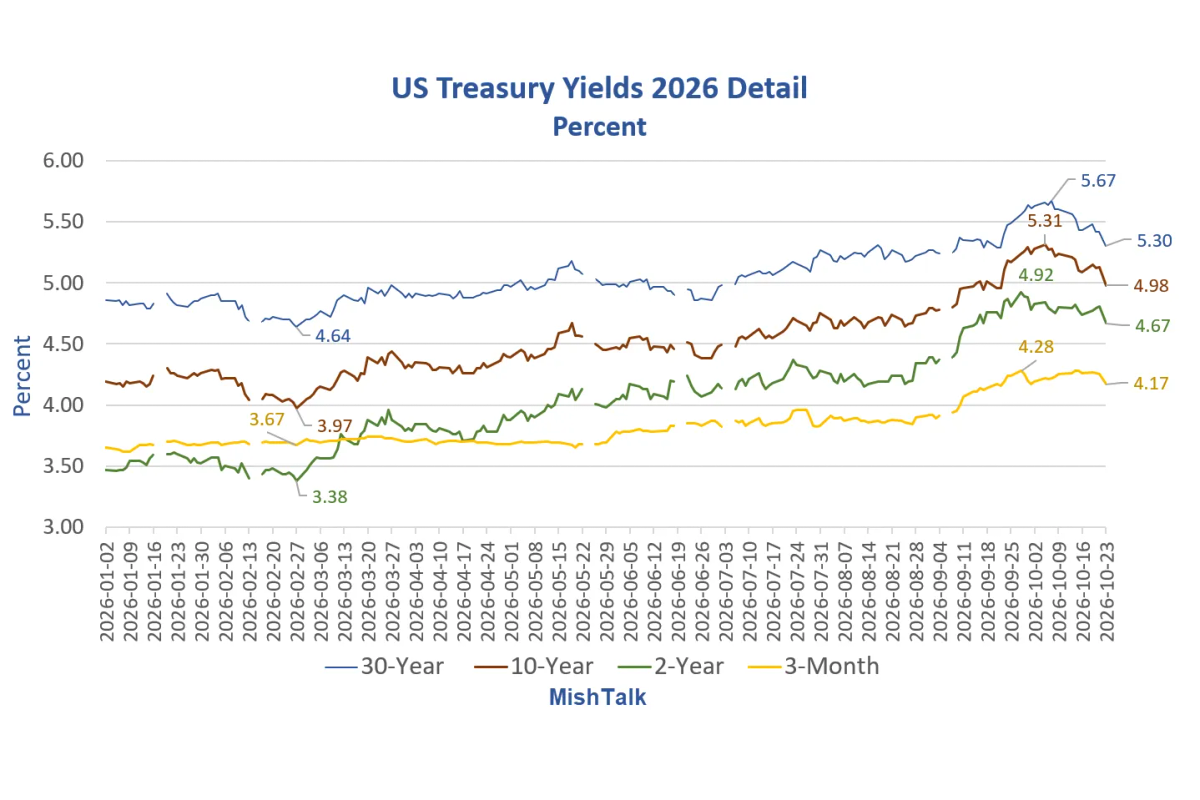
Finally, although everyone knows (or should know) how awful these reports are, the markets still react to the data. For example, the immediate reaction in the bond market was higher yields.
Related Posts
February 11, 2026: BLS Revises Nonfarm Payrolls for 2025 Lower by 1 Million Jobs
For the second year, the BLS annual benchmark revision was hugely negative.
February 11, 2026: Another Look at the Incredible January 2026 Jobs Report
Do you believe the nonfarm payroll report for January 2026?

Comments
Log in or sign up to join the conversation.