

While investors bask in the sun of global upswing in economic activity and the accompanying surge in equity prices, it is important not to lose sight of the possibility of a slowdown or even a recession. Just as trees do not grow to the sky so do economies stop expanding and enter into recessions. Right now, the focus is on the how much room there is on the monetary policy side to combat a future recession. Some economists are asking themselves: are today’s rate hikes providing the room needed to lower rates in the not too distant future? Is that why the Fed, in particular, seems to anxious to normalize rates in order to fight the next recession?
Fiscal space is the flexibility that governments have in spending choices. It is the room in the government’s budget that allows it to respond to recessionary conditions without placing great stress on its overall financial position.. Figure 1 (top panel) provides some insight into the degree to which government borrowings’ constrain advanced economies. Japan’s net debt as percent of GDP is the highest at 131% while Canada’s is the lowest at 26%.
Figure 1 Measures of Fiscal Room
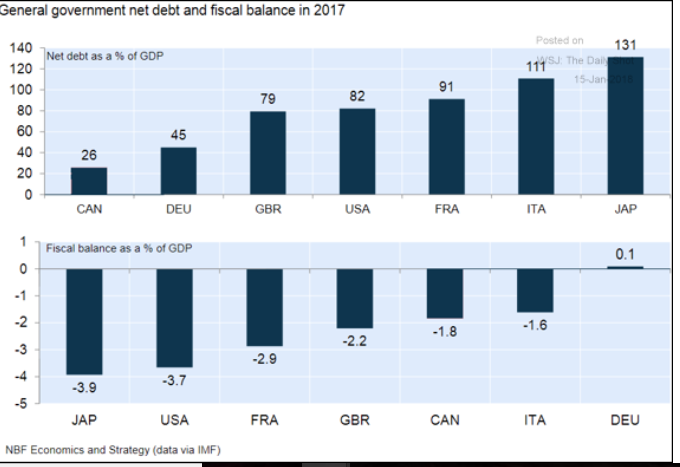
Another way to view fiscal room is to measure “ fiscal balance” (Figure 1, lower panel). A country is in negative fiscal balance if total revenues fail to match its total outlays; a positive balance is a sign that revenues exceed outlays. Again, at the one extreme Japan has the highest negative fiscal balance and at the other extreme Germany runs a slightly positive balance.
The United States seems to be somewhere in the middle regarding fiscal policy room, but that should not give policymakers much comfort. The Congressional Budget Office analysis indicates that the U.S. budget deficit will soar to a massive US $1.7 trillion or 6% of GDP by 2027 compared to the current 3.6 %. The majority of economists agree that the debt-to-GDP ratio would move higher over the next 10 years. The United States is moving away from providing the necessary room to use fiscal stimulus to tackle future recessions. The recent tax reform bill has eliminated much of that room.
The ability to deal with future recessions requires a combination of monetary and fiscal stimulus. Central banks are assuming responsibility for providing more room by raising rates now. However, it is quite a different situation regarding fiscal policy. The United States has made the biggest shift and no longer has the room to expand fiscal policy in the event of a recession. Thus, the burden of dealing with future recessions will continue to be heavily on the shoulders of the Federal Reserve. In a sense, the United States is forced to fight with one hand tied behind its back.



Comments
Log in or sign up to join the conversation.