

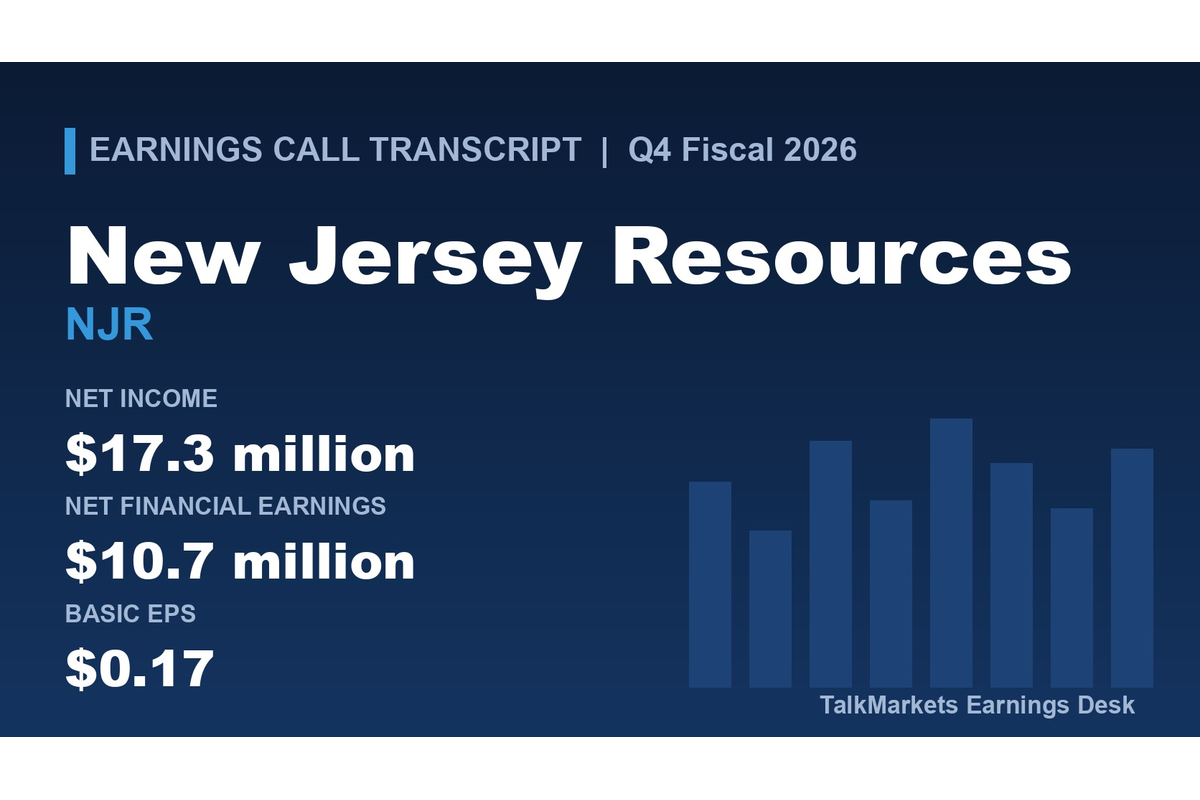
New Jersey Resources' fiscal Q4 2026 net income rose to $17.3 million, or $0.17 per share, while net financial earnings fell to $10.7 million; full-year net income was $368.4 million.
Ticker: NJR
New Jersey Resources Corporation (NJR) reported results on 18 November 2026 for its fiscal 2026 fourth quarter and year ended 30 September 2026. The energy company's fourth quarter is seasonally its weakest for the gas utility, which posted a net financial loss. Clean Energy Ventures and Storage and Transportation grew earnings in the quarter, and the company reported higher net income and net financial earnings (NFE) for the full year.
The key numbers (three months ended 30 September 2026)
Metric | This year | Last year | Change |
|---|---|---|---|
Total operating revenues | $374,365 thousand | $336,078 thousand | |
Net income | $17.3 million | $15.1 million | |
Basic EPS | $0.17 | $0.15 | |
Net financial earnings | $10.7 million | $16.2 million | |
Basic NFE per share | $0.11 | $0.16 |
Net financial earnings by segment (fourth quarter)
New Jersey Natural Gas: net financial loss of $(24.4) million, against $(8.0) million, driven mainly by higher depreciation and interest expense, partly offset by higher utility gross margin.
Clean Energy Ventures: NFE of $33.5 million, against $23.8 million, on higher Renewable Energy Credits and electricity revenue.
Storage and Transportation: NFE of $9.6 million, against $4.6 million.
Energy Services: net financial loss of $(7.9) million, against $(4.5) million.
At 30 September 2026, NJNG served approximately 596,000 customers, against approximately 589,000 a year earlier. Clean Energy Ventures placed 14 commercial solar projects into service during fiscal 2026, adding 72.4 MW of capacity and bringing total in-service commercial solar capacity to approximately 552 MW.
CEO Steve Westhoven said fiscal 2026 demonstrated the value of NJR's diversified energy platform and disciplined execution, with higher net income and NFE and strong performance at Energy Services.
Full fiscal year
For fiscal 2026, consolidated net income totalled $368.4 million, or $3.65 per share, against $335.6 million, or $3.35 per share, in fiscal 2025. NFE was $361.6 million, or $3.58 per share, against $329.6 million, or $3.29 per share. Total operating revenues were $2,267,800 thousand against $2,036,412 thousand. Capital expenditures, including accruals, were $734.3 million against $752.5 million.
NJNG also filed a base rate case with the New Jersey Board of Public Utilities on 1 June 2026, later updated to seek an increase of approximately $158.3 million.
Source: SEC Form 8-K Exhibit 99.1
Full call transcript
Operator:
Hello, and thank you for standing by. My name is Trevor, and I will be your conference operator today. I would like to welcome everyone to the New Jersey Resources Fiscal 2026 Fourth Quarter and Year End Financial Results Conference Call. All lines have been placed on mute to prevent any background noise. After the speaker's remarks, there will be a question and answer session for members of the financial community. To ask a question, press star 1.
To withdraw the conference is being recorded and will be available for replay on New Jersey Resources Investor Relations website at investor.njresources.com. I would now like to turn the call over to Karen Daley. Please go ahead.
Company Executive:
Thank you, Trevor, and good morning. Before we begin, I would like to remind everyone that certain statements in today's call may contain estimates and other forward-looking statements. The current expectations, assumptions, and informing the basis of our forward-looking statements include many factors that are beyond our ability to control or estimate precisely. This could cause results too materially different from our expectations as found on slide 2.
These items can also be found in our forward-looking statement section of yesterday's earnings release and in our most recent forms 10-K and 10Q as filed with the Securities and Exchange Commission. We do not assume any obligation to update or revise any forward-looking statements referenced herein in light of future events. We will also be referring to certain non-GAAP financial measures, such as net financial earnings or NFE.
We believe that NFE, net financial loss, utility gross margin, financial margin, adjusted funds from operations, and adjusted debt provided a more complete understanding of our financial performance. However, these non-GAAP measures are not intended to be substitute for GAAP. Our non-GAAP financial measures are discussed more fully in item 7 of our 10-K. Today's presentation and the most recent earnings press release were furnished with yesterday's form 8-K and are available on our website.
I am joined by Steve Westhoven, President and Chief Executive Officer, Roberto Bell, Senior Vice President and Chief Financial Officer, as well as other members of our Senior Management Team. Steve will begin with an overview of our Fiscal 2026 Performance and Fiscal 2027 Outlook, followed by a review of our business unit. Roberto will then review detailed Fiscal 2026 Financial Results, introduce our Fiscal 2027 Guidance and Capital Plan, and discuss our current financial position. Steve will then return with closing remarks before we open the call for questions.
I will now turn the call over to Steve.
Steve Westhoven (President and Chief Executive Officer):
Thanks, Karen, and good morning, everyone. Before I begin, I would like to take a moment to formally welcome Karen Daly, who joined NJR this week as our head of investor relations. We're excited to have her on board and know she's also looking forward to working with all of you. With that, let's get started with our Fiscal 2026 Performance. New Jersey resources delivered net financial earnings of $3.58 per share. Our sixth consecutive year exceeding our initial guidance. We also raised our dividend for the 31st consecutive year.
This performance reflects the strength of our complimentary businesses and the ability of our employees to execute. Across the entire company, our team delivered exceptional service through periods of extreme weather and record system throughput. We prioritized affordability for our customers, while continuing to make critical investments in safety and reliability of our infrastructure. Here are some of the highlights from each business unit.
At New Jersey Natural Gas, we remain focused on the fundamentals of safety, reliability, and ahead of the winter heating season, we've lowered the average residential customer bill by 9%, while continuing to invest in our system, add customers, and advance our base rate case. Clean Energy Ventures added 72.4 megawatts of new capacity through the completion of 14 solar projects. At the same time, the team continued to advance its strong pipeline of investment options that will drive growth over the coming years.
Storage and transportation grew revenue through re-contracting and made significant progress on its growth strategy by securing its FERC certificate for the expansion at Leaf River. Energy Services generated significant cash flows that were reinvested in our infrastructure business, reducing our need for new debt. Home services helped customers' homes comfortable through this year's extreme weather, and was named RUDES Top 20 Pro Partner for the 10th consecutive year.
Now, turning to our outlook on slide six, today we are initiating fiscal 2027 NFEPS guidance in the range of 325 to 340 per share, consistent with our long-term growth target of 7 to 9%. We are also updating our five-year capital plan through fiscal 2031 at a range of 5.3 to $5.7 billion. More than 60% of this capital is planned for our regulated utility, with a focus on safety, reliability, and energy efficiency. Importantly, we expect to fund this plan without block equity, while maintaining strong credit metrics.
It will provide more detail on the capital and financing plan later in the presentation. Turning to slide seven, our outlook is built around key strategic priorities, affordability, consistent execution, disciplined capital deployment, and robust organic growth across our infrastructure business. At the Jersey Natural Gas, we expect continued rate-based growth through fiscal 2031, driven by customer additions, investments, safety and reliability, and energy efficiency programs that provide customers cost savings opportunities.
Storage and transportation, we expect net financial earnings to double from fiscal 2025 to fiscal 2027, driven by favorable re-contracting at both Leaf River and Adelphia. In addition, the phase one of Leaf River expansion is fully contracted and now under construction. At clean energy ventures, we expect to grow our installed capacity significantly, helping to meet the need for new electric supply in the markets we serve. TV's well positioned with a robust pipeline of ITC eligible projects and organic growth opportunities that capitalize on our existing assets.
I'll walk through each business starting with New Jersey Natural Gas on slide eight. Managing cost impacts for our customers remains central to how we run New Jersey Natural Gas. Natural Gas remains by far the most cost-effective way for our customers to heat their homes and businesses. Throughout fiscal 2026, we took several steps to strengthen this value proposition. New Jersey Natural Gas's customer bill reduction of 9% went into effect on October 1st. That translates to an annual savings of over $150 for the average residential customer.
We invested a record $101 million through Save Green, helping customers reduce energy use and lower their bills by up to 30%. We also prioritize assistance for our most vulnerable customers. This year, we hosted 27 energy-assistant days throughout our service territory. These are dedicated in-person outreach events to enroll customers in energy assistance and bill payment programs. Through these efforts, New Jersey Natural Gas helped connect our most in-need customers with nearly $21 million in bill payment assistance. That's money that stays with families across our service.
Turning to slide nine earlier this year, the company made a coordinated set of regulatory filings with the objective of mitigating customer bill impacts while recovering our investments. The initial filings provided for a 9% bill reduction as previously mentioned. We also filed for a base rate increase to recover investments in safety and reliability. The rate case is moving forward as expected with a resolution anticipated by the end of the winter heating season.
We expect that the impact of their base rate case combined with the recently implemented bill reduction will leave customer bills nearly flat compared to where they were at the time of the filings. On the customer growth side, the utility continues to see steady customer additions from mix of conversions and new construction. In fiscal 2027, we expect to reach 600,000 customers served, a milestone achievement for the company reflecting the execution and commitment of our employees every day.
Turning to S&T on slide 10, over the last decade, total U.S. natural gas demand, including exports, increased 45%, while working storage capacity remained nearly unchanged. That in-balance reinforces the value of flexible strategically located storage. This has created opportunities at Leaf River for both favorable re-contracting and organic expansion. We are moving rapidly to execute on these opportunities. As mentioned earlier, Phase 1 of our Leaf River expansion is fully contracted and we initiated construction in October.
We expect the incremental 5.1 BCF of working capacity to be bought into service in 2028. In total, our FERC authorization allows for the expansion of Leaf River's capacity to more than 55 BCF. Looking ahead, Leaf River has even more capacity to grow, including the potential for additional caverns. Successful re-contracting is expected to double S&T's NFE between fiscal years 2025 and 2027 to a range of $37 million to $42 million.
This updated range, slightly lower than previously communicated, reflects the short-term reduction in operational flexibility during construction of Phase 1 of Leaf River. By fiscal 2029, the short-term capital cost impact will be resolved and S&T NFE is poised to grow in the range of $55 million to $65 million. Turning to clean energy ventures on slide 11, our proactive approach to safe harboring provides a strategic advantage that will drive significant solar capital deployment into fiscal 2030. CEV's project pipeline is unique.
We have secured investment options, largely through joint development agreements that provide CEV with the right but not the obligation to invest. This optionality gives us flexibility to direct capital opportunistically. CEV is also pursuing additional opportunities that leverage the long-term value of our grid-connected solar assets. We see a real opportunity to optimize our already built and paid for solar interconnections through the use of battery storage and other distributed generation, such as fuel cells and linear generators.
Importantly, as part of the big beautiful bill, these technologies will continue to benefit from investment tax credits into the 2030s. A strong example of this strategy is our recent acquisition of two Massachusetts solar plus storage projects, both of which are now under construction. These projects both pair 15 megawatts of solar arrays with 9 megawatts of on-site batteries. This allows for the interconnection to be used for more hours of the day and for generation to be shifted into peak demand hours with the goal of lowering prices.
Given our objective to invest in solar firming technologies, we are transitioning our discussion of in-service capital and project pipeline from megawatts in-service to capital expenditure in-service. We believe that these types of investments are not appropriately captured by a megawatt-based installed capacity metric. In the 16 years we've operated CEV, we've established best-in-class capabilities around developing, building, and operating distributed generation assets. One thing is clear, distributed generation plays a vital role in today's energy landscape, and its importance will only continue to grow in the years ahead.
With that, I'll turn the call over to Roberta for the financial review.
Senior Vice President and Chief Financial Officer:
Thanks, Steve. Good morning, everyone. Fiscal 2026 reflected solid execution across New Jersey resources, complementary businesses. Consolidated NFP was $361.7 million, or $3.58 per share. We raised NFPPS guidance by 45 times during the year, and executed initial guidance for a six consecutive year. In terms of segment contributions, New Jersey National Gas represented approximately 50% of consolidated NFPs. Turning to capital investment of slide 14, we invested $833 million in fiscal 2026 across our infrastructure businesses. New Jersey National Gas invested approximately $600 million, including savegreens.
About 40% of that earned near real-time returns. Clean energy ventures invested approximately $170 million, primarily focused on developing, constructing, and acquiring commercial-scale solar energy facilities. Transportation invested approximately $63 million, and Atlantic expansion of existing caverns at Lift River. Moving to slide 15, we're initiating fiscal 2027 NFPPS guidance in the range of $3.25 to $3.40, consistent with our 7 to 9% long-term annual growth target. We expect New Jersey National Gas to contribute 60 to 65% of fiscal 2027 NFP.
Clean energy ventures is expected to contribute 14 to 18%, tourism transportation 10 to 14%, and energy services 8 to 14. Our strong NFPPS projections are supported by a robust capital plan as reflected on slide 16. From fiscal 2027 through fiscal 2031, we plan to invest in the range of 5.3 billion to $5.7 billion, with over 60% of those investments dedicated to New Jersey National Gas. Two years through fiscal 2028, we expect capital investment to reach approximately $2.3 billion, with roughly $1.1 billion invested in fiscal 2027.
Clean energy ventures will represent a significant portion of the capital deploys that were unregulated subsidiaries. A solar and battery storage are among the most efficient ways to bring new supply to the grid. A clean energy segment is uniquely positioned to address increasing market demands. A search for raising our 2027 expected capital expenditure targets for clean energy ventures to a range of 400 to $500 million, up from 270 to $370 million.
Turning to slide 17, our financing plan is designed to fund our strategy growth well within our credit capacity. For fiscal 2027 through fiscal 2031, projected sources and uses approximately $6.7 billion, the plan includes about $5.5 billion of investments and $1.2 billion of dividends funded primarily by approximately $3.9 billion of operating cash flows and $2.6 billion of debt, with a very modest amount of equity. Our adjusted SFO to adjusted debt ratio was 25% in fiscal 2026, aided by very strong cash generation at energy services.
The expected metric averaged 20 to 21% over the next five years, providing financial flexibility as we execute a significant organic investment problem. Finally, on slide 18, our relationship liquidity supports the capital plan. So, September 30, 2026, we had approximately $2.9 billion of notes and first mortgage bonds. My sure is the schedule is with no significant concentration in anyone here. We have $900 million of committed credit facilities available for fiscal 2031. Our secure utility ratings remained strong and unchanged.
A1 at movies and 8 plus at fetch will outlooks that were reaffirmed earlier this year. Based on our current plan and even our financial strength to fund capital expenditure, we do not anticipate the need to issue any low equity for the next five years. I would now turn that call back to Steve.
Steve Westhoven (President and Chief Executive Officer):
Thanks, Roberto. I'll close where I started. Everything in our plan begins with delivering affordable, safe, reliable energy to the families and businesses we see. At New Jersey Natural Gas, our growing customer base, the cost advantage of natural gas, and our service excellence, the core of how we are. All of our other businesses complement that foundation. State Energy Ventures is set to deploy significant capital on new and organic projects that help meet the pressing need for more electric.
Storage and transportation is set for robust growth in the company. Storage and pipeline capacity that supports reliable supply back by long-term contract. And Energy Services generates additional cash flows that contribute to earnings that can be reinvested in our priorities remain clear. Keep energy affordable, operate safely and reliably, deploy capital in a disciplined manner, and grow where NJR has a strategic advantage. Finally, I want to thank our employees across NJR, your dedication to our customers is what drives everything we do.
With that, we'll open the line for questions.
Operator:
We will now begin the question and answer session. If you would like to ask a question, please press star one to raise your hand. To withdraw your question, press star one again. We ask that you pick up your handset when asking a question to allow for optimum sound quality. If you are muted locally, please remember to unmute your device. Please stand by while we compile the Q&A roster. Your first question comes from the line of Gabe Moreen with Mizuho. Gabe, your line is open.
Gabe Moreen (Mizuho):
Good morning, team. Maybe if I can start out on CIV and the boosted outlook there. Can you just talk about, and it seems like it's not just for 27, it's for 28 as well, in terms of this boosted level of cap X and growth, hopefully. Keith, I was in a degree to which all that is contracted at this point. Your confidence in terms of any permits you might need to secure that cap X spend, and relatedly, the mention of the 350 megawatts of interconnects in PJM.
Does any of that cap X capture some of that opportunity, or is that going to be something potentially separate from this elevated cap X, or higher cap X?
Company Executive:
Yeah, thanks for the question. We put that in the capital plan. So, obviously, we've got high degree confidence that we're going to be able to execute. A number of factors are basically making that cap X plan what it is. Certainly, support policies, pushing this forward, distributed gen, and it has been popular speed to market capability.
Also, returns have been attractive, so, in diversified company like ours, we're able to put capital where you have attractive returns and ship, and that's what you see in that capital plan that you have.
Gabe Moreen (Mizuho):
Okay, great. And as far as the interconnects and the likes, sorry, Steve, I don't know if I caught an answer. Is that embedded to a degree in that capital plan? Taking advantage of those?
Company Executive:
You'll have to connect. So, are you talking about the interconnect process? Are you talking about the...
Gabe Moreen (Mizuho):
Oh, I just mean like the sighted in the slides of 350 megawatts that you've got potentially, you know, if you're existing sites to connect more power into the grid?
Company Executive:
Yeah, I think in the early years, we're working, or we're, you know, for the solar that we're making investments in, you know, not so much taking advantage of those interconnects at this point, that would take place in your outer years, will be able to expand and take advantage of those. And that would be more of that, you know, solar deferring strategy.
Gabe Moreen (Mizuho):
Okay, thanks, Steve. And then maybe if I could just follow up in terms of the program year seven request in terms of vis-a-vis the seed green program, can you talk about kind of the two options you're proposing at the BPU and to what extent, you know, you're assuming that those move forward and your guidance and capital at this point?
Company Executive:
Yeah, you already gave this technically actually, so I encourage because of the new administration affirmative commitment to energy efficiency, which everyone knows is one of the most effective ways that we have to reduce customer bills, that the Extension will take us one more program year through June of 2028, and give us a runway for just the E programs with a path to achieve the historical ROEs.
And so before the process for we submitted proposals, we should have worked step for having active dialogue with the Board of Public Utilities and expect resolution sometime in spring of 2027.
Gabe Moreen (Mizuho):
Thanks, Bob. Appreciate it.
Operator:
Your next question comes from the line of Eli Jossen with JP Morgan. Eli, your line is open.
Analyst (JP Morgan):
Hey, good morning, everybody. Thanks for taking time. Hey, so just obviously you have stronger 27 and 28 figures, but if we think about kind of the back half of the plan and what might drive upside and how you're risk-weighting certain opportunities, but yeah, just broadly the shaping of the plan and thinking about the trajectory that you've given today. Thanks.
Company Executive:
Eli, you know, diversified company, we've got, you know, a number of options to be able to deploy capital. You know, you see that, you know, as I said before, the game, you know, we're able to ship the plan to where most of track returns are. And, you know, options going forward, you know, for us, you know, certainly utility be a big driver of our capex, you know, energy efficiency, like Pat just talked about.
You know, CV has a lot of optionality, especially in the back half of the plan with all those interconnects that already exist. You know, we can take advantage of, you know, speed the market being very important there in the markets of PJM. And then, you know, Leaf River, you know, we've got, you know, our first phase that we started, we sort of put a little bit of capital to work in doing the groundwork to decide on our second basic expansion of Leaf River.
There's even expansions beyond that. And we haven't talked about the Adelphia Gateway, you know, pipeline that has some expansion as well. So when you look at the plan that we have along with the diversified, you know, businesses that we have, you know, a lot of options to be able to expand going forward. And given the macro coalition growth in, you know, the energy markets, we feel like we're really well positioned.
Analyst (JP Morgan):
Awesome. And then maybe just shifting to the EPS Kager, I know you guys are in the middle of a rate case and, you know, RA are constantly reassessing the outlook. But just, can you remind us how we should think about your, you know, overall rebasing strategy and what you might need to see to think about rebasing at your next capital, or your next role forward. And yeah, just the rebasing strategy overall, thanks.
Senior Vice President and Chief Financial Officer:
Hey, like this, Roberto. So if you look at us historically, we've been replacing every two, two, three years. So most likely we will be replacing next year. But having said that, yet remember that the way we measure our growth projections is based on this, on this based on how we're going to do this, I finish our guidance removing the renewing the game from the solar sale, afraid of the residential solar sale.
And yet to remind everyone what we have been doing over a number of years now, about six years, is we have been increasing our guidance every year at a midpoint of about 8% or so. And so it's been a very, very honest, increasing guidance. So hopefully that gives you some context.
Analyst (JP Morgan):
Great. Thanks, Vess.
Operator:
Your next question comes from the line of Constantine Leadnev with Wells Fargo. Constantine, your line is open.
Analyst (Wells Fargo):
Good morning. Thanks for taking the questions. Maybe just following up a little bit on the CapEx side of things, just as we think about the cadence and the mix of spend in the new five-year plan, do you anticipate any shifts in kind of regulated versus the unregulated side of business? How is the 2.1 billion CEV pipeline reflected within that timeframe?
Company Executive:
We expect that moving forward 60% of our capital, 60% of our hertz majority is still coming from the utility, and we have that through the five-year plan. You might see some slight shifts, but we don't expect anything to disrupt those metrics as we get.
Analyst (Wells Fargo):
Okay, understood. And the 2.1 billion just in terms of the timing of how that's reflected within the five-year that's fully incorporated partially.
Company Executive:
I think there'll be some variability to it, obviously just through construction schedules and things like that, just as execution. But we expect to have it as a steady line with a little bit of growth that's associated with it in order to get to growth now.
Analyst (Wells Fargo):
Okay, understood. And then maybe just shifting to New Jersey, just with a few different regulatory approaches that we've seen on rate cases in the current cycle. Any thoughts on how competitive the case is relative to the EO1 mandates and any read-throughs from other ongoing cases like the use of deferral accounting and such?
Company Executive:
Yeah, as far as the EO1 goes, it's mainly concentrated on the electrics. And for our rate case, it's been just the regular rate case. There's nothing in there that's out of the ordinary. And we've been proceeding forward like we have in the past, so it's being processed as normal. That is really the only thing I can tell you.
Analyst (Wells Fargo):
Okay, and just on the business review process, any read-throughs, any positive read-throughs from the proposals that were out there, there's talk of multi- or constructs and performance mechanisms.
Company Executive:
No, there's, we haven't, like I said, this is a plain vanilla rate case. None of those factors have been brought up to us at this.
Analyst (Wells Fargo):
Okay, understood. Appreciate it by today. Thanks.
Company Executive:
All right, thank you.
Operator:
Your next question comes from the line of Juliane Dumoulin-Smith with Jeffries. Juliane, your line is open.
Julien Dumoulin-Smith (Jefferies):
Hey, good morning, team. Hi, guys. I'll do it. Nice to chat.
Company Executive:
Hey, Juliane.
Julien Dumoulin-Smith (Jefferies):
Hey, thanks again for the time. Look, just a couple of cleanup items at this point. Just following up a little bit on the tone from some of the earlier questions. How do you think about just rate-based growth? You know, I think you guys pulled up from the deck versus last time. It might be more of a technicality, but how do you think about that through 30 here and just any twists or turns about that?
And then how do you think about rate-based growth given the fact that you guys have CAPX through 31 at this point? I know there's a little bit of different years in the deck.
Company Executive:
I mean, you know, rate-based growth has been really regular. You know, we've got, you know, pipeline of investments at the utility that really follow, you know, the same year on year on year. You know, customer growth is robust. We've got, you know, vintage pipeline that needs to be replaced, and we've got that program that we continue to move forward. You can see the break down as we break down our capital plan.
Energy efficiency, you know, big part of it, with the concentration on affordability, you know, we expect that to maintain, you know, Pat had referenced that earlier when he was talking about energy efficiency. So really, you know, it's kind of the same old story, you know, with the utility and, you know, we're in a good place. You know, natural gas is the cheapest way that you can keep and maintaining reliability, you know, being sensitive to our customers at the same time.
And, you know, marrying those two things to gas put together the rate.
Julien Dumoulin-Smith (Jefferies):
Got it. So no change to the seven and nine from prior years. Okay, excellent. And then just coming back to the CV side of things just real quickly. I mean, obviously, you know, that's seeing a little bit of an uptick here. You talk about a higher percentage from the last year, that 14, 18% from 10%. How does that evolve through the plan here? Can you talk about that a little bit? And what's driving that uptick in, in CV this specific year?
You know, is it, is it tax credits or how do you think about credit transfers, or is this the sale at least back? And then ultimately, just given that you've given a 31 CapEx number here, can you talk about the plan around CV specifically or solar versus maybe some storage focus? As you think about the credit program evolution here in Cliff, if you will, how do you think about the different programs that you could pivot into?
Company Executive:
Yeah, you know, I think, you know, through your first part of your question, you know, just kind of the earlier part of the CapEx plan, CV teams did a great job, basically, you know, of St. Harvey and a number of projects. And, and you can see, you know, as we've talked about, we've got a big pipeline, you know, ability to kind of move that forward or move that around, you know, based on returns, you know, we're seeing attractive returns.
So the result of those things and, you know, favorable policy environment, certainly a pull in the, you know, kind of the factor into tailwinds, you know, for CEV right now. You can see that we've changed the metric for megawatts, the CapEx, that we're anticipating, you know, slight shift, you know, going forward. This would be out in the, in the later years. Distribute generation is really popular. You can see that with hyperscalers and things like that.
So, you know, we're seeing this trends moving forward and we have the opportunity here with all of our existing interconnects to be able to leverage those and put, you know, capacity in the ground, you know, quickly. So we're working, you know, towards that. So we've got a confidence plan, you know, we've got, you know, good projects lined up for this foreseeable future and that all factors in to the CapEx plan that you would.
Julien Dumoulin-Smith (Jefferies):
And maybe just to have, especially, do you have a 31 CEV, you know, kind of budget that you'd kind of rent or put a, you know, target us in on? And I know you guys are maybe less granular normally.
Company Executive:
Yeah, you know, we have the granularity and the prompt year and the next year. But, you know, we're giving the broad number for the outer years and, you know, we'll just, we'll leave it at that. But, you know, the narrative that I've just dated, you know, just really gives the reasons and the confidence for, you know, why?
Julien Dumoulin-Smith (Jefferies):
Yeah, no, I appreciate that perspective here. And then as you dig, just a quick compliment to that, just when you, what do you think about the growth on sort of the adjacent businesses as you think about the later years of the plan, be it, you know, the S&T, you got this new cavern, for instance, into 31. Any particular points that you'd flag as other notable offsets in the back half of the year or back half of the plan, I apologize.
Company Executive:
Yeah, you know what, it's, you've got, we're an infrastructure company, we've got a lot of existing infrastructure in the ground and the easiest way to be able to meet growing demand in the marketplace is to use your existing infrastructure. So when we think about growth in the back half of the plan, all of our existing infrastructure is available for expansion.
It's just a matter of being able to put together, you know, the right policies, you know, permitting customers and things like that in order to meet, you know, the market. You know, you can see this in a smaller way with, with Lee River right now, existing asset, you know, ground field development, you know, it's the, it's the most economic to bring the market in a market that's short on storage.
And I think that, you know, that theme carries through across our entire company and will continue to drop, you know, in the outer years, the capital plan.
Julien Dumoulin-Smith (Jefferies):
Excellent. Thank you guys very much. That's the vlog, nice to chat.
Company Executive:
All right, thanks, Julie. Thanks.
Operator:
Your next question comes from Travis Miller with Morningstar. Travis, your line is open.
Travis Miller (Morningstar):
Good morning, everyone. Thank you. Yes. Save green. How much of that CAPX forecast for 27 and 28 depends on the outcome of the regulatory proposal?
Company Executive:
I've said a very diminutive about the, you recall that the T2, which I think is a PY6 program, authorized about $380 million of investment. So as you look forward in our capital plan, very little of what we have in that plan is tied to anything related to a program extension. That said, we're optimistic about the programs.
As I mentioned earlier, there's one of the best tools that we have to help lower energy demand, and particularly to think about the energy supply situation in Jersey that every day, a lot saved, every decade, there's only good use for economic growth development. And so we're optimistic that we'll continue.
Travis Miller (Morningstar):
Okay, yeah, kind of a long of investment go. You know, is there some point at which energy efficiency meets the diminishing returns type of situation? Or how long do you see that kind of 90 million run rate going?
Company Executive:
And so the easiest way to think about that, Travis, is that when we look at the programs that are in place since 2009, we've had roughly 120,000 customers participate through that energy efficiency program, predominantly residential, and then some commercial. So from a market penetration perspective, we're only toward your show the way there on a 600,000 customers now. All that being said, not everyone will benefit from that type of message. So there's a fair bit of revenue here.
So once the policy environment is supported, we think there's more credit changing.
Travis Miller (Morningstar):
Great. And then you're shifting over to the CEV. When you talk about distributed generation and putting past the undergrad, is that can we read through that combined with your shift to the dollar amount versus megawatts that see some more battery investment and battery plus storage, possibly other types of clean energy?
Company Executive:
I'm sorry. Travis, you thought today, right, we announced the Massachusetts project. You mentioned that in the script. We've got some batteries that are already starting to be employed and we're making investments. And so like I said, I think that in the ability to efficiently use our interconnects is going to create the scenario where you're going to make investments, we're balancing and an optimization.
Travis Miller (Morningstar):
Okay. And when you say interconnects using interconnects, that means putting batteries, they're not putting more solar panels. How's it going to work existing interconnects?
Company Executive:
The existing interconnects that we have on the Greek connection solar.
Travis Miller (Morningstar):
So you could put batteries there, basically, right?
Company Executive:
That's correct.
Travis Miller (Morningstar):
Or distributed generation? One other real quick one. Are there any large single customers? You mentioned real briefly data centers, but are there any large single customers that you've contracted with that would be included in those CAPX figures?
Company Executive:
I mean, there's always points in working at developing solar and those are behind the meter. So they do have a customer associated with it, but nothing that's added in normal or we're highlighting at this.
Travis Miller (Morningstar):
Okay. Perfect. Appreciate all thought.
Operator:
Your next question comes from the line of Chris Ellinghouse with Siebert-Williams-Shank. Chris, your line is open.
Analyst (Siebert Williams Shank):
Hey, everybody kind of in Siebert's CAPAC. Are you seeing some improved return expectations in the CAPX numbers?
Company Executive:
Yeah, we're seeing some attractive returns. Seab group did a great job. Seabartoring projects themselves in a position were really to choose the best projects to make investments in. So I think your statement there does line up the returns are attractive, and that's one of the reasons.
Analyst (Siebert Williams Shank):
Okay, that's on slide 10, S&T. You still have some investment decisions for maybe not in current CAPX.
Company Executive:
We're business energy infrastructure. Energy grows in the United States. Administrations are going to come and go. Something that...
Operator:
We have reached the end of our Q&A session. I will now pass the call back to Karen for closing remarks.
Company Executive:
Thank you all for joining us today, and thank you for interested in New Jersey resources. We look forward to seeing many of you in a couple weeks in New York City for utilities. In the interim, if you have any follow-up questions, feel free to email us at investor relations at njresources. Thank you and have a wonderful day.
Operator:
This concludes today's call. You may now disconnect. Thank you.
Comments
Log in or sign up to join the conversation.