

As the bogeyman of inflation dominates the North American bond markets, Europeans are contending with financial markets that are firmly expecting more deflation. In a world gone upside, the European mortgage borrowers are not charged any interest or, in many instances, are actually paid small monthly amounts to take and retain mortgages. To North Americans, this seems like something out of an Alice in Wonderland, but in the Eurozone “free “money is very common place. Denmark’s largest mortgage lender reports that nearly half of its outstanding loans offer negative rates ( there can be some administrative charges). ( Danish Mortgages). How did the European mortgage market trip over and land on its head?
The key to understanding interest rates is to consider the rates banks charge each other for very short-term lending. Individual banks periodically need additional cash overnight to maintain their reserve requirements, while other banks possess excess cash reserves which can be made available for short-term lending. In Eurozone, the “Euribor” rate, short for the Euro Interbank Offered Rate, is determined by a group of banks who borrow funds from one another. More importantly, the Euribor rate provides the basis for interest rates on a host of financial products, especially savings accounts and mortgages. As the accompanying chart dramatically points out, the Euribor rate plunged right after the 2008 crisis and then dipped lower in 2016 and now seems to rest comfortably at just about minus 0.05%. Mortgages are frequently adjusted to the movements in Euribor and have steadily dropped as that rate continues to fall.
(Click on image to enlarge)
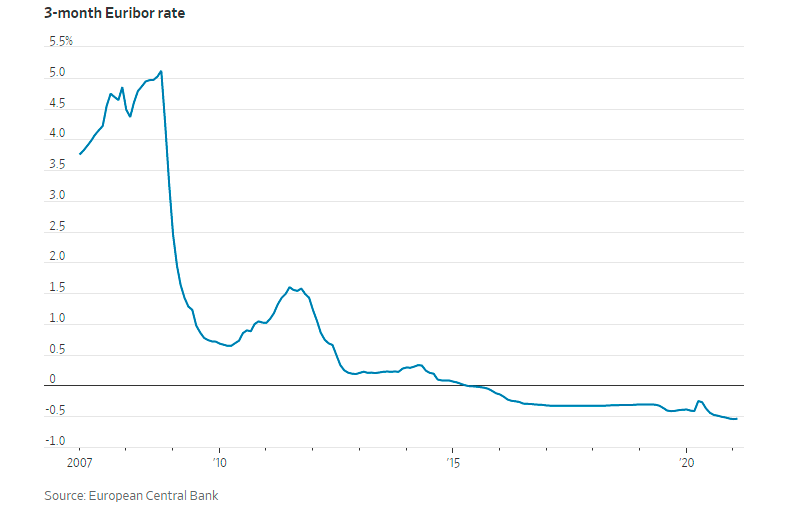
The drive to push interest rates in Europe ever lower started as early as 2012 when the European Central Bank (ECB) introduced negative rates for commercial banks wishing to deposit excess reserves with the central bank. This discourages banks from depositing reserves with the ECB in the expectation that banks would make more loans available to businesses and consumers. Interest rates in Europe never recovered from the ECB’s rate cuts and remain negative. Now, the impact of negative rates is well-embedded in the European banking system as banks have started to charge customers who wish to place deposits. No longer able to absorb negative rates, banks are turning away depositors, unless they are willing to pay the bank to accept their money----another case of Alice in Wonderland?
But the real issue is simple, but deeply concerning. European banks have no good loan opportunities and hence have no need of more deposits. Europe continues to suffer greatly from the pandemic. Banks have made it more difficult for business to borrow, as concern over debt repayment remains very high while the economy continues to limp along. France and Italy continue various degrees of restrictive lockdowns, threatening the summer opening for the tourist season. With tourism accounting for as much 15% of national income, another summer lost would likely result in permanent damage to the industry and the economy at large. Already, forecasts anticipate further economic contraction into the third quarter of 2021.



Comments
Log in or sign up to join the conversation.