


Market Correction
The market reached an all-time high on October 6, when the S&P 500 was up 14.2%. Since that peak, the S&P 500 Index has declined 11.7% through Friday’s (11/20/2026) close, which qualifies as a market correction, with much of the drop coming after the US midterm elections. On Monday (11/23/2026), the S&P 500 Index surged higher by 4.73%. The period following midterm elections historically tends to be favorable for stocks; however, so far this year, market returns have been anything but favorable since the election. Two major themes appear to be acting as headwinds for US equities: the first being forward expectations around Artificial Intelligence (AI) capital expenditures (CapEx), and the second being inflation expectations and interest rates.
Below is a summary of where these two themes have a broader impact on the market.
1. Inflation is sticky and its impact on the Federal Reserve’s interest rate policy.
2. Higher interest rates put pressure on the federal budget deficit due to increased interest expense.
3. A blue wave election leading to questions about the sustainability of growth in Artificial Intelligence.
4. The CEO and founder of Nvidia (NVDA) being relieved of his duties at the company but reinstated on Monday.
Sticky Inflation and the Budget Deficit
Coming into 2026, inflation had been on a downward trajectory (green line on chart below). As 2026 has unfolded, the downward trend in inflation is turning out to be more difficult to sustain. A spike in the flexible category is largely related to higher energy prices, a consequence of the war with Iran. Although sticky inflation is increasing at a lower rate, the category represents 70% of the calculation in the overall CPI-U (total inflation).
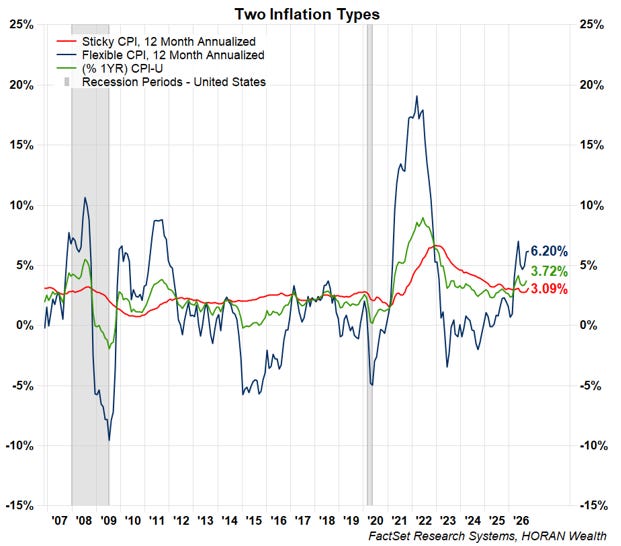
Areas carrying the largest weight in the sticky inflation category are household furnishings, owner equivalent rent, food away from home, and medical services. The red line on the chart shows the sticky inflation category is turning higher, while the flexible inflation category has spiked higher since the start of the year. As Milton Friedman’s famous quote notes, “Inflation is always and everywhere a monetary phenomenon.”
With the federal budget deficit running at nearly $2 trillion a year, funding the deficit comes from issuing new Treasury debt and/or the Federal Reserve releasing currency into circulation or using the currency to buy the debt. In fact, the Federal Reserve’s balance sheet is once again growing this year. The U.S. money supply, M2, is growing at about 6%, yet real GDP is only growing at 2%. The result is that inflation could remain a headwind because M2 is growing faster than real GDP.
Although the Fed continues to “talk” higher interest rates since Fed Chairman Warsh took the leadership reins, the Fed has increased the Fed Funds rate just one time with a 0.25% increase. The difficulty in raising interest rates stems from the fact that this puts added pressure on the budget deficit as government debt is rolled over at higher interest rates, and interest expense on the government’s debt obligations is running at nearly $1.4 trillion at an annualized rate.
Artificial Intelligence, Data Centers and a Blue Wave Election
Artificial Intelligence (AI) has been the main driver of economic growth over the past few years. The growth in AI has led to the need for increased data center capacity, but the success of the Democratic party in the midterm elections is partly attributable to its platform policy of reining in the growth of data centers. It has been the data center expansion that has contributed to a great deal of the economic activity of late. Companies that are involved in the build-out of the data centers, like Caterpillar (CAT) (earth-moving equipment), Trane (TT) (HVAC), Williams (WMB) (natural gas pipeline), and many utilities (electricity and build-out of power grid), have been the main driver of much of the economic expansion. If states and the federal government are successful in reining in the growth of data centers, this could prove to be an additional headwind to an already slow-growth economy. Secondly, there are questions about whether or not the data center growth is in an overbuilt state, i.e., too much capacity.
Anthropic (ANT), one of the frontier AI labs, recently completed its IPO, and its prospectus shows that revenue growth, while still strong, slowed in the most recent quarter. Some market participants view slower revenue growth at the frontier AI labs as a possible sign that demand is maturing, which could reduce the need for additional CapEx. Hyperscaler CapEx now represents roughly 2.1% of US GDP on a trailing 12-month basis, so a pullback in this spending could be a headwind to economic growth and market returns.
Strong Earnings
According to Factset, for the third quarter 2026 earnings reporting season, “With 93% of S&P 500 companies reporting actual results, 84% of S&P 500 companies have reported a positive EPS surprise, which is above the 5-year average of 78% and above the 10-year average of 77%. And 74% of S&P 500 companies have reported a positive revenue surprise.”
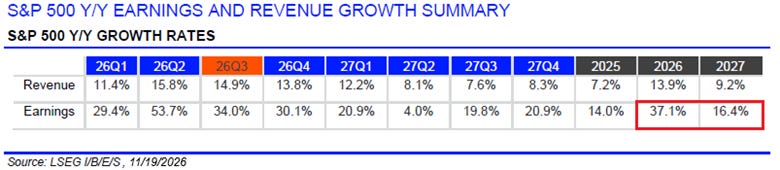
“In aggregate, companies are reporting earnings that are 3.5% above estimates, which is below the 5-year average of 7.5% and below the 10-year average of 8.0%. If 3.5% is the actual number for the quarter, it will mark the lowest earnings surprise percentage reported by the index since Q4 2022 (1.3%). The blended (year-over-year) earnings growth rate for the S&P 500 is 32.9%. If 32.9% is the actual growth rate for the quarter, it will mark the third-straight quarter of earnings growth above 25% for the index.”
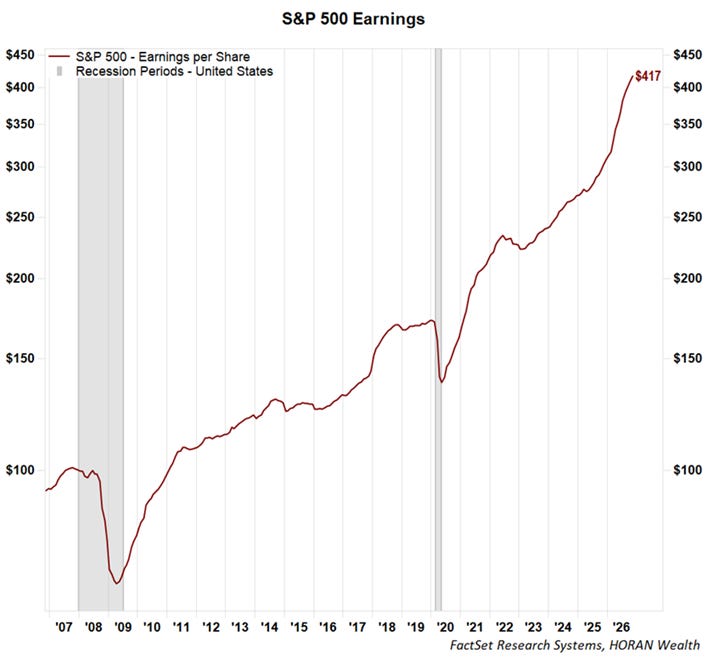
Clearly, S&P 500 earnings continue to exhibit a strong rate of growth. However, the lower surprise rate may be an indication that the market is anticipating a slowing in the rate of growth of earnings. Analysts’ growth estimates for S&P 500 earnings in 2027 are lower than earnings growth expectations for 2026. This slowing growth rate can be a headwind for stocks; however, a mid-teen growth rate of 16.4% for 2027 is strong.
Market Weakness Centered in the Mag 7 Stocks
The market weakness experienced since mid-October has mostly been centered in the Magnificent 7 stocks and AI-related stocks, those that have benefited most from the focus on AI. A part of this weakness is the result of the firing of the founder of Nvidia, CEO Jensen Huang. Jensen Huang has been a visionary in the AI growth opportunity. In a surprise move on Monday, Huang was reinstated as the CEO of Nvidia. In the short run, this is a positive solely for maintaining Nvidia’s leadership in the data center ecosystem. Additionally, after the stock’s contraction of 47% from its early October high, the stock’s valuation (P/E) is 7.5 times the company’s fiscal year-end January 2028 earnings, where the January 2028 earnings growth is +72% compared to the January 2027 estimate. This represents a more than 50% discount to the valuation of the S&P 500 Index, which is trading at 16 times forward earnings. The market’s reaction on Monday and after the announcement of Huang’s return saw NVDA stock jump 31.4%, or up by more than $39 per share. This is a surprisingly large move for a stock of this size, i.e., a company with a market cap over $3.7 trillion.
Conclusion: A Declining Market Not Unusual
Although a market pullback is not uncommon in any given year and averages an annual drop of 13.9% over the last 80 years, there are differences between this decline and historical ones due to the concentration in technology in the S&P 500, a concentration level not seen since the technology bubble in 2000.
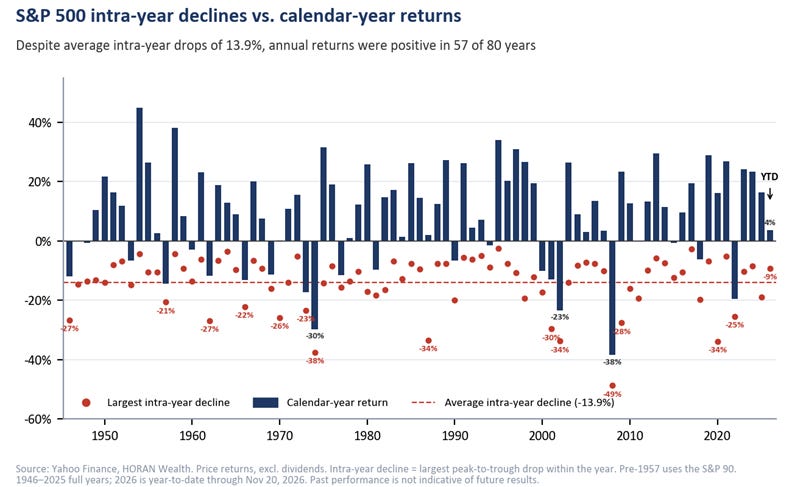
Seeking diversification outside of the mega-cap technology stocks that make up almost 40% of the S&P 500 Index may potentially lead to a less sharp drawdown of one’s portfolio. Using the S&P 500 Equal Weight Index (green line in the below chart) as a gauge of performance across the broader equity market, one can see that this more balanced participation of stocks has resulted in less of a pullback.
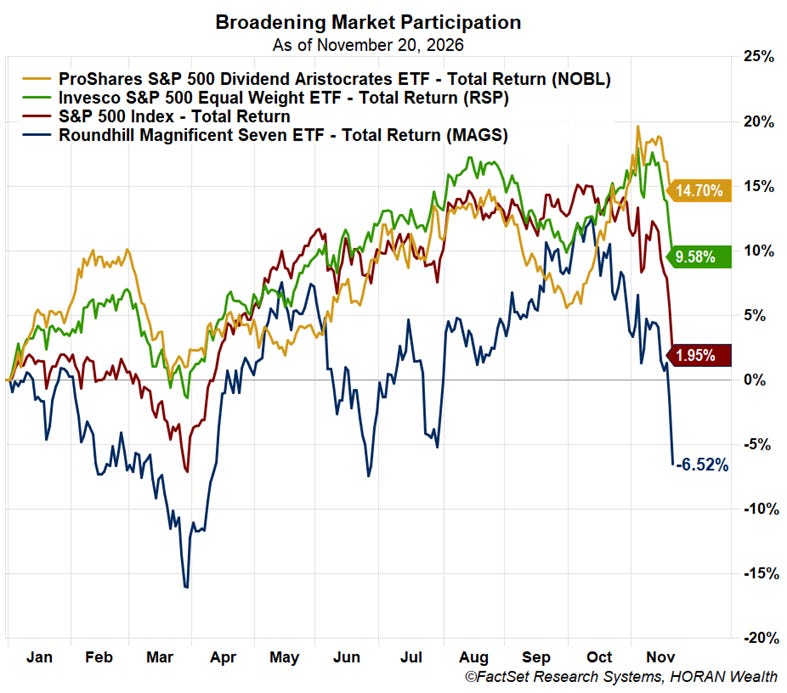
We believe the economic fundamentals in place at the beginning of the year remain. We believe politicians will not kill the AI infrastructure build-out as the train seems to have left the station. Yes, there likely will be more oversight of the build-out of the AI infrastructure and the rate of growth may slow, but we do believe growth will remain in place looking into 2027. This pullback likely creates an opportunity to adjust one’s portfolio and begin building positions in some stocks that may be unjustifiably down.

Comments
Log in or sign up to join the conversation.