


Over the course of the last 12 months, the defensive stock sectors in the S&P 500 Index outperformed the more cyclically oriented ones, with most of the outperformance beginning to unfold at the beginning of October. This is not much of a surprise, as uncertainty around mid-term elections often leads to investor uncertainty and market volatility.
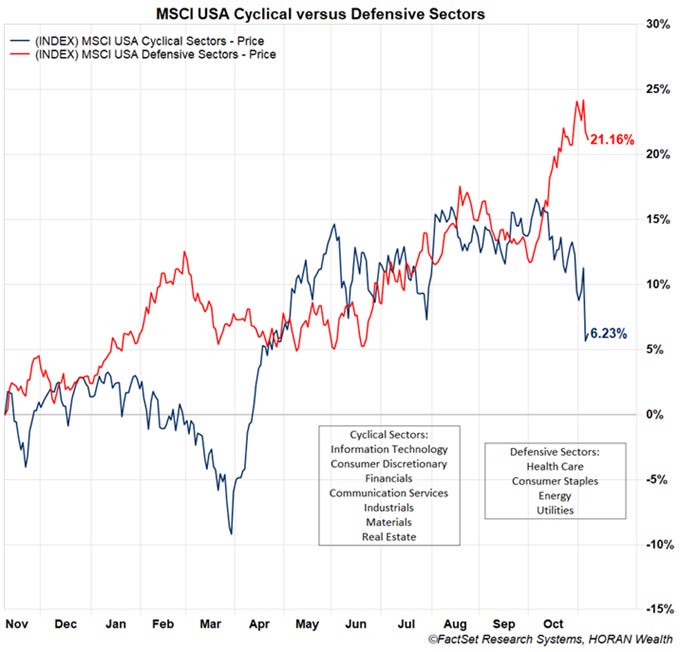
The weakest performing cyclical sector is the Technology Sector (XLK), which is down -14.1% in the last thirty days. Conversely, the defensive Consumer Staples (XLP) sector is up 10.7%, and the Health Care (XLV) sector is up 9.3%. As the chart below shows, the outperformance of the defensive sectors has pushed the valuation or price earnings ratio of some of these sectors to elevated levels.
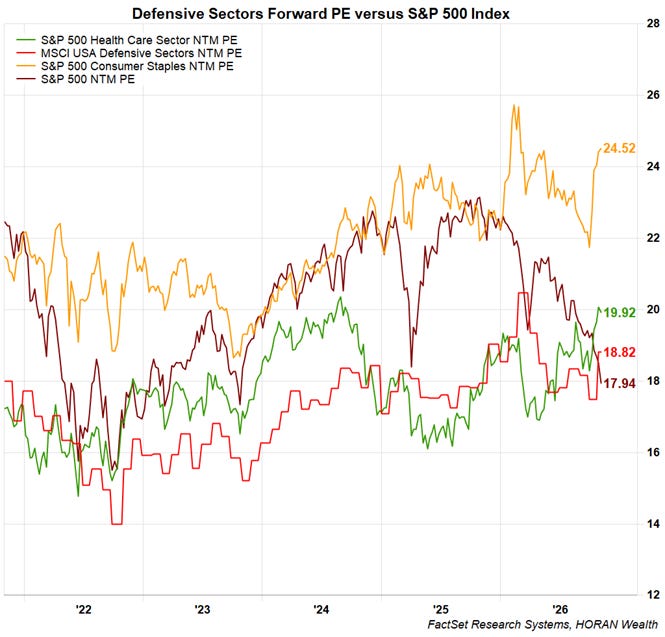
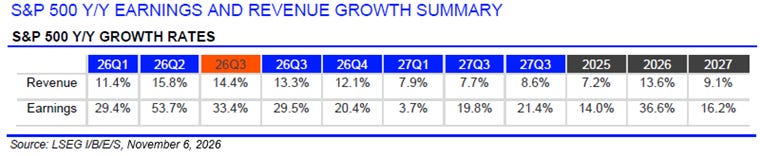
The valuation or P/E of the S&P 500 Index (maroon line above) has declined to 17.9 as the earnings growth rate of the S&P 500 Index has outpaced the return of the index. Year to date through Friday’s close, the S&P 500 price return is 7.76% compared to an estimated earnings growth rate for the S&P 500 companies this year equaling 33.6%. Through the first three quarters of the year, the year-over-year quarterly growth rate is 29.4%, 53.7%, and 33.4%--again far outpacing the market’s return, thus a lower market P/E now versus at the beginning of the year.
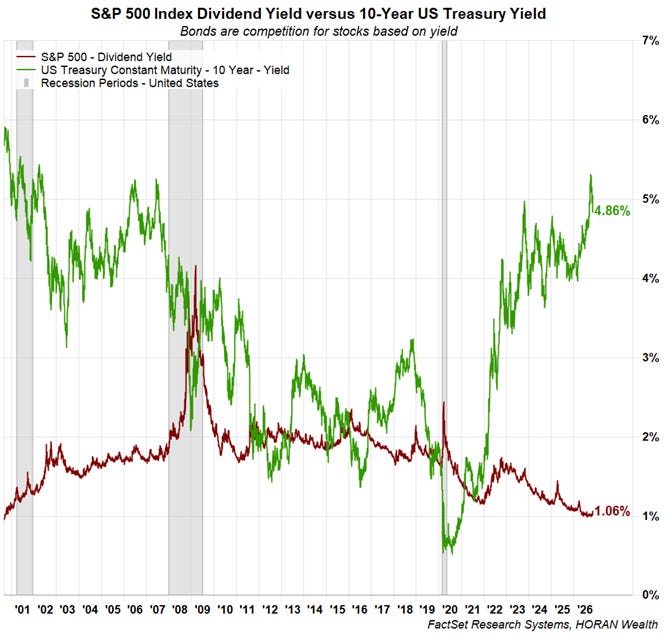
Lastly, one other factor worth noting is dividend yield. Broadly, as the chart below shows, the S&P 500 Index’s dividend yield is near a record low at 1.06%. This compares to a yield of 4.86% on the 10-year U.S. Treasury. This yield differential has led to bonds becoming reasonable competition to stocks, at least from an income-earning capacity.
For stock investors, because some of the factors, like valuation and yield, appear elevated at the moment, other factors like cash flow should be incorporated into one’s analysis of stocks. Below is a chart showing the risk/return metrics for a cash flow yield strategy versus other valuation metrics. Incorporating cash flow is always important, but especially in this current environment where the hyperscalers are spending enormous amounts of dollars on capex in the build-out of data center infrastructure.
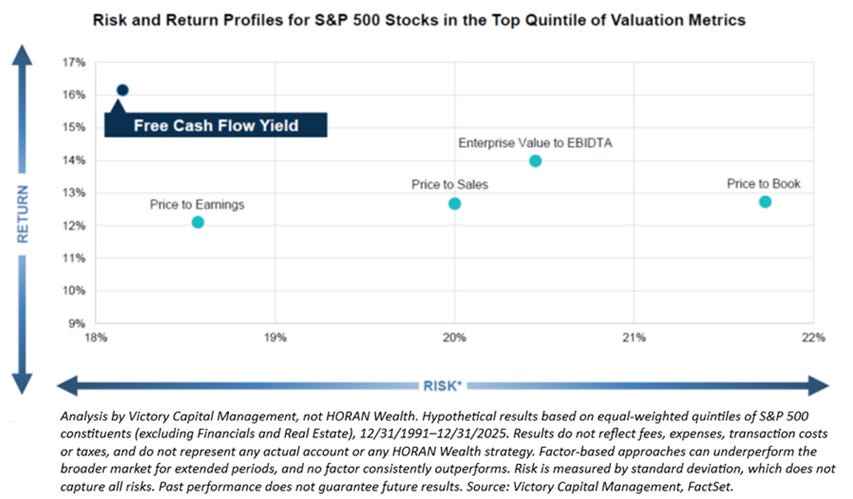
At the end of the day, growth in artificial intelligence infrastructure is not being eliminated. Certainly, the growth may slow, but the train has already left the station on this technology. Being mindful of valuations and cash flow metrics can help investors navigate potential rough waters, though.

Comments
Log in or sign up to join the conversation.