

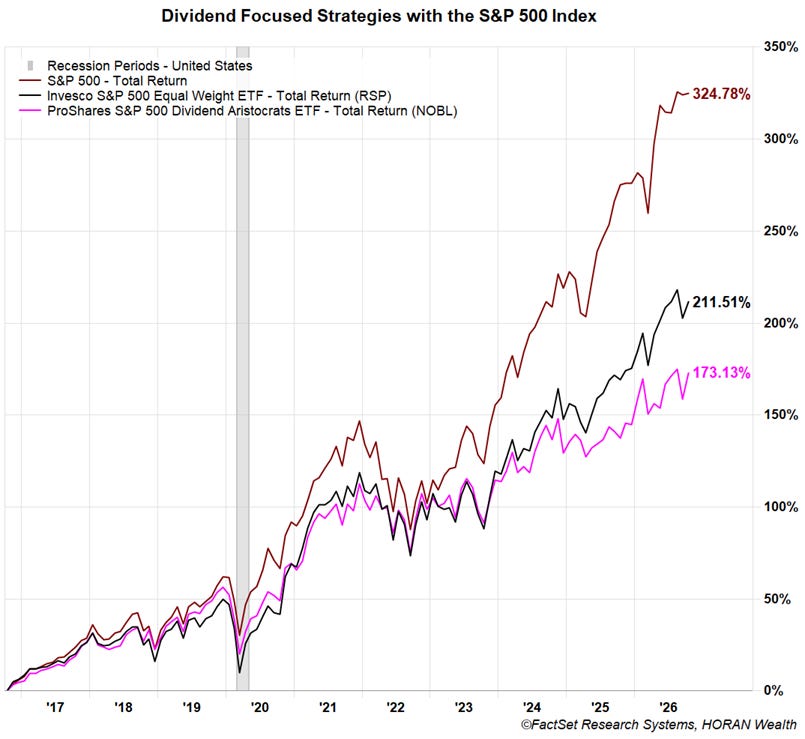
It seems with most investors’ focus being on the buildout of data centers and continued growth of artificial or super intelligence, the often called tried and true, stable dividend paying stocks in the S&P 500 Index have taken a back seat over the last ten years. As the below chart shows, the ProShares S&P 500 Dividend Aristocrats ETF (NOBL) has returned a cumulative 173% versus a return of 324% for the S&P 500 Index over this time period. Over the long run though dividend paying stocks have outperformed the broader market with lower volatility; however, this long run outperformance has not occurred in this recent 10-year time frame.
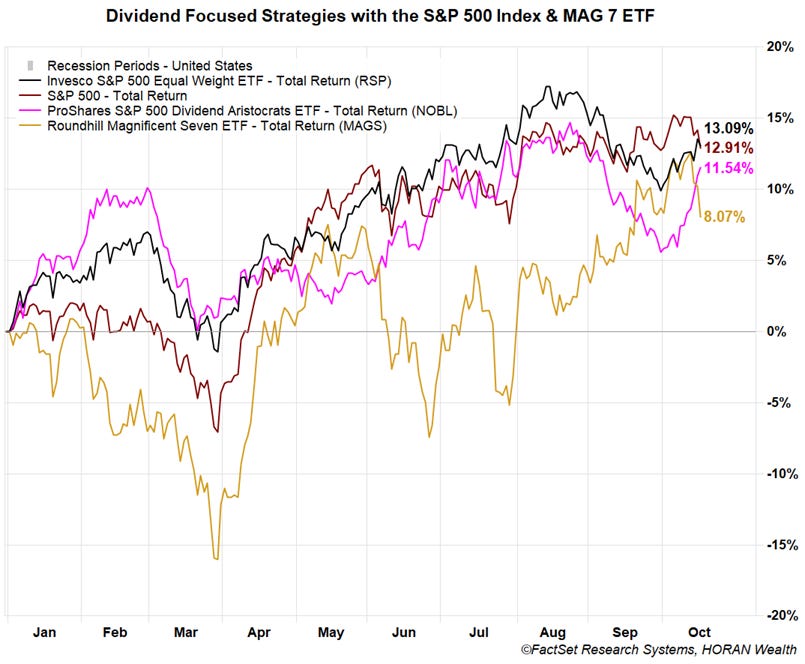
Narrowing the time frame to just this year though one can see the dividend payers are strengthening in performance and the return on NOBL is ahead of the return for the Mag 7 ETF (MAGS). In the month of October to date, NOBL is up 5.64% and the S&P 500 Index is up just .15%. Might one be seeing the tide return to favoring the payers?
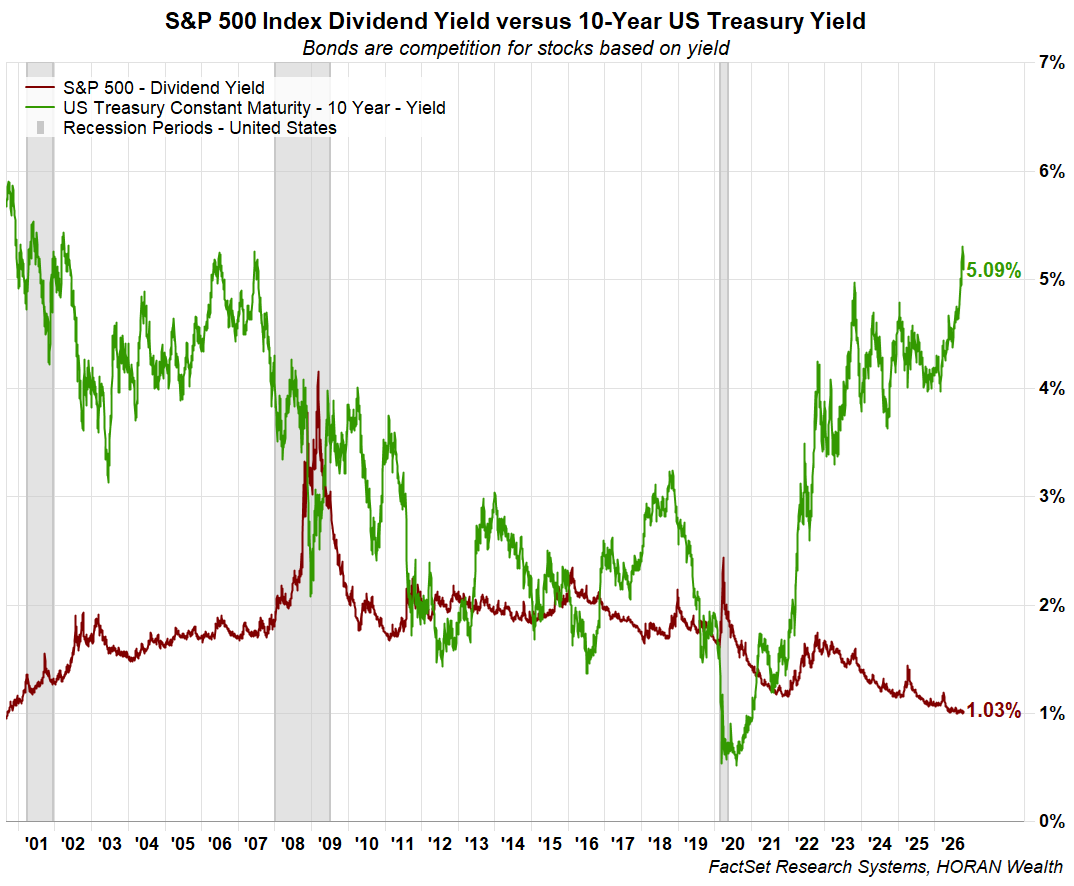
With the rapid increase in the 10-year U.S. Treasury yield to a touch over 5%, less than 5% of S&P 500 Stocks have a dividend yield greater than the yield on the 10-Year U.S. Treasury. As recently as July 2016 over 60% of the S&P 500 Index stocks had a yield greater than the 10-year Treasury yield. As one can see in the below chart, the S&P 500 Index is at a record low yield as of June 30, 2026.
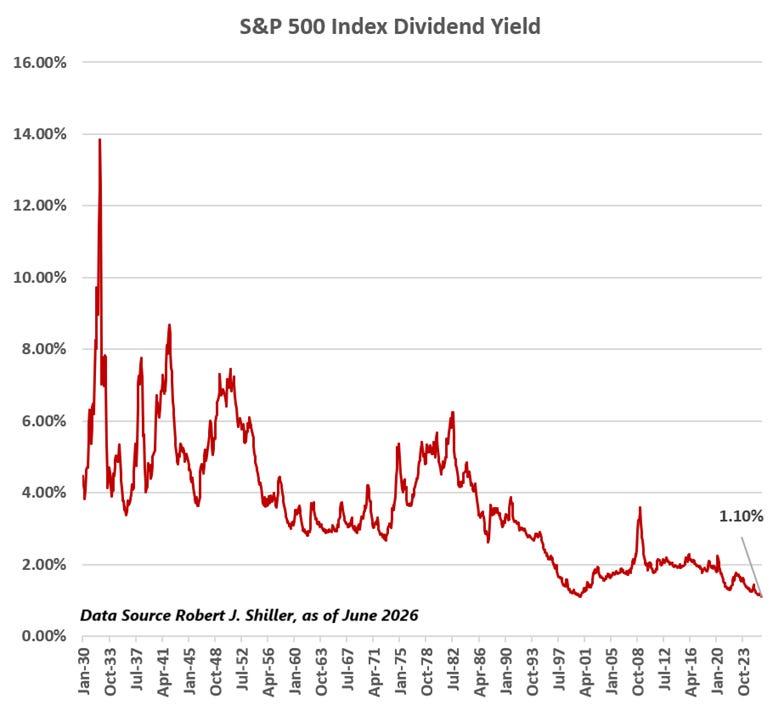
Partially contributing to this yield difference is the strong return in the S&P 500 Index itself. The 3-year annualized return is over 20%, i.e., up roughly 22% in each year of the last three years. The dividend growth rate for the S&P 500 Index is approximately 6.5% and the growth rate has been lower going back a few years. So, the Index return is growing faster than the rate of growth in the dividend; thus, placing downward pressure on the Index’s dividend yield.
In spite of the low index yield, companies do not seem interested in increasing the amount of earnings paid out in dividends. The dividend payout ratio for the S&P 500 Index is a low 21.4%.
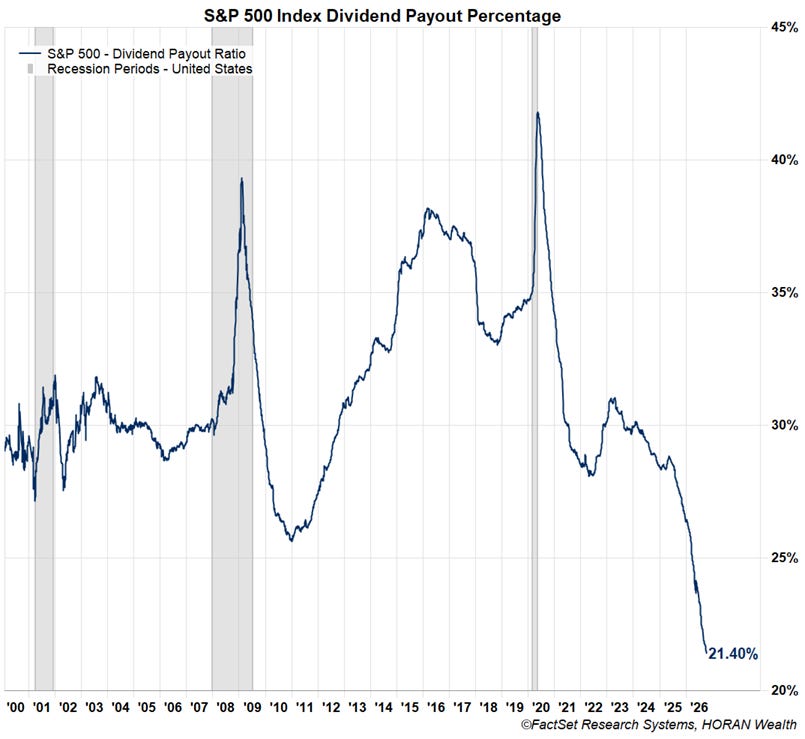
Contributing to this lower payout of earnings is the fact the S&P 500 Index is comprised of a little more than 50% in technology or technology related stocks when adding back technology stocks S&P Dow Jones Indices reclassified in 2018. Many of the technology-oriented firms have been focused more on capex spending as the build out in A.I. infrastructure continues.
Looking ahead, the A.I. infrastructure build out is likely to continue. The speed at which this is occurring likely slows relative to the prior growth rate. In part, other infrastructure, like energy needs, is unable to keep pace with the physical build out of the data centers. Microsoft just announced it was pulling out of a data center deal in the U.K., some speculating this is due to a delay in the buildout of the energy infrastructure.
As the growth in A.I. infrastructure slows, investors may turn their attention to stocks and investment sectors that have lagged the A.I. related trade. A headwind for stocks too, is the fact bond yields are now competition for equities.

Comments
Log in or sign up to join the conversation.