

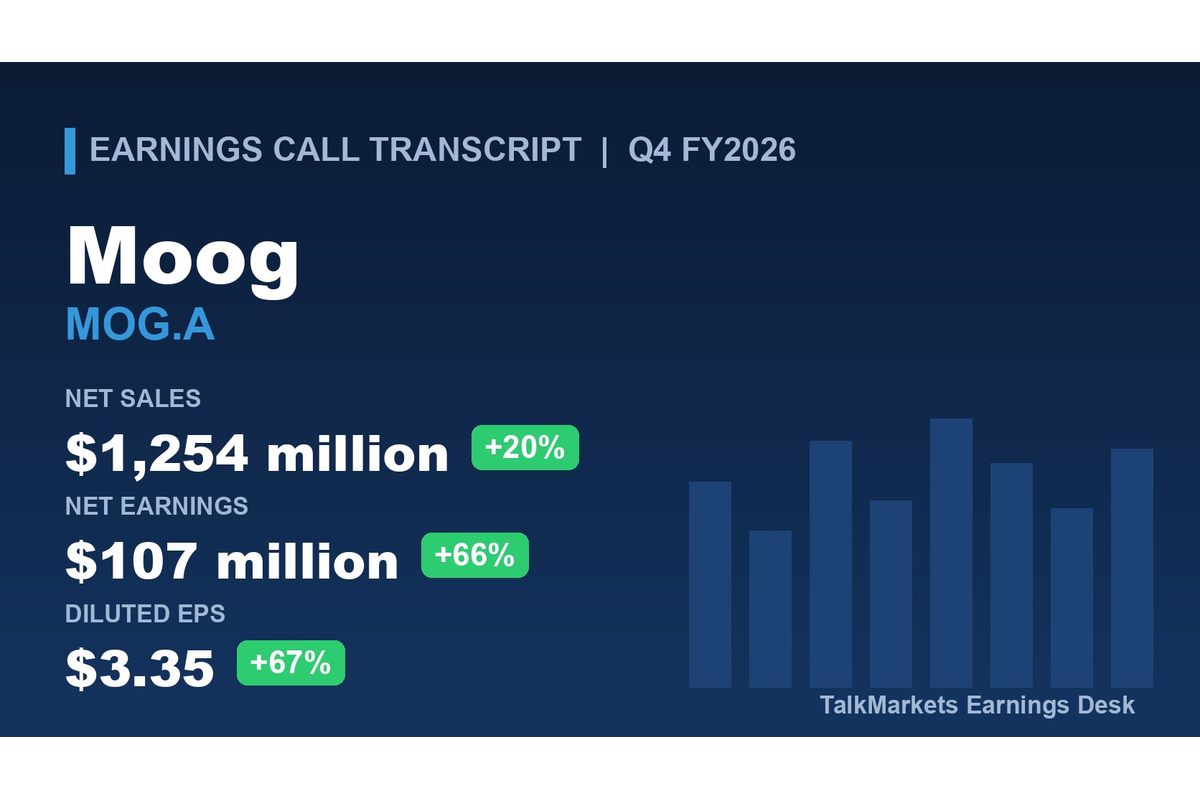
Moog's fiscal Q4 2026 net sales rose 20% to $1.3 billion with record sales in all four segments, while net earnings rose 66% to $107 million and diluted EPS rose 67% to $3.35.
Ticker: MOG.A
Moog Inc. (MOG.A) reported results on 20 November 2026 for its fiscal 2026 fourth quarter, the three months ended 3 October 2026. The maker of precision motion and fluid controls posted record quarterly net sales in all four segments and record full year results.
The key numbers (three months ended 3 October 2026)
Metric | This year | Last year | Change |
|---|---|---|---|
Net sales | $1,254 million | $1,049 million | +20% |
Segment operating margin | 14.2% | +230 bps | |
Adjusted segment operating margin | 14.1% | +40 bps | |
Net earnings | $107 million | $64 million | +66% |
Diluted EPS | $3.35 | $2.01 | +67% |
Adjusted diluted EPS | $3.37 | $2.56 | +32% |
Free cash flow | $156 million | $199 million |
Segment operating margin benefited from the absence of the prior year's legal settlement charges, a gain on the sale of a non-core business and stronger business performance. Free cash flow fell as the company used more working capital. Twelve-month backlog increased 14% to $3.4 billion.
Results by segment
Space and Defense: sales up 27% to $389 million, on demand for missile controls and spacecraft components. Operating margin rose 340 basis points to 13.6%.
Military Aircraft: sales up 20% to $283 million, driven by higher OEM activity. Operating margin rose 170 basis points to 15.7%.
Commercial Aircraft: sales up 13% to $286 million, on aftermarket growth and higher OEM production. Operating margin rose 150 basis points to 12.9%.
Industrial: sales up 17% to $297 million, driven by demand for data center cooling pumps and the timing of medical orders. Operating margin rose 190 basis points to 14.6%.
CEO Pat Roche said: "Fiscal 2026 was a milestone year for the company. We delivered record results and achieved the goals we established at our 2023 Investor Day."
Full year
For fiscal 2026, net sales rose 17% to $4,523 million from $3,861 million. Net earnings rose 79% to $420 million from $235 million, and diluted EPS rose 79% to $13.11 from $7.33. Adjusted diluted EPS was $12.36 against $8.69, up 42%. Free cash flow was $307 million, an increase of $179 million. The company also issued guidance for fiscal 2027.
Source: SEC Form 8-K Exhibit 99.1
Full call transcript
Operator:
Hello everyone, thank you for joining us, and welcome to the Moog fiscal 2026 fourth quarter and full year earnings conference call. After today's prepared remarks, we will host a question and answer session. If you would like to ask a question, please press star one to raise your hand to withdraw your question press star one again. I will now hand the conference over to Aaron Astrachan, Director of Investor Relations. Aaron, please go ahead.
Aaron Astrachan (Director of Investor Relations):
Good morning, and thank you for joining Moog's fourth quarter, 2026 earnings release conference call. I'm Aaron Astrachan, Director of Investor Relations. With me today are Pat Roche, our Chief Executive Officer and Jennifer Walter, our Chief Financial Officer. Earlier this morning, we released our results and our supplemental slides, both of which are available on our website. Our earnings press release, our earnings supplemental slides and remarks made during our call today contain adjusted non gap results.
Reconciliations for these adjusted results to gap results are contained within the materials provided. Lastly, our comments today may include statements related to expected future results and other forward-looking statements, which are not guaranteed. Our actual results may differ materially from those described in our forward-looking statements and are subject to a variety of risks and uncertainties that are described in our earnings press release and in our other SEC filings. Now, I'm happy to turn the call over to Pat.
Pat Roche (Chief Executive Officer):
Well, good morning, and welcome to our earnings call. I'm proud to share that we've delivered an outstanding quarter, closed out an exceptional fiscal year, and delivered on all of our Investor Day goals. And what a fitting way to salute our 75th anniversary year milestone. Our full year financial performance was exceptional. We delivered across the business and together achieved remarkable results. We established fiscal year records for orders, backlog, revenue, segment operating margin, earnings per share, adjusted EBITDA and free cash flow.
It is worth reflecting on what these record-breaking achievements say about our business. Annual revenue up in every segment by between 14 and 22% is a testament to our ability to ramp operations and deliver for our customers. Adjusted segment operating margin up 120 basis points was primarily driven by our continued focus on pricing and simplification. Plus, record adjusted EBITDA and free cash flow along with adjusted earnings per share of 42% are the result of our commitment to improved financial performance.
I'm extremely pleased with what has been achieved. Our journey over the last three years has been remarkable. I spoke of an inflection point in 2023, leading to stronger financial performance. I'm excited to report that our employees' exceptional commitment, disciplined execution and an unrelenting focus on pricing and simplification delivered the promised results. Measured against the fiscal 2022 baseline used at our Investor Day, we achieved compound annual growth of 10%, well above the 5% to 7% range we announced.
We drove initiatives and new ways of working that yielded, on average, 100 basis points per year adjusted segment margin enhancement, exactly on target, despite the impact of tariffs. We delivered compound annual adjusted earnings per share growth of 22%, beating our 15% to 20% range. And finally, we delivered adjusted free cash flow conversion of 78%, right within our target range of 75% to 100% for fiscal year 26%.
I'm so proud that the entire organization worked together to deliver on our ambitious commitments over the last few years. What we have learned how to apply our problem solving capability to deliver significant operational improvements. I'm excited for what more we can do over the coming years as we pursue excellence. Now, let me turn to the macro environment. While there has been some variation in the intensity of engagement, the significant conflicts in Ukraine and the Middle East remain active.
Europe is also experiencing increased levels of disruption due to hybrid warfare. In this context, the demand signals to urgently rearm and to respond to the changing character of conflict are as strong as ever. From a domestic perspective, the recent US election changes the leadership of both the House and the Senate in January. We anticipate that we may be working under a continuing resolution for several months until a National Defense Authorization Act for 2027 is passed.
While that could delay some new program starts, the urgency of our customer's requirements remains high, and we are well positioned to deliver for them. With recent completion of first fuselage, and we continue to support the program's success. Investments in defense across Europe and the rest of the world are also strong, and we are actively expanding our presence in these markets. In commercial aerospace, there is strong demand for new aircraft and after market support.
Boeing notably received certification for both the 737 MAX-7 and the MAX-10. The latter being the first commercial aircraft certified under the 2020 Aircraft Certification Safety and Accountability Act. Boeing and Airbus continue to increase production while managing specific supply chain constraints. We maintain steady production rates aligned with their requirements. After market demand remains strong with high utilization of fuel efficient aircraft. Finally, industrial markets are strong with positive sentiment in the US and stability in Europe.
AI investment is a significant demand driver across many industrial end markets such as energy, semiconductor and infrastructure. We continue to benefit from exposure to a diverse range of industrial applications due to our portfolio. Now, turning my attention to how we perform this year against my leadership priorities, starting with customer focus. Customer demand is very strong, and we are strengthening our position on long-duration opportunities across multiple applications.
These include integrated missile defense, strategic deterrence, hypersonics, space launch, affordable mass, next generation ground vehicles, next generation military aircraft, future vertical lift and commercial aircraft. Our innovation has established us as an industry leader in precision motion and fluid control. We were honored to play a role in Voyager 1's milestone achievement this week with the NASA Space Probe having reached one light day distance from Earth.
Our valves manufactured and shipped 50 years ago from our western New York site continue to precisely control the flow of hydrogen fuel in millisecond bursts, thereby controlling its orientation in space. This mission critical component enables the spacecraft to accurately point its antenna back to Earth a mere 16 billion miles away. Our operational performance has strengthened customer confidence and provided a foundation for future growth. Our operating model is simple.
Focus our efforts on those customers who value our partnership and consistently meet or exceed our commitments to those customers. This year was exciting to see how our customers responded. We received performance recognition from several customers, including BAE Systems, Embraer and General Dynamics Land Systems. Those recognitions reflect on both our engineering capability and our ability to execute with quality reliability and consistency. Our range of highly engineered solutions tailored to the needs of the warfighter was recently on display at AUSA 2026.
The event provided an excellent opportunity to engage with suppliers, customers and military leaders from home and abroad. Our success in business capture must be matched by success in delivery. We've prepared for the necessary capacity increase in our factories and supply chain. We continue to optimize our footprint and to pursue focused factories. We will invest in new facilities to support in support of the secured demand over the coming months.
In addition, we have already built capacity and capability in factory automation and risk-based supplier resilience and strengthened workforce training and development. We turn to people behind every achievement of the last few years has been our people. Their dedication, ingenuity and commitment to our customers and to one another have made this success possible and I could not be prouder of what they have accomplished together.
As leaders, one of our most important responsibilities is to nurture the unique culture that makes our company special, creating an environment where people are engaged, feel valued and can do their best work safely. I am proud that our latest employee survey with participation from more than 85% of our employees showed engagement above the manufacturing benchmark. Just as importantly, our safety performance continues to be strong with incident rates better than target.
Our culture is core to our employee value proposition and is a competitive advantage as we attract talent to support future growth. Our recruitment activity is successfully delivering the necessary hires to support our headcount growth, which was 5% over the last 12 months. Our proven training center model is helping those new hires to become productive more quickly. Shifting to our environmental impact, we have made substantial progress delivering on our environmental roadmap.
While manufacturing activity has increased significantly over the last few years, with revenue up almost 50%, we have managed to significantly reduce greenhouse gas emissions and to hold almost flat our consumption of water in water stressed areas. We have also identified priority hazardous waste for targeted actions. Moving to financial strength, we outlined a clear approach to drive improved financial performance during our 2023 investor day. We identified pricing and simplification as the key levers to deliver enhanced margins.
And outlined several initiatives that supported our improvements, including 80 20 portfolio shaping, focus factories, footprint rationalization, system convergence, automation and lean. Our approach has delivered substantial performance improvement, enabling us to deliver on the promised margin enhancement. We also see the gains in productivity and asset utilization since fiscal 22, while revenue has increased by almost 50%, headcount has only grown by 6% and factory square footage has declined by 10%. This results in operating profits per employee that are up 96%.
We've also made excellent progress improving the efficiency of our balance sheet. A year ago, we outlined a series of actions to reduce trade networking capital, particularly in commercial aircraft, by reshaping supplier relations, better aligning material receipts with demand and shortening manufacturing cycle times. Those actions have delivered results. Despite record sales growth, working capital as a percent of sales declined this year, contributing to significantly stronger cash generation.
Our strategy to improve performance has positioned us well to support our projected growth into fiscal 27 and beyond. We have clear expectations on performance and work today has ensured that our resources are focused on the customers and products that are critical for our long term future. As a leadership team, we will continue to drive further financial performance gains through consistent application of our proven approach.
Our financial performance will improve as we scale the business and drive operational excellence building on this firm foundation. During the year, we also strengthened our capital structure at the right time by extending the 1.1 billion revolving credit facility and the 250 million term loan to February 2031, an issuing $500 million of 5.5% senior notes due in October 2034, creating a staggered maturity profile.
In summary, our operational and financial performance over the last three years clearly demonstrates that we can drive substantial improvement to the benefit of our customers, employees and shareholders. We developed new organizational capability to drive change across the enterprise. We set clear performance expectations. We redesigned our organizational structure to create clear lines of accountability. We had a clear approach to performance improvement. We committed to ambitious goals and we delivered. We are committed to a journey of continuous improvement.
Our business is performing well today, and we know that it can perform even better in the future. We've shaped how we work over the last three years to incorporate the various approaches that helped defy our business and drive profitability. This way of working based on an 80 20 mindset constitutes an operating model that we will continue to build over the coming years to drive further real measurable improvement.
I look forward to sharing how we will leverage the growing scale and our passion for continuous improvement to drive stronger financial performance. When we host our investor day in March 2027, in the meantime, I'm looking forward to further growth and increased performance in fiscal 27. Now, let me hand over Jennifer for a reflection on the full year and to provide detailed analysis of our performance in the quarter and our guide for 2027.
Jennifer Walter (Chief Financial Officer):
Thanks, Pat. In fiscal year 2026, we achieved a record level of sales, expanded our operating margin significantly and generated strong free cash flow. Sales for FY26 was $4.5 billion, up 17% over FY25, with strong growth in each of our segments. Sales and space and defense increased 22% due to strong, broad-based defense demands. Commercial aircraft sales increased 17% due to ramp up on some of our key production programs, continued after market growth and pricing.
Industrial sales increased 15% as a result of growing demand for data center cooling pumps, as well as strong sales for medical applications. Military aircraft sales increased 14%, with peak levels of development on the MV-75 program, a particularly high level of aftermarket activity and higher activity on major legacy programs. Our FY26 adjusted segment operating margin of 14.2%, increased 120 basis points over FY25, driven by strong operational performance. Operating margins expanded in each of our segments, except for commercial aircraft.
In industrial, our operating margin expanded 250 basis points to 16.0%, due to incremental margin on our growing data center cooling pump business, and the recovery of previously incurred, i.e. Patera. Military aircraft operating margin increased 180 basis points to 14.1%, as a result of a more favorable sales of business mix and pricing. Our operating margin in space and defense increased 120 basis points to 14.7%, due to profitable sales growth. Offset by increased investments in cost development, business capture, and operational readiness.
In commercial aircraft, our operating margin decreased 30 basis points to 12.1%. As an unfavorable sales mix, in the absence of a prior year product line gain, more than offset significant pricing benefits. Adjusted earnings per share in FY26 were $12.36, up 42%. The increase was driven by the higher level of sales, stronger operational performance, and the tariff refunds. For the year, we generated free cash flow of over $300 million.
This represents the conversion rate of 78% getting us into our long-term target range. Let's shift over to our fourth quarter results. We had a strong finish to a record year. Our fourth quarter was marked by record sales in each of our segments, a robust operating margin, and strong cash generation. Sales in the fourth quarter of $1.3 billion were 20% higher than last year's fourth quarter. Sales were strong across our entire business, with double digit percentage increases in each of our segments.
Facing defense sales of $389 million were up 27% over the fourth quarter of last year, reflecting broad-based defense demands. Demand was particularly strong for missile control and spacecraft components. In military aircraft, sales of $283 million were up 20% over the fourth quarter of last year. The sales growth reflects the high level of activity on production and funded development programs. The MV75 program remained relatively stable over the past three quarters, while contributing to the growth from the same quarter a year ago.
Aftermarket activity also contributed to the sales increase. Commercial aircraft sales of $286 million increased 13% over the same quarter a year ago. The increase was driven by continued growth in aftermarket and higher production levels on some of our major platforms. Industrial sales were $297 million in the quarter, up 17% over the same quarter a year ago. Over half of the growth was driven by the rapidly expanding data center cooling market. In addition, our medical business benefited from the timing of orders.
We'll now shift to operating margins. Adjusted segment operating margin in the fourth quarter was 14.1% of 40 basis points from the fourth quarter a year ago. Our operating margin was up in industrial and military aircraft and down in space and defense and commercial aircraft. Space and defense operating margin was 13.7% in the fourth quarter down 140 basis points. The decrease related to higher product development, business capture and operational readiness investments. This pressure was partially offset by profitable growth within the business.
Military aircraft operating margin was 15.7% in the fourth quarter of 160 basis points from the fourth quarter last year. Production pricing and the level of activity contributed to the stronger margin as did a favorable mix. Commercial aircraft operating margin was 10.9%. 50 basis points below the fourth quarter last year. Our mix within our OE business was unfavorable compared to the same period a year ago. This pressure was partially offset by incremental profit from stronger aftermarket sales.
Industrial operating margin was 16.3% up 240 basis points from the same period a year ago. We're benefiting from efficiencies as we scale to support demand growth for data center cooling home. We also benefited from the higher level of medical sales. Putting it all together, adjusted earnings per share came in at $3.37. 81 cents compared with last year's fourth quarter. The increase is primarily due to incremental profit associated with the higher sales level.
Margin expansion also contributed to the increase in earnings per share. Let's shift over to cash flow. In the fourth quarter, we generated free cash flow of $156 million representing free cash flow conversion of 145%. Strong earnings contributed to our cash generation. We also generate cash from working capital items, most notably from customer advances across various defense programs. Capital expenditures increased sequentially as expected as we invested in facilities to support our growth.
Our leverage ratio was 1.4 times as of the end of the fourth quarter. Both our earnings performance and cash generation have driven our leverage ratio down. Our capital deployment priorities will continue to center around organic growth. And we'll pursue strategic acquisition to complement our existing portfolio. We strive to have a balanced capital deployment strategy over the long term. During the quarter, we spent $50 million to repurchase shares under our existing Sherry purchase optimization.
We'll now shift over to our initial guidance for next year. In fiscal year 2027 will continue to build upon our financial strength with record sales, stronger operating performance, and meaningful operating cash flows. We're projecting sales of $5.0 billion in FY27, a 9% increase compared to FY26. We're projecting growth in three of our segments and a comparable level in the other. The largest increase in sales will be in commercial aircraft. Sales are projected to grow 20% to $1.3 billion.
Driven these production rates for wide body and narrow body programs. Aftermarket activity will also increase, particularly for engine components. Space and defense sales are projected to increase 12% to $1.5 billion. We're seeing strong defense demand across our entire book of business. In particular for control from missiles as those programs ramp and spacecraft components. Industrial sales are projected to increase 5% to $1.2 billion. Driven by increased demand for data center cooling pumps.
Military aircraft sales are projected to be 1.0 about the same as in the prior year. Growth and new and legacy production programs will be offset by a reduction of activity on the MV 75 program. Let's shift over to operating margins. We're projecting our adjusted segment operating margin in FY27 to be 14.2%. Up 70 basis points operationally over FY26 due to profitable sales growth. Our operating margin in FY26 was 14.2%.
Or 13.5% excluding 70 basis points of benefit from the tariff refund operationally will have margin expansion in each of our segments in FY27. I'll now talk through our adjusted segment operating margins exclusive of the tariff refund and highlight the operational drivers. Our operating margin and space defense will increase 70 basis points operationally to 15.0% in FY27. We'll continue to benefit from profitable sales growth. Military aircraft operating margin will increase 40 basis points operationally to 14.2%.
Driven by increased pricing in both OE and in the aftermarket and a more favorable next. In commercial aircraft, our operating margin will increase 100 basis points operationally to 12.2%. We're benefiting from the higher level of sales and pricing. Industrial operating margin will increase 50 basis points operationally to 15.3% in FY27 due to efficiencies associated with growth. For FY27 adjusted earnings per share are projected to be $13.30 plus or minus 25 cents.
That's up 8% for nearly a dollar over FY26 adjusted earnings per share. The increase largely reflects the higher sales level partially offset by a higher tax rate. For the first quarter, we're forecasting earnings per share to be $2.65 plus or minus 10 cents. We're planning for both sales and operating margin to accelerate through out the year. Finally, turning to cash. We're projecting to generate $250 million of free cash flow in FY27.
This anticipates $120 million of major facilities investment to support our growth in addition to our more typical capital expenditures. For the year, we're expecting total capital expenditures of $360 million. We'll hold our use of cash from changes in working capital to a minimum. The pressures on working capital associated with our strong growth will be largely offset by our initiatives to reduce the amount of physical inventories on hand as a percentage of sales by shortening our sourcing and manufacturing cycle.
This marks the significant amount of progress in improving our cash flow. Excluding the incremental facilities investment, we're well into our 75% to 100% free cash flow conversion target range. For the first quarter of FY27, we anticipate to generate a slightly positive level of free cash flow reflecting normal timing of compensation payments. We're proud of our operational performance in FY26 and look forward to reporting continued success in FY27. And now I'll turn it back to Pat.
Pat Roche:
Thanks Jennifer. So fiscal 26 was a remarkable year and a fitting way to celebrate Moog's 75th anniversary. We delivered on our commitments, strengthened the business and demonstrated what focus execution can achieve. We see this performance as a foundation, not a finish line. Demand is strong. Our market positions are expanding and there remains significant opportunity to improve how we operate. We enter fiscal 27 confident in our ability to grow and create further value for our customers and our shareholders.
Thank you to our employees for an exceptional year and to all of you for your continued support of Moog. And with that, let me open the floor to questions.
Operator:
We will now begin the question and answer session. If you would like to ask a question, please press star 1 to raise your hand. To withdraw your question, press star 1 again. We ask that you pick up your handset when asking a question to allow for optimum sound quality. If you are muted locally, please remember to unmute your device. Please stand by while we compile the Q&A roster. Your first question comes from the line of Justin Lang with Morgan Stanley.
Your line is now open. Please go ahead.
Analyst (Morgan Stanley):
Yeah, hi. Good morning. Thanks. Thanks for taking the questions. Pat, I want to start on the guidance and for the defense businesses. He touched on expectations for more protracted CR, but just given all the debate we're hearing around reconciliation and FY27 budget levels, can you just talk a little bit more about the level of visibility you have into next year?
And are there any specific programs you'd call out where the outlook is maybe a bit more contingent on where funding ultimately lands and could be a swing factor for the defense businesses next year? Thanks.
Company Executive:
Justin, hi. Thanks for the question. Yeah, when we look at our portfolio on the defense side, as you know, it's broad base. So we have exposure to lots of different activities that are going on in the defense side. We feel that there is significant demand out there on their punishment side, which is really urgent. And we believe that we'll find its way through whatever deliberations go on in the government.
Our exposure to those programs on the missile is significant, as you know, we have seen progressive growth in those programs over the last number of years. Over 30% growth year on year coming into 26 with our final numbers and seeing continued growth at that rate into next year as well. So I think it's down to the mix of businesses that we have exposure to.
Obviously, a continuing resolution would delay the starts on some new programs, but that's not a huge portion of our fiscal 27 guidance. So we remain confident in our guidance for the year, even though there is that uncertainty there. And it's due to the portfolio of exposure that we have, Justin.
Analyst:
Got it. That's helpful. I think it's a 60 figure of bid and I called out the 120 million of facility investments. So you get to the final point on, you know, sort of what the investment is earmarked for and what it all unlock. Thanks.
Company Executive:
Yes. We do have an elevated level of regular capital expenditures pre approaching 5% of sales. And that's just a part of our ongoing continuing growth. But in addition to that, we are planning an additional facilities. Growth to support and growth that we have that growth are on programs that are secured generational program. So it is a significant. Investment in this year. That's why we're highlighting it now.
So it's really including the building and spit out acquisitions of property and equipment to go in that to support our long term growth.
Analyst:
Kind of great. Thanks. Nice quarter.
Operator:
Your next question comes from the line of Tomohiko Sano with JP Morgan. Your line is now open. Please go ahead.
Analyst (JPMorgan):
Good morning. This is Ethan on for Telmo. Just to just to start off on the data center calling business. Good morning. On the data center calling business in relation to 2025, I believe you said it was 25 million in sales. I believe recently highlighted. Approaching 100 million sales. That's correct. Yeah, that would imply an increase of like 75 million this year. When we're looking at the guidance for industrial, believe it, it says it's roughly a 60 million dollar increase.
Would this imply kind of just slow down on the overall industrial side, or is this on just the slow down on the pumps business?
Company Executive:
I wouldn't characterize anything as a slow down the pumps business. The pumps business, as you say, almost quadrupled in revenue during the course from 25 to 26. We're expecting continued growth on pumps into next year. We have the A&T capacity available to deliver on that and are ramping our supply chains to ensure we can meet the demand from the hyperscalers that are our customers. So the data center cooling business continues to grow.
We would see it in fiscal 27 as roughly 3% of our global most total sales. So it's an important piece of business for us.
Analyst:
That's helpful. And then when we're when we're looking at kind of the next stage, you would you achieved your margin target of roughly 100 basis points, a annual margin expansion. How much more runway do you see into 2027 and 2028 in relation to like pricing and simplification? Is this more of like a shift automation productivity volume leverage? You just walk us through a little bit.
Company Executive:
Well, we're looking forward actually to describe our journey for the next three years that are upcoming investor day. That would be a super opportunity for us to lay out how all those plans come together to deliver on to deliver ongoing continuous improvement in our performance over the next three years. We've given the 27 guidance today that shows we are continuing to deliver margin enhancement into 27.
We lay out the rest of that story at the investor day itself, but it is based on a belief that we have an approach to driving improvement in the business that has proven to be successful. And that we are continuing to focus on doing that as a leadership team.
Analyst:
Okay. Thank you. I'll hop back in the queue. Thank you.
Operator:
Your next question comes from the line of Michael Chiamoli with Guggenheim securities. Your line is now open. Please go ahead.
Analyst (Guggenheim Securities):
Hey, good morning, guys. Really nice results. Hey, Jennifer, can I just go back to the catbacks or even Pat? Can you give us any any specific detail? I mean, are these are you building out facilities specifically for missile components? Is it satellites? Is it preparation for something like MV 75? Can you, you know, is it broadly? Maybe, you know, the industrial data center cooling?
Can you give us a little bit of a flavor of where that capex is going to and where we might see, you know, I guess the product portfolio expand once the new capacity comes online?
Company Executive:
Yeah, Michael. Good morning. Welcome. She went to our live ago. I'll start with the $120 million kind of above the typical level that we have. We're looking specifically for new space to support the growth that we're having in our space and defense business, as well as in some of our commercial business. These are where we need significant amount of new space available for it.
We are growing also in our base amount of capital expenditures too, and that's to support the regular growth. But that's more routine in nature. That's why we were calling out the $120 million of facilities investments include both facilities as well as sit out of those facilities. So, one immediate commercial, the missile program is the missiles programs as they begin to expand. And so we need to find additional space to accommodate that growth.
Analyst:
Got it. Got it. And what about commercial? I would have thought you have some capacity since we're technically not back to current build rates. Is that we're just speaking more broadly commercial platforms or industrial or what's the detail there?
Company Executive:
Oh, say it's a general need that we have in commercial. These are facilities that we're actually putting in Western New York. Most of the commercial activity is actually in the Philippines for on the OE side of it. But we do have repair activity work that happens here. And as you know, we've been hitting record levels of that for the past several years. And so we need additional space to keep up with the anticipated increasing demand on that part.
Analyst:
Got it. And just on that topic, Jennifer, do you have the commercial OE and aftermarket growth in the current quarter and then what the expectation is for next year within the commercial aircraft segment?
Company Executive:
Yeah. So commercial aircraft, commercial aircraft OEM sales for the fourth quarter of the full year. Did you say Michael?
Analyst:
Fourth quarter.
Company Executive:
Fourth quarter was 180 million on the OE side and 105 on the aftermarket side. So we're still showing increases both year over year. As we look to next year, we're looking for the business to be $1.27 billion. Split OE of $860 million and $410 on the aftermarket side. So the OE business going into next year on 26 to 27 will increase 28%. And aftermarket will increase 8%.
So we're still seeing robust amounts of aftermarket growth activity, but the ramp ups on the OE side on the production level are overtaking that level.
Analyst:
Got it. That's helpful. And last one here, and I'll get out of the way, just on the industrial path. I guess X the pumps call it 75 million. It also sounds like you had some medical timing. Maybe that gave a little bit of benefit in the fourth quarter. Any trends, you know, I guess it would suggest maybe automation, sim and test, not growing as fast. Maybe any color there on kind of bookings or what the outlook for those product categories are.
Company Executive:
Yeah, I think your summary is fairly much on the mark. I mean, a lot of the growth is coming from that data center cooling pump business. I would describe the rest of the business is relatively stable. There's some puts and takes in it overall.
If you look at the PMI information on sentiment over over the last number of months in the U.S. and pretty consistently in the expansion territory in Europe, it's a little bit more on the margins, I would say, but stable. So yes, the biggest piece of the growth is coming from the data center cooling activity. The rest of the business I would say is stable.
Analyst:
Got it. That's helpful. Thanks guys. I'll jump back in the queue.
Operator:
Your next question comes from the line of John Tanwan Teng with CJS. Your line is now open. Please go ahead.
Analyst (CJS Securities):
Good morning and congrats on the really nice quarter and outlook. I was wondering if you could expand a little bit more in the FLARA program. What the expected headwind is next year compared to this year. And when do you see that ramping again as you start to approach production?
Company Executive:
Yeah. Hi, John. Welcome. MV 75 program is going really well for us. We've been successful in hitting milestones as that program has progressed. As you know, this year was a year in which we reached a peak level of activity on the EMD phase of that program. Next year, we are expecting and aligning our activities with the priorities and milestones that Bell have for the program.
That has involved moving around some elements of activities, making sure that we tackle the areas that need to be progressed more actively on the engineering side and moving some of the other stuff later out. And so overall, the level of activity is down next year relative to this year. But the program continues to move successfully forward.
Analyst:
Okay. Thank you. With a little bit more detail. Specifically, if you think it might be impacted by the potential moratoriums and maybe, you know, I guess fast tracked approvals before those start. Do you any of your hybrid scale customers here have exposure to the states who might be implementing them? And if that's going to hurt in 27 or 28 or at any point in the in the future.
Company Executive:
Thanks, John. We're pretty confident in the numbers we've put together for this year. A lot of the product that we're producing is going into data centers that are already in construction are permitted already. So we're not expecting to have any short term impact on our ability to move these are in 44 pumps, which is what we're shipping today. We've been building up capacity because of the demand that's out there.
I would say that we could ship more if we had our supply chain fully up to the rates that we are capable of building at. And so we're still projecting growth into next year and we're confident in that growth, John. So I think that's the answer. In addition, I would say that not all of in the future, a lot of refurbishment of data centers will go on to upscale their capability.
And so that would move data centers that are today, maybe cloud infrastructure that are air cooled in the future could be liquid cooled as well. And so that creates another avenue for our pumps to be used in the future, even a site from new construction activity.
Analyst:
Got it. That's very helpful. Thank you. If I could sneak one more in there, Jennifer, do you have a percentage of what CapEx is going to be that's going to be associated with maintenance versus growth?
Company Executive:
We don't quite do that split. We are more looking at what's our typical type of capital expenditures that may have some normal maintenance type of turnover of old machines replacing with new ones and some on the tangential sides of new capabilities. That's about almost 5% of our sales in capital expenditures. That's the regular amount that I would care total up to be about $240 million.
That's before the $120 million that we're specifically calling out for very specific investments that include both facilities and fit out of facilities.
Analyst:
Okay, great. Thank you.
Operator:
Your next question comes from the line of Gautam Kana with TD Cowan. Your line is now open. Please go ahead.
Analyst (TD Cowen):
Yeah, a couple quick ones was wondering what rate are you selling into the a 350 at monthly what monthly shipment rate.
Company Executive:
I got them. Good morning. We've, we've not issued the shipment rates that we have and we haven't been doing that for a while now. My answer on a 350 is that we are working in line with the needs of our customers. We take their skyline plans into account in all cases. And we also factor in other data that we have on the market and what's happening out there.
And so we've been, we've been able to operate a pretty stable production rates for both customers. And we are, we're pretty confident in that we've positioned those rates appropriately to the real demand that's out there.
Analyst:
If it's fair to assume that you've, you're shipping it or I mean, because their deliveries have been quite soft here to date. Have you paired back the kind of match at type of cadence or you get, because I'm just curious about the OE guide for next year kind of what is. If you could frame up some of the programmatic assumptions for us.
Company Executive:
We take into account the data on what's actually happening. Gautam as we set our projections going forward. So I think we, what we have in there is something that we're comfortable with. Even, even in light of current production rates that we're seeing.
Analyst:
Okay. And just to follow up on an earlier question, if there's like a budget CR for DOD through much of next year, what, what, where are the incremental risks if, if there are any business.
Company Executive:
Risks are on new starts programs of themselves. They wouldn't be significant revenue levels associated with them in our plans. But that's one area they may get pushed out to the right of the consequence of a holdback. I think there's a redistribution of funding that necessarily has to happen. If the continuing resolution continues and that favors programs that have high urgency and high priority for the US government. And I think our exposure on those is good.
Analyst:
Yeah, asking maybe more specifically, are there any programs within the mode portfolio that you would call out as. Watch items in a extended CR situation.
Company Executive:
Let me see. Maybe there's a. It may be some more of the more longer term strategic programs that have been spoken about get pushed to the right of the consequence of it. But as I say, I think the programs where there's a defined need. They will get resources and I think our exposure to those got them is good. So I prefer to focus on that side rather than the long tail of small opportunities or others that make it pushed out.
Analyst:
Thank you.
Operator:
There are no further questions at this time. I will now turn the call back to Pat Roche for closing remarks.
Pat Roche:
So thank you everyone for joining the calls that that wraps up the call for now. And I appreciate you taking the time to listen to our update on the business and look forward to providing an update again in the next quarter. Thank you.
Operator:
This concludes today's call. Thank you for attending. You may now disconnect.
Comments
Log in or sign up to join the conversation.