

Mission Accomplished
The markets have already shaken hands, even though the diplomats are still arguing over the wording of the peace treaty.
The S&P 500 and Nasdaq Composite are printing fresh highs, not with hesitation, not with the cautious optimism of a market dipping its toes, but with the conviction of jumping in with both feet, as if it has already glimpsed the future. Price is no longer waiting for confirmation. It is front-running the outcome, pulling sentiment forward and forcing reality to catch up.
The shift is profound. What began as hope has hardened into something far more constructive and far more directional. Hope has given way to a bright, beaming light at the end of the peace tunnel. The market is no longer asking whether there will be a deal. It is trading as if the deal is already signed, sealed, and quietly filed away.
Under the surface, the move carries the unmistakable signature of a market that came in underexposed. Broad swathes of participants are still in disbelief, caught flat-footed, now staring at a tape where value has already moved beyond reach. There are simply not enough reasonably priced, good-quality stocks left to buy.
This is not rotation. It is a pursuit. A scramble that compresses time and stretches valuation, where entry points vanish faster than conviction can rebuild, forcing capital to chase price rather than wait for it.
The numbers tell the same story. The S&P is punching through 7000, up double digits from the late March lows. The Nasdaq 100 has been grinding higher for eleven consecutive sessions, a streak that does not suggest balance but momentum bordering on urgency. 14% in a straight line is not an accumulation. It is acceleration.
This is a market diving in with full commitment, not easing in to test the waters’ temperature. In a matter of days, it has snapped back to that familiar post-shock reflex in which hesitation disappears, and momentum takes control. The velocity of the shift is what throws even the most seasoned players off. One moment, the tape is bracing for escalation. The next is accelerating higher, scrambling to keep pace with a rally that is already in motion.
And yet the contradictions are everywhere, hiding in plain sight.
Oil is elevated. Yields are elevated. Deficits are expanding. The labour market carries new uncertainty, whether from the Iran war cycle or from the quiet encroachment of artificial intelligence. Terminal values are being rewritten in real time. Supply chains have taken real hits (although I think they'll heal quickly), not theoretical ones. Access to critical inputs ( oil, gas, fertilizers) remains fragile.
And yet everything is blue skies again.
This is the market at its most reflexive. It does not deny the risks. It simply chooses to outrun them.
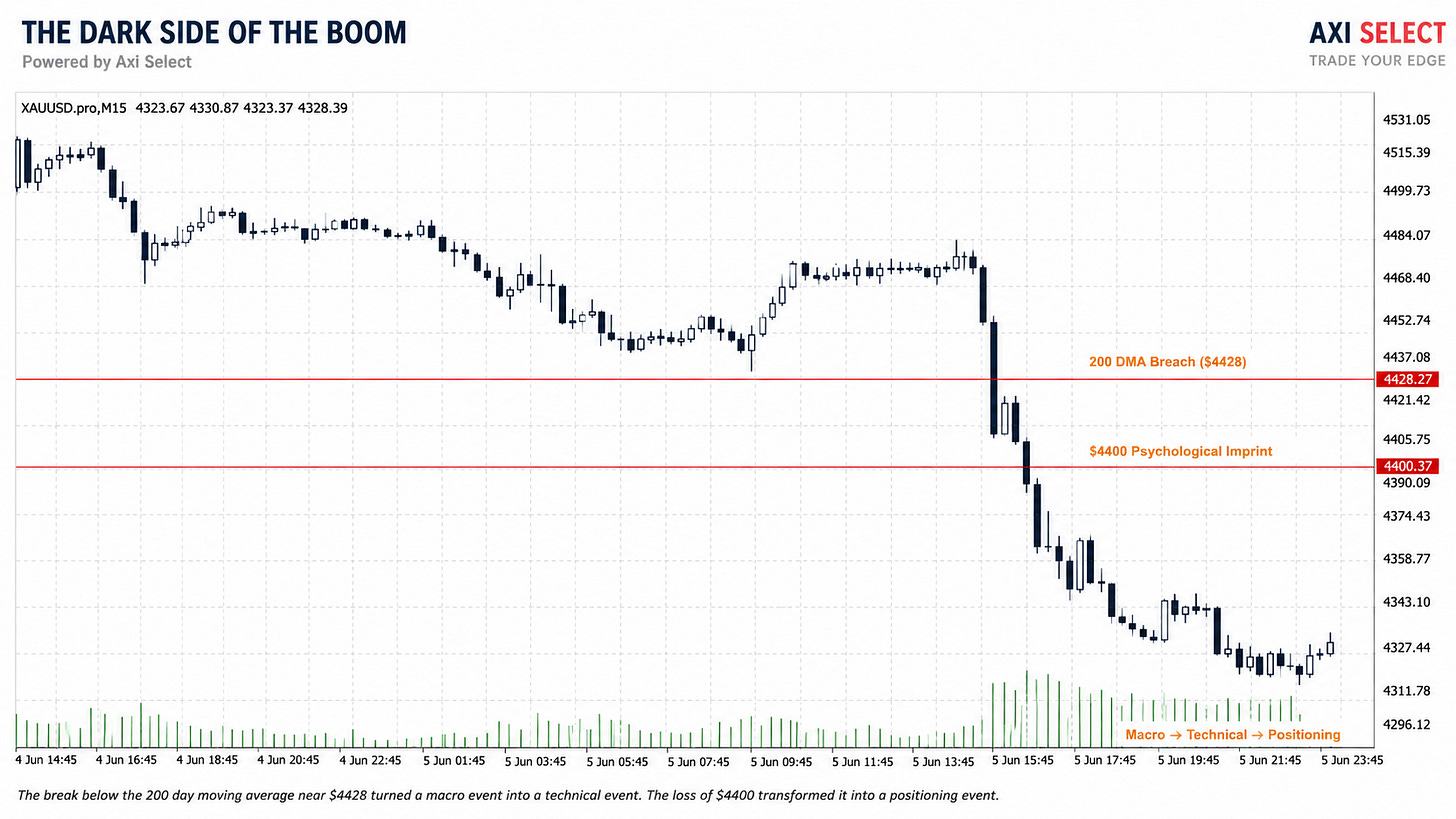
Even central bank expectations are bending in strange directions. Rate-cut bets have softened, the tone drifting marginally more hawkish despite softer trade price data, with pockets of inflationary pressure still flaring beneath the surface. Gold (GLD), sensitive to that shift, slips back under 4800 as the market trims its dovish expectations.
But that consensus feels misplaced.
Because beneath the surface, the ingredients for policy easing are quietly assembling. Supply chains are not in tatters. Employment risks are not fully priced to the downside. And as base effects begin to strip out prior tariff distortions, the inflation narrative could soften faster than the market expects. The path toward a September cut is not only viable. It is building even if pricing doesn’t reflect it, as Hedge funds are still wading into more hawkish Fed-outcome structures.
Flows, however, are not waiting for that inevitable Fed policy debate to resolve today.
They are one way.
Systematic strategies, discretionary accounts, real money, all chasing from behind. The market is structurally under-risked and structurally forced to correct that positioning at ever higher levels. It is the purest form of upside-down convexity. Positioning is effectively short gamma to the upside, meaning every incremental move higher forces more buying, not less.
That is how melt-ups are born. Not from confidence, but from necessity.
And so the rally feeds itself.
Not because everything is perfect, but because enough participants are out of position that price becomes the catalyst. The market is not celebrating peace. It is racing toward it, dragging capital along in its wake, indifferent to valuation, dismissive of contradiction, and entirely focused on one thing.

Comments
Log in or sign up to join the conversation.