

Smart investing doesn't need to be too sophisticated. On the contrary, a simple and straightforward investment thesis can many times produce superior returns. Microsoft (MSFT) is a rock-solid business that will continue doing well in all kinds of economic environments, and the stock is already priced at very reasonable levels.
Solid Fundamentals
The world at large is going through a challenging period, and it's hard to know how long it will take for the COVID-19 crisis to be overcome. In these kinds of environments, companies with solid fundamentals, strong cash flows, and healthy balance sheets are particularly attractive for investors looking to go bargain-hunting in high-quality business.
Microsoft is a top player in software, productivity, and cloud computing. The PC software market is quite mature, and it's also being hurt by disruptive competition, but Microsoft is more than compensating for the weakness in this area with sustained vigorous growth in productivity and cloud.
Source: Microsoft
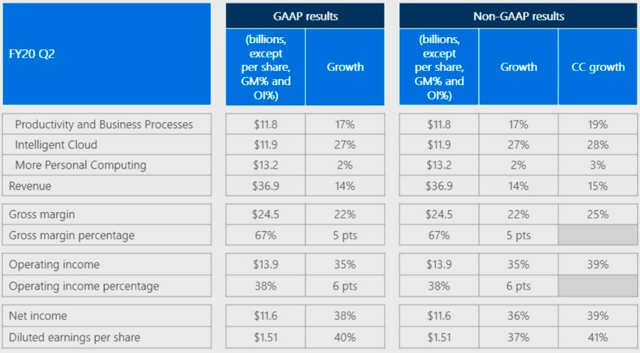
The financial reports for the second quarter of the fiscal year 2020 show that the business keeps firing on all cylinders overall, with revenue increasing 14%, operating income growing 35%, and earnings per share jumping by 40%, versus the same quarter in the prior year.
Cash flow from operations reached $10.7 billion during the quarter, an increase of 20% year-over-year. Free cash flow amounted to $7.1 billion during the period, increasing by 37%.
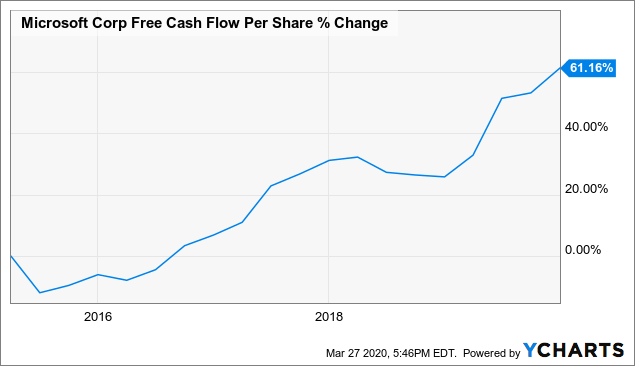
The company has an impeccable track record of cash flow generation in the long term. Besides, the balance sheet is pristine, with nearly $134 billion in cash and liquid investments to make all kinds of investments and acquisitions.
Data by YCharts
Microsoft benefits from sound competitive strengths driven by factors such as cost advantages, the network effect, and high switching costs for clients.
- Cost advantages are a major driver in the software business. Once the software has been developed, providing it to a new client has almost zero marginal costs, so the market leaders tend to get stronger and more profitable over time. The scale of the business is also a major source of competitive advantage in the cloud segment.
- The network effect means that users attract each other to the leading platforms in a particular segment. In businesses such as Office 365, users want to have a platform that is compatible with others and works smoothly. In LinkedIn, the bigger the network the more valuable the service it provides.
- Switching costs mean that it can be expensive and risky for customers to move from Microsoft to another provider. As long as Microsoft continues delivering well, chances are that most of the company's clients will remain with the company and even expand their relationships over time.
The impact of the global coronavirus crisis still remains to be seen, and it will obviously have repercussions for all kinds of businesses across the board. On the other hand, Microsoft is benefiting from the work-from-home trend, and the company announced on March 19 that it surpassed 44 million Teams users versus 20 million in November.
What doesn't kill you makes you stronger, and Microsoft will emerge from this crisis stronger than ever. Besides, the company is benefiting from massive long-term tailwinds taking place on a global scale, with or without the pandemic.
In the words of CEO Satya Nadella:
"Stepping back from the quarter and reflecting more broadly on the next decade, the defining secular trend will be the increasing rate of digitization of people, places, and things. This malleable power of software will drive productivity growth across all industries, leading to more inclusive economic growth far beyond the domains of consumer tech today."
The sanitary and economic crisis produced by COVID-19 will pass sooner or later, and the trend towards digitalization and productivity will not be derailed. On the contrary, it will probably gain acceleration, and Microsoft is in the right position to benefit from such a trend.
Reasonable Valuation
Microsoft's stock is holding on relatively well in comparison to the broad market during the coronavirus panic. The stock is down by 20% from its highs, while the S&P 500 is down by 25% from its highs of the year.
This makes sense considering that Microsoft is a large and stable business with a rock-solid balance sheet. Besides, the different productivity applications from Microsoft can become increasingly valuable in times of social distancing and home-office all over the world.
Regardless of the reason, the fact is that other stocks in the market have taken a much bigger hit than Microsoft in recent days, but Microsoft is still priced at very reasonable levels when considering the quality of the business.
The company is expected to produce $6.9 in cash flow per share during the current year and $8.07 next year. Under those assumptions, the stock is trading at a free cash flow yield of 4.4% and 5.2%, respectively. This is quite moderate coming from a tech leader with healthy financial performance and a solid business model.
Moving forward, the table below shows the average earnings per share estimate and the implied forward PE ratio for Microsoft in the years ahead. These estimates are obviously subject to a large margin of error in the current economic environment, but it's worth noting that valuation is not excessive at all based on these assumptions.
| Fiscal Period Ending | EPS Estimate | YoY Growth | Forward PE |
| June 2020 | 5.63 | 22.45% | 27.75 |
| June 2021 | 6.19 | 10.00% | 25.23 |
| June 2022 | 7.2 | 16.28% | 21.7 |
| June 2023 | 7.75 | 7.64% | 20.16 |
| June 2024 | 9.8 | 26.53% | 15.93 |
| June 2025 | 11.13 | 13.57% | 14.03 |
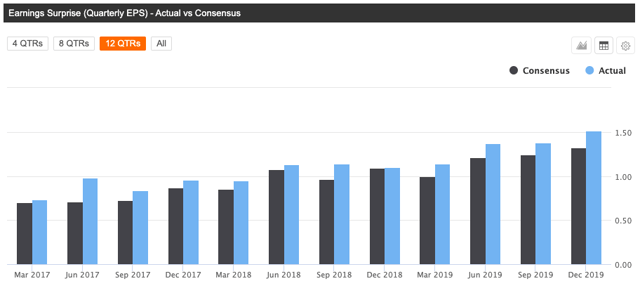
It is also important to note that Microsoft has delivered earnings numbers above Wall Street expectations in each of the past 12 quarters in a row. This speaks well about management and its ability to consistently outperform expectations over time. Mediocre companies generally over-promise and under-deliver, typically making excuses to explain their disappointing numbers. Great companies, on the other hand, tend to outperform expectations through good and bad times.
Source: Seeking Alpha
Fundamental momentum has important implications in terms of valuation. If Microsoft will continue delivering higher than expected earnings in the future, then the stock is actually cheaper than what current valuation ratios are suggesting.
Valuation should be interpreted in the right context, and we need to incorporate other return drivers when assessing valuation levels. A company that generates strong profitability and consistently beats expectations deserves a higher PE ratio than a business with below-average profitability and underperforming expectations.
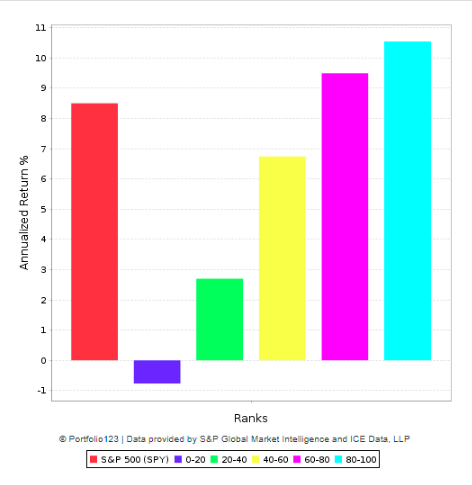
In that spirit, the PowerFactors system is a quantitative system that ranks companies in a particular universe according to a combination of factors: financial quality, valuation, fundamental momentum, and relative strength.
Data from S&P Global via Portfolio123
The backtested performance numbers show that companies with high PowerFactors rankings tend to deliver superior returns over the long term, and the higher the ranking, the higher the expected returns.
This bodes well for Microsoft, as the company has a PowerFactors ranking above 99, meaning that Microsoft is currently in the top 1% of companies in the US stock market when considering valuation, financial quality, fundamental momentum, and relative strength together.
Backtested performance data for these kinds of algorithms should always be taken with a grain of salt. The backtested data shows that a large number of companies with high PowerFactors rankings tend to deliver superior returns over the years, but this does not tell us much about how a specific company such as Microsoft is going to perform in a particular year such as 2020.
That being acknowledged, it is good to know that Microsoft is attractively valued when considering valuation levels in the context of other return drivers. If the company continues executing well and outperforming expectations, then the stock should still offer attractive upside potential going forward.
Risk And Reward
In times of extreme market volatility and rampant uncertainty, it is more important than ever to be transparent about how you are managing your overall portfolio exposure and risk levels.
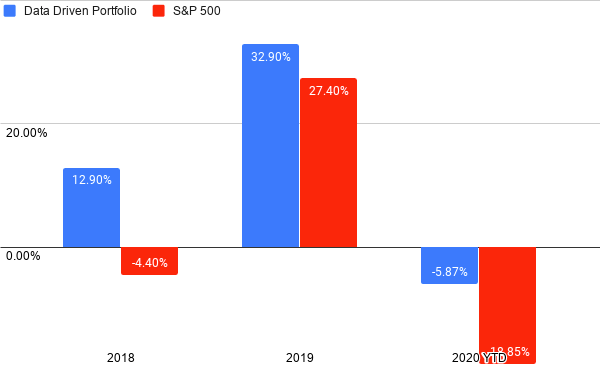
My portfolio was 50% in cash and 50% in equities as of February of this year, when markets started plunging due to the COVID-19 crisis. As prices collapsed, I slowly increased my exposure to 70% inequities. After that, I reduced my exposure to 60% by reducing 10% in the ferocious rally from Monday to Thursday this week. Now I have 40% in cash, and Microsoft is one of the stocks that I am planning to buy in the near term, especially if prices pull back again in the coming days.
Microsoft is a resilient business, and the company is strong enough to successfully go through any crisis. However, no business is completely immune to a recession, and investors tend to sell stocks en masse during times of panic. This means that buying Microsoft right now could carry some volatility risk, even if the business fundamentals will remain untouched.
From a company-specific perspective, the PC industry is going through a major transformation, and Microsoft doesn't have a strong presence in mobile, which puts the company at a disadvantage versus players such as Alphabet (GOOGL) and Apple (AAPL).
Microsoft is facing rising competitive pressure from all fronts in different business segments. While the company has the strengths to continue thriving in spite of growing competition, this is an important factor to watch in the medium and long term.
Those factors being acknowledged, the investment thesis for Microsoft is actually quite simple. In times of rising uncertainty and record volatility in the market, it makes sense to stick with solid businesses that have the strengths and resources to successfully go through all kinds of scenarios, and Microsoft fits that description quite well.
The stock is not a bargain at current prices, but it is already very reasonably valued for such a high-quality business. The bigger the pullback due to macroeconomic factors in the short term, the bigger the opportunity for long-term investors in Microsoft's stock.
Performance as of March 26, 2020:



Comments
Log in or sign up to join the conversation.