

The general market started to show weakness two weeks ago according to this PMO Index shown below, but it took about seven days for the weakness to develop into a real downtrend. I think this happens frequently where the market slowly erodes and then falls apart for a short period of time. And even though this pattern happens a lot, it is still hard to handle and leads me to a bit of doubt and second-guessing. But now I am happy that I had the discipline to stick to my plan and reduce holdings while the PMO was at the top of the range.
Now what? The PMO is at the bottom of the range, and that means it is too late for me to be selling. It is time to start watching for the next buying opportunity. The trick is to give the downtrend just a little bit of time to stabilize at these lows, and then monitor closely for the clues that it is time to step in.

This chart below shows the negative divergence of late July where the broad market index broke to new highs while the PMO Index in the chart above was suggesting the majority of stocks were starting to develop weakness.

So far this year we've seen some pretty clear price patterns above and below trendlines which is a lot easier to trade than when the market is choppy like it was last year.

One very important clue within the short-term trend is the level of 52-week lows. Too many lows at the top of the PMO range is a very bad sign for the market, but a lot of new lows at the bottom of the range is a positive indication that the selling may be close to completion.
Watch for a price reversal day in the downtrend, and then in the following day or two pay attention to the level of new lows to see if it drops way down below 50 or so. That is often a good sign that the market is done with selling and has switched back to buying.

This 10-day inverted put/call shown below helps too. In May this indicator started to show a little strength about a week before the market confirmed a new short-term uptrend.

I like to watch this Package Index because it is often ultra-sensitive to the economy and rates. At this point, the price action of the index is choppy, but not showing any real weakness. If this index holds onto this strength, then the general market weakness is probably a good buying opportunity.

The chart below shows that about 50% of stocks are still above their 50-day price average. Before the market is ready to start moving higher again, my guess is that a little more damage needs to occur until the percent reaches nearer to 40% or so.Just a guess though.

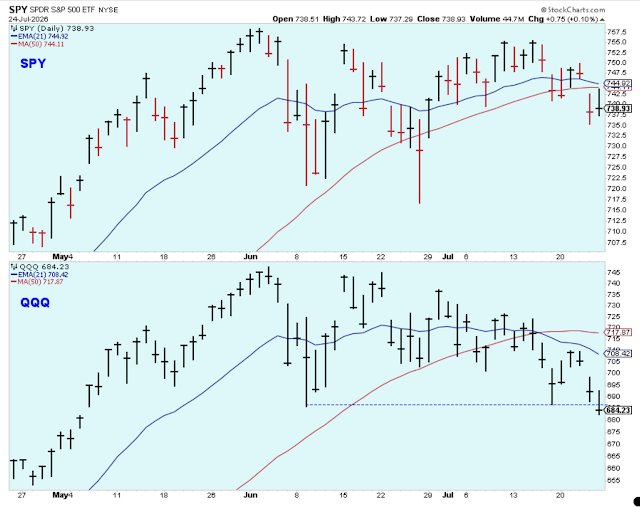
The three charts that follow below show some of the weaker indexes. Over the next couple of weeks, let's see if they can hold above their trendlines and support levels. If they do, then it is probably a nice tick mark in the plus column for the general market.


Here is a look at a weekly chart to get a feel for the bigger picture. Is this a picture of a market rolling over, or is it a giant consolidation before the start of the next big move into new highs? At this moment, I am on the fence and need more time to think about it.
I will say one thing, though. The price momentum indicator in the bottom panel provides a pretty good view of the medium-term trend, and this shows that there are usually about two very good medium-term buying opportunities every year.
Despite the market rally off the May low, this indicator hasn't turned higher, and maybe (emphasis on maybe) we are getting ready for the next medium-term buying opportunity where this indicator drops down to the lows of its range, and if we are brave enough then we get to pick up some stocks at really good prices? Just a thought.

Below is the spreadsheet I use to see which areas of the market are leading. I like to be invested in the leaders for the most part.
Bonds have been leading stocks for some time which you don't often see in a bull market, and small companies are lagging way behind the large companies.
Among the sectors, the defensive, dividend-paying stocks are clear leaders. Defensive now includes the XLK where the top four holdings are Microsoft, Apple, Mastercard, and Visa with their dependable growth and fortress balance sheets.
I should mention that all but one of the sector ETFs are skewed right of the 50% mark, and that strikes me as bullish for the general market.
It isn't a surprise to see Home Construction as an Industry leader with rates low and going lower. This group does well near the end of a bull market, but the stocks scare me at this point in the cycle.

The market took a hard hit this week, but the Long Leveraged Funds are still showing unexpected strength. I'm a buyer of some of these leaders when this short-term downtrend bottoms out.

Here is a look at the Short Leveraged Funds. The two oil-related leaders have been up there for the entire general market short-term uptrend that just completed. I continue to hold these and a few others, but I will be watching carefully for opportunities to close them out in the coming weeks. I would rather sell early and miss out on gains than to sell late and see gains slip away.

A couple weeks ago it looked like bond prices were getting ready to pull back in price, but now bond prices have broken out of a two-month base.

Yields are respecting the downward sloping 50-day moving average.

Outlook Summary
The long-term outlook is cautious as of May-18.
The medium-term trend is up as of Jun-07.
The short-term trend is down as of Jul-19.
The medium-term trend for the price of bonds is up as of Nov-16 (prices higher, yields lower).
Investing Themes:
Treasuries, Cash
Top-Rated Stocks in Uptrends.
Strategy During a Bull Market:
- Buy large-cap stocks and ETFs at the lows of the medium or short-term market trends.
- Buy small-cap growth stocks on breaks to new highs in the early stages of market trends.
- Reduce buying when the market trend is at the top of the range.
- Take partial profits when the market uptrend starts to struggle at the highs.
- The cardinal rule is never invest based on personal politics. The stock market can do well regardless of which political party is in control.


Comments
Log in or sign up to join the conversation.