


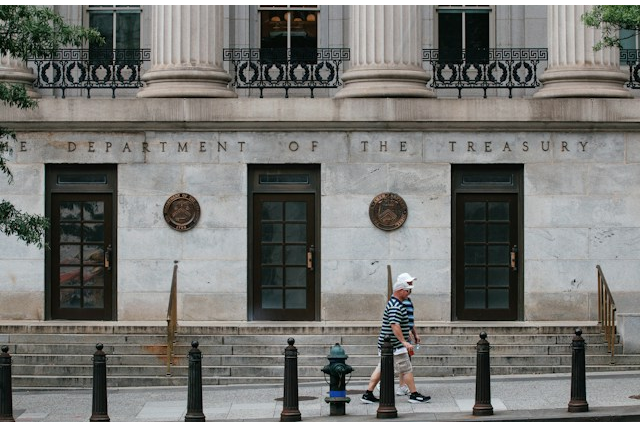
Longer dated fixed-income assets are rallying on an early announcement that the US Treasury will at least double the size of its buybacks in the coming months. The measure arrives after the 30-year yield jumped yesterday to its highest level since ’07. The proclaimed purchases will target the back end of the curve, which has struggled the most in recent years in light of expanding deficits that are projected to widen, thereby supporting loftier term premiums and elevated rates. Additionally, competition for debt financing from AI firms, heavier inflation expectations, geopolitical tensions driving energy price volatility and economic growth that has held up well globally are contributing to costlier interest expenses. Plunges of over 10 basis points throughout the 20- and 30-year tenors, precisely the areas Secretary Bessent will focus on providing liquidity to most, are helping stocks break a three-day losing streak, as the four major domestic benchmarks advance alongside 8 of the 11 principal sectors. Cryptocurrencies are benefiting from the revival in animal spirits too as bitcoin (BTC.X) surges to a summer high just short of 70k. Elsewhere, the greenback and volatility protection instruments are retreating in consideration of looser financial conditions and a risk-on mood on Wall Street, commodities are rising across the board, helped by the weaker dollar, ongoing US-Iran complications and speculative enthusiasms, and prediction markets are experiencing engagement as well.
Treasury To Rely on Bill Issuance Further
The move to support liquidity conditions from the 10- year maturity out to the 30 will be financed by heavier bill issuance at the front end of the fixed-income complex as the government debt total remains in a firm upward trajectory. Those shorter tenors are more influenced by the Federal Reserve’s monetary policy decisions rather than fiscal dynamics, and they shield Washington from being punished imminently for having sustained outsized budget deficits for almost three decades. The measures are essentially a method of yield curve control designed to suppress long-term rates that are deemed too elevated and at risk of derailing the economic expansion. Ultimately, I believe that borrowing costs would have dropped naturally; however, the Treasury would prefer that they fall from greater bond demand and not in response to a cyclical downturn, as the latter would compromise revenues and counter progress on bridging the gap resulting from lighter interest expenses.
International Roundup
UK Price Pressures Intensify
Rising energy costs contributed to the UK’s Consumer Price Index including owner occupiers’ housing depicting accelerating price pressures and are providing fodder for inflation hawks at the Bank of England. For the first time in 12 months, the gauge’s rate of increase accelerated with its year-over-year (y/y) result of 3.1% in July jumping by 0.3 percentage points from June, according to the Office for National Statistics. The monthly CPIH, furthermore, hit 0.3% after showing no change in June. The core version, which excludes energy, food and tobacco, illustrated the impact of fuel and electric expenses. It climbed only 2.9% y/y after June’s 2.8% ascent.
The Consumer Price Index, which excludes homeowner costs such as mortgage payments, insurance and taxes, also accelerated, climbing from June’s 2.6% y/y and 0.1% m/m prints to 2.9% and 0.3%. both metrics matched the economist consensus estimates.
Within the monthly CPIH, housing and household services climbed 0.9%. The component of that category that is specific to household owners was up 0.3%. Other categories that became more expensive and the extent of their changes were as follows:
Health, 0.5%
Transport, 0.2%
Alcohol and tobacco, 0.2%
Miscellaneous goods and services, 0.1%
Categories with no m/m change were restaurants and hotels, food and non-alcoholic beverages, and education. The broad all goods category, meanwhile, slipped 0.1%. Within this group, clothing and footwear led the decline, posting a 0.9% descent. The furniture and household goods category, furthermore, fell by 0.4% while recreation and culture and communications each slipped 0.1%.
In July, the UK’s energy regulator set a 13% increase in its energy price cap and is expected to approve an additional 4% hike. Looking ahead, the Bank of England (BoE) meets Sept. 17 to set its key interest rate, which is currently 3.75%. During its last meeting, three of the organization’s nine members voted for a hike with inflation exceeding the bank’s 2% target. With no apparent end to the Middle East crisis, the UK’s next inflation release, scheduled for the day before the BoE’s next meeting, is likely to be pivotal.
But Producer Price Index Eases
July input prices for businesses sank 1.7% m/m following June’s 1.9% drop. Economists anticipated a goose egg. Input costs eased on a y/y basis, falling from 7.4% in June to 4.9% but exceeded the 6.6% estimate. An 18% m/m drop in crude prices helped to tame input inflation. Also in July, factory gate prices were mixed. The 0.2% m/m pace was a reversal from June’s 0.1% descent but the y/y rate, at 3.1%, eased slightly from 3.5% in the preceding month. The monthly result matched the consensus estimate and the annual rate was a tad lower than the 3.2% estimate. Factory gate price pressures were restrained by refined petroleum products becoming 2.9% less expensive than during June but input cost changes were moderated by crude oil falling 18% on the month.
Australia Wage Gains Match Expectations
Wages in Australia were up 3.2% y/y, during the second quarter, which matched both the economist consensus estimate and the first quarter result. On a quarter-over-quarter basis, wages were 0.8%, which also matched the forecast and the print for the first three months of 2026.


Comments
Log in or sign up to join the conversation.