

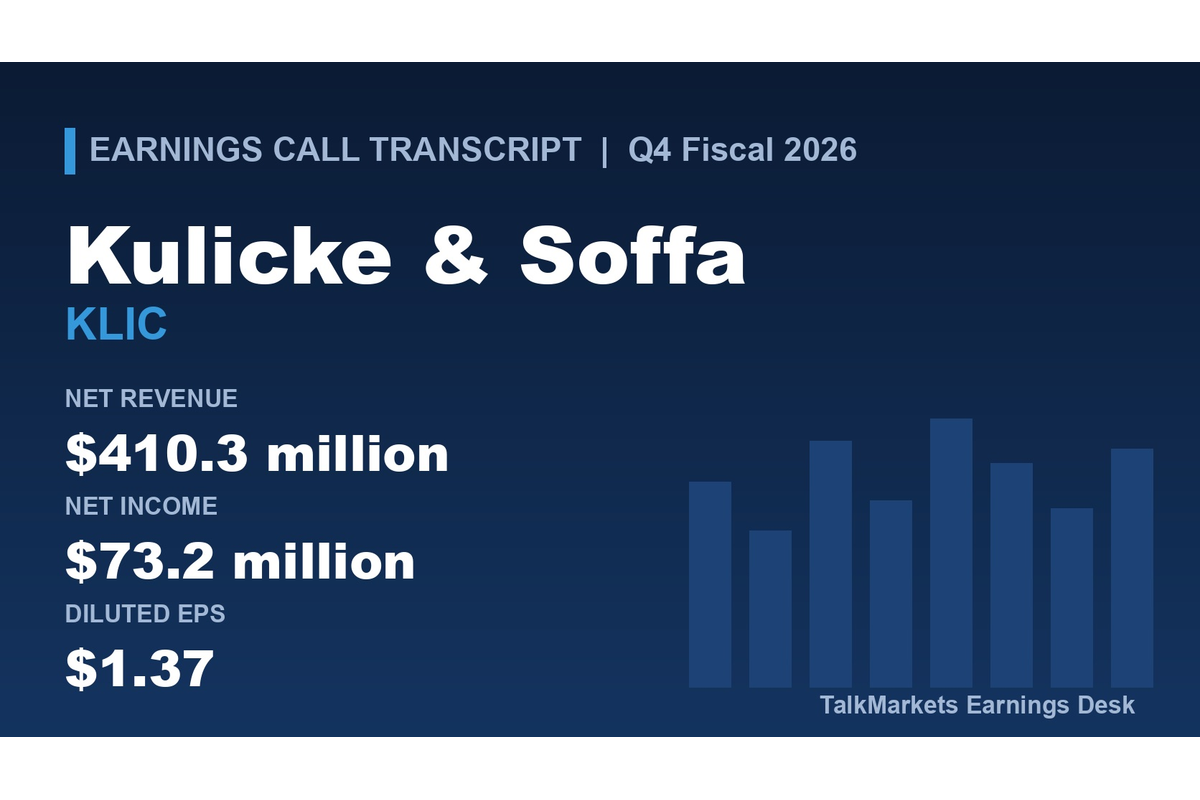
Kulicke & Soffa's fiscal Q4 2026 net revenue rose to $410.3 million from $177,558 thousand, and net income reached $73.2 million, or $1.37 per diluted share, against $6,379 thousand.
Ticker: KLIC
Kulicke and Soffa Industries, Inc. (KLIC) reported results on 18 November 2026 for its fourth fiscal quarter ended 3 October 2026. The semiconductor assembly equipment maker more than doubled revenue from a year earlier and also grew from the previous quarter's $330,409 thousand. The company said core wire bonding demand is resilient and its technology is evolving with AI, data centre and advanced packaging trends.
The key numbers (fourth fiscal quarter ended 3 October 2026)
Metric | This year | Last year | Change |
|---|---|---|---|
Net revenue | $410,281 thousand | $177,558 thousand | |
Gross profit | $195,959 thousand | $81,210 thousand | |
Income from operations | $87,151 thousand | $888 thousand | |
Net income | $73,233 thousand | $6,379 thousand | |
Diluted EPS | $1.37 | $0.12 | |
Non-GAAP diluted EPS | $1.52 | $0.28 |
Gross margin for the quarter was 47.8%, and the GAAP operating margin was 21.2% against 0.5% a year earlier. Non-GAAP net income was $81.4 million. GAAP cash flow from operations was $25.4 million and adjusted free cash flow was $14.6 million.
Buybacks and dividend
Kulicke & Soffa repurchased 35.0 thousand shares in the quarter at a cost of $3.1 million. Cash dividends declared were $0.205 per share for the quarter, the same as a year earlier.
Management
New President and CEO Raj Talluri called it a tremendous quarter, pointing to strong financial results and growing visibility in the Advanced Solutions portfolio. The company began Advanced Solutions system manufacturing on its newly completed Singapore production floor during the first quarter of fiscal 2027.
Full fiscal year
For fiscal 2026, net revenue was $1,182.9 million, against $654,081 thousand in fiscal 2025, and gross margin was 48.4%. Net income was $182.6 million, or $3.42 per diluted share, against $213 thousand, or $0.004 per share, a year earlier. Non-GAAP net income was $210.9 million, or $3.95 per diluted share.
GAAP cash from operations was $71.9 million and adjusted free cash flow was $50.2 million. The company repurchased 0.2 million shares for $10.4 million during the year, and cash, cash equivalents and short-term investments were $517.0 million at 3 October 2026.
Source: SEC Form 8-K Exhibit 99.1
Full call transcript
Operator:
Greetings, welcome to Kulicke & Soffa fourth quarter 2026 results conference call. At this time, all participants are in a listen-only mode. A question-and-answer session will follow the formal presentation. If anyone should require operator assistance, please press *0 on your telephone keypad. Please note this conference is being recorded. I will now turn the conference over to Joe Elgindy, Senior Director of Investor Relations. Thank you. You may begin.
Joe Elgindy (Senior Director of Investor Relations):
Welcome everyone to Kulicke & Soffa's fiscal fourth quarter 2026 conference call. Raj Talluri, Chief Executive Officer, and Lester Wong, Chief Financial Officer, both join me on today's call. Non-GAAP financial measures referenced today should be considered in addition to, not as a substitute for, or in isolation from our GAAP financial information. GAAP to non-GAAP reconciliation tables are included within our latest earnings release and earnings presentation. Both are available at investor.kns.com, along with prepared remarks for today's call.
In addition to historical statements, today's discussion contains forward-looking statements regarding our future performance and outlook. These statements are made under the Safe Harbor provisions of the Private Securities Litigation Reform Act of 1995 and involve risks and uncertainties that may cause actual results to differ materially. For a complete discussion of the risks associated with Kulicke & Soffa that could affect our future results and financial condition, please refer to our latest Form 10-K in upcoming SEC filings for additional information.
With that said, I would now like to turn the call over to Raj Talluri for the business and market overview. Please go ahead, Raj.
Raj Talluri (Chief Executive Officer):
Thank you, Joe. Good day, everyone. Since joining K&S as CEO on September 1, I've spent considerable time with our teams and key customers assessing our opportunities and sharpening our strategic priorities. I'm honored to join the company during its 75th anniversary and grateful to our board, Lester Wong, the executive team, and the broader K&S organization for their leadership through the transition. K&S is positioned at the intersection of AI infrastructure, electrification, and advanced packaging.
These transitions are expanding the relevance of our core interconnect technologies while accelerating adoption of our advanced solutions portfolio. Importantly, our growth is supported by multiple products, customers, and packaging transitions, not a single application or investment cycle. We expect our served available market to increase from approximately $2.7 billion in fiscal 2027 to more than $4.5 billion in fiscal 2030. I look forward to bringing greater attention to our highest value opportunities and leading the company through its next phase of growth.
Looking back at fiscal fourth quarter, four themes stand out, continued strength and evolution within our core wire bonding business, accelerating adoption of our advanced solutions, greater organizational focus on long-term strategic execution, and strong operational and financial execution. First, our core wire bonding technology remains essential to the market, but it is not static. The technology continues to support higher bandwidth, greater density, and more complex multi-die architectures.
As AI adoption drives continuous data center infrastructure expansion, it's creating a new wave of semiconductor unit growth, reinforcing the critical role of wire bonding across high-volume semiconductor production. Ball bonding sales increase 162% year over year, and we estimate that 75% of semiconductor package units deployed in the data center require wire bonding. Together, these factors demonstrate how AI infrastructure investment is benefiting both from our advanced packaging portfolio and our core high-volume business.
Within the wedge segment, recent pin and thermal solutions, which build on past K&S, power ribbon, and copper wire innovations, are now emerging to support more efficient power delivery and storage needs. Additionally, the broad adoption of compound semiconductors combined with the world's need for cleaner electricity and transportation is creating unique automotive and industrial advanced packaging requirements that expand the market for K&S.
Within the ball segment, stack-wire bonding was first deployed in NAND packages over 10 years ago as one of the first truly high-volume applications leveraging 3D die stacking. K&S technology helped enable this transition then and enjoys a strong market share today. We continue to prepare for a different but similar revolution which will unlock the performance and power efficiency improvements across LPDDR applications, leveraging our vertical wire bonding process. I will share some more points regarding this vertical wire transition shortly.
Wide-bonding remains an innovative, flexible, and resilient technology which is directly contributing to advanced packaging trends. I will now touch on a second topic, accelerating the demand for advanced solutions portfolio. Fluxless TCB is moving beyond initial deployment in the scale production and expanding across chip-on wafer and chip-on substrate and multiple customers. As TCB scales, panel-level packaging is now expanding our near-term opportunity while hybrid bonding provides an additional longer-term growth vector.
Advanced solutions revenue, excluding Project W, increased from $57.6 million in fiscal 2025 to $112.7 million in fiscal 2026, exceeding our prior forecast. As we scale operations to support growing customer adoption, we recently received industry recognition which further validates the technology leadership of our advanced solutions portfolio. Last month, at Semicon West, our innovative TCB program received the North America Semi Award, providing additional industry recognition of the technology leadership behind our advanced solutions portfolio. We are pleased to join the list of previous winners of this prestigious award.
In fiscal 2027, we expect to ship more than twice as many TCB systems as in fiscal 2026, generating $150 million to $200 million of revenue and expanding our install base by more than 50%. AI, heterogeneous, and HPC market trends are driving an emerging requirement for fluxless panel-level thermal compression within the chip-on-substrate market. Fluxless is enabling the chip-on-substrate process to evolve with advanced packaging, directly supporting larger, more complex, and higher bandwidth packaging architectures.
Today, our growing advanced solutions roadmap extends across chip-on-wafer substrate and panel-level processes, as well as hybrid bonding. Our chip-on-wafer and chip-on-substrate systems are ramping in production to support leading logic and photonics applications. Our future large panel and hybrid bonding systems further expand our reach into larger multi-dialogic assembly and next-generation memory applications. We've expanded the reach of Aptura, our leading TCB platform. We recently shipped industry's first panel-level fluxless TCB system, Aptura WSX, supporting substrate bonding engagements with two leading customers.
The platform expands our heterogeneous packaging capabilities and positions K&S to capture emerging panel-level opportunities as advanced architectures continue to rapidly evolve. According to the Yole Group, the served available market for ultra-high-density panel-level equipment is anticipated to grow at a 75% CAGR through 2031, creating a significant new opportunity for our advanced solutions portfolio. Our advanced solutions team also continues to actively develop a hybrid bonding platform in close collaboration with leading logic and memory customers.
We expect to ship our first hybrid system for a customer evaluation in fiscal 2027. To support this growing trajectory, I'm pleased to report that the expansion of our Singapore manufacturing footprint will more than triple advanced solutions capacity remains on schedule. During the first fiscal quarter, we initiated production within this new space and expect to gradually increase capacity over the coming quarters as planned. The expansion was initially designed to support approximately $400 million in annual advanced solutions revenue under our existing vertical integrated process.
I'm pleased to report that we now expect it can support nearly $500 million of annual revenue. Turning to our market overview, demand remains strong through a broad base of customers reflecting both technology transitions and capacity requirements. General semiconductor and memory markets are benefiting most directly from global data center expansion with K&S providing both technology and capacity solutions for this growing market need. We also see improving dynamics within automotive and industrial.
At this point, the fleet utilization across our ball-bonding install base is estimated at a healthy 90% highlighting the strength and breadth of the current demand. Demand remains broad based during September quarter and our teams continue to flex capacity across multiple product ramps despite ongoing supply chain constraints. Within general semiconductor, AI infrastructure investment is benefiting K&S through two distinct channels. First, it's increasing packaging complexity in leading edge logic and photonics supporting demand for advanced solution portfolio.
Second, the expansion of data center infrastructure is increasing demand for broad range of supporting memory, power management, connectivity, and general semiconductor devices, many of which continue to rely on high volume wire bonding. Memory represents another structural growth vector. We are building from an established leadership position in stack NAND while advancing vertical wire solution for next generation stack DRAM applications.
Vertical wire supports more direct interconnect paths in stack packages, helping customers increase bandwidth density while reducing packaging footprint and creating a more stable path to additional die stacking. Although memory revenue moderated sequentially from a strong fiscal third quarter, underlying customer engagement remains constructive. Customers continue to prioritize HBM capacity while actually preparing for next vertical wire transition in stack DRAM. To illustrate this transition, a leading memory customer that previously moved its LPDDR process to flip chip is now returning to wire bonding for upcoming LPDDR packages.
This architecture enables higher bandwidth, smaller footprint, and a more scalable path to additional die stacking. Within automotive and industrial, wedge segment sales increased approximately 65% sequentially, supported by improving demand across power semiconductors and EV related applications. While the end market remains below its long term average, customer activity and utilization indicate that a gradual cyclical recovery is underway. In parallel, our newer pin, terminal, and ribbon solutions are expanding our content opportunity as power devices become more complex.
Lastly, we continue to sharpen execution to enhance strategic success over the coming years. This included updates to our incentive compensation program to prioritize profitable growth and operational execution while linking leadership incentives to longer term strategic and financial targets which enhance shareholder value. Across our core markets and advanced solutions portfolio, we see multiple technology transitions creating opportunities for K&S well beyond the current AI investment cycle. AI is an important catalyst, but the broader opportunity is a long term shift towards increasingly complex heterogeneous packages.
Over the coming quarters, we intend to provide additional details for strategy and long term financial targets. With that said, I will now turn over the discussion to Lester, who will provide a brief financial update.
Chief Financial Officer:
Thank you, Raj. My remarks today will refer to GAAP results unless noted. Fiscal 2026 was a strong year for K&S. We made significant development progress, expanded customer engagement, and aggressively ramped up capacity to deliver excellent financial results. Full year revenue increased to approximately $1.18 billion, representing growth of approximately 81% over fiscal 2025. This performance reflects broad base strength across our core ball and wedge businesses, continued growth in memory and general semiconductor, and the scaling of our advanced solution portfolio.
Our business segments, R&D, operations, and supply chain teams remain in close coordination to support both our customers' immediate requirements and their future production plans. Higher revenue translated into a substantial improvement in profitability. For the full year, we deliver gross margins of 48.4%, GAAP earnings per share of $3.42, and non-GAAP earnings per share of approximately $3.95.
The improvement in earnings reflect higher production volume, improved factory utilization, and discipline execution while we continue to increase investment in customer program, manufacturing capacity, and the advanced packaging opportunities that are expected to support our next phase of growth. For the fiscal fourth quarter, we again deliver revenue above guidance as we continue to execute an aggressive production ramp across served markets. Revenue increased by 24% sequentially to $410.3 million, which represented a 131% improvement over the same period in the prior year.
This rapid increase demonstrates the responsiveness of our manufacturing model, the operating leverage potential, and the ability of our global teams to support multiple product ramps while navigating a dynamic supply chain environment. Fiscal fourth quarter non-GAAP EPS was $1.52 and represented a 26.7% sequential increase. Total operating expenses came in at $108.8 million on a GAAP basis and $99.8 million on a non-GAAP basis.
As explained last quarter, this sequential increase was related to variable sales incentives, employee incentive compensation, and investments necessary to support our growing base of new opportunities. Tax expense came in at $20.5 million, and we anticipate our effective tax rate will remain above 20% over the near term. Looking ahead, demand for our products remain robust. For the fiscal first quarter of 2027, we expect revenue of approximately $410 million plus or minus $20 million with gross margins of 48.5% plus or minus 100 basis points.
We typically experience a 5% to 15% sequential revenue decline in the December quarter. Against that seasonal pattern, our guidance for flat sequential revenue demonstrates the strength and breadth of current demand. This outlook exceeds our prior expectations and represents a 105% increase over the same period in the prior year. GAAP EPS is anticipated to be approximately $1.48, and non-GAAP EPS is anticipated to be approximately $1.65, each plus or minus 10%.
As Raj discussed, our advanced packaging opportunity set is expanding, and we are increasing resources selectively to support the programs with the greatest customer traction and long-term return potential. Considering this need, our outlook considers non-GAAP operating expenses of $89 million for the December quarter. We anticipate operating expenses will remain at this level through fiscal 2027. 8% of growth and advanced packaging transitions add diversification and consistency to all segments. We anticipate above average demand will continue through fiscal 2027. This concludes our prepared comments.
Operator, please open the call for questions.
Operator:
Thank you. If you would like to ask a question, please press star 1 on your telephone keypad. A confirmation tone will indicate your line is in the question queue. You may press star 2 if you would like to remove your question from the queue. And for participants using speaker equipment, it may be necessary to pick up your handset before pressing the star keys. Our first question is from TD Cowen. Please proceed.
Analyst (TD Cowen):
Hi. Thanks for taking my question, and congrats, Raj, and welcome to K&S. I had two questions. First one, I think Lester, you mentioned that, you know, with data centers, et cetera, you have extended visibility. Is there any way to think about how your revenues would trend beyond the December quarter? Should we assume it improves off of these higher levels?
Chief Financial Officer:
Well, I think, you know, as you know, we said that we're pretty confident in terms of the first half of the fiscal year. This is because we're seeing, you know, POs coming in as well as utilization rate, which is above 90% as well as the backlog, you know, doing quite well. And then I think Raj was just in China meeting a lot of our customers, and, you know, I think they continue to remain a bit bullish.
I think beyond that, the second half, I think the visibility is not as good. So I think it's probably a little bit too early to kind of talk about for the rest of the fiscal 2027.
Analyst (TD Cowen):
Got it. And then Lester, you know, when I look at your run rate levels today, it's kind of similar to your calendar 2021 peak, both from a revenue standpoint. Gross margins are similar, but opex and tax rate is higher. I'm just wondering, why wouldn't the gross margins be higher now versus calendar 21, especially given the fact that you don't have the China LED that you had back then. You have more of TCB mixed today, which is higher margins.
Why wouldn't the gross margins be higher compared to calendar 21?
Chief Financial Officer:
Gross margin is higher than 2021. Our gross margin back then was about 46% or so. I recall now we're around 48%. So I think we actually have done better in terms of gross margins since 2021. I think this is a factor of basically, you know, laser focus on cost reduction as well as, you know, also, you know, as you said, the product mix has changed a little bit.
Back then we had our, as you mentioned, we did have some LED, but also we had our SMT business unit, which the margins were not as good as, you know, our core business of ball bonder. And then obviously, Advanced Solution now is ramping up.
Analyst (TD Cowen):
Thanks, Lester. Thanks, Raj.
Operator:
Our next question is from Needham and Company. Please proceed.
Analyst (Needham & Company):
Hi, thanks for taking my question. Welcome aboard, Raj. Maybe a first high-level question to you. You know, I've been covering K&S for five years. Many of us have been here for a little bit longer. But wondering how you view KNS right now, you've been here for more than two months. And, you know, from our perspective, right, there are lots of new opportunities in Advanced Solutions. But on the other hand, a good part of the wire-bonding business is still pretty cyclical.
And that creates a little bit of difficulty for us to really forecast, et cetera. But how do you think about the business? How do you plan to grow the business knowing a good part of the story is still going to be quite cyclical if I'm not wrong? Thank you.
Chief Executive Officer:
Charles, thank you for the question and good wishes. Yeah, you know, it's been a couple of months since I've been here. And I spent quite a bit of time in the last couple of months visiting customers. You know, visited quite a few of our customers in China, visited all the leading IDMs like Intel and Micron, where I came from, you know, supplier conferences last week. You know, at the end of the week, I was at TSMC supplier conference.
I got a good feel for the business from our customers. You know, I'm actually very pleased and very excited to be here. The company has been done extremely well. Lester and the team have done a great job. And you can see the results for the year. You know, the ball-bonder business, yes, it is cyclical. But then, you know, most of semiconductor is, and I've spent 30 years in semiconductor. It's just the nature of the beast. The capital equipment may be a little bit more, but still.
The good news is that we are seeing, with the more recent, you know, demand growth in AI, you know, as I mentioned in the prepared remarks, you know, 75% of, you know, a lot of things in products in the data center itself are still using ball-bonders. So it's a continuous to grow as AI build out comes out. We have a strong product portfolio across wedge-bonders, ball-bonders, you know, with electrification, with industrial. You know, we have a secure demand that's not just in any one space.
So that part is very encouraging. Now, the AI, I think, is truly a great opportunity. And the technology mode we have there is pretty significant. You know, I spent some time in Fort Washington. You know, we are the only ones who can do, you know, fluxless with formic acid and plasma. And, you know, our products are already in high-volume production.
And what I see from visiting our customers is that that market is going to be, you know, really much bigger than maybe, you know, all of us think, you know, particularly with things like panel, with things like hybrid bonding. And we have now have products for both of those, and we have a strong roadmap. So I feel really good that the company has got a strong technology mode in the existing businesses, but also a great opportunity in the emerging space that's really taking off now.
And the company has been, you know, investing for a long time in the advanced solutions, but now it's really picking up. And as we showed in the numbers, we were able to double it from last year to this year. And we are talking about doubling the number of units shipped again next year. So really, really I'm thinking that will help all the investors feel good about our business.
Analyst (Needham & Company):
Thanks, Raj. Maybe this is a question for Lester. So every quarter we ask this question. Lester, are you able to provide some breakdown on the wire bonding utilization rates across different regions, across different locations for the last quarter? Thank you.
Chief Financial Officer:
Sure, of course, Charles. So utilization rate overall is at 90%. In China, it's around 93 or so. The rest of Asia is close to 90. Southeast Asia is also close to 90. Europe and North America are lagging a little bit, but they're also creeping out. And markets are concerned, general semi again is over 90. Memory is close to 90. Auto-industrial is lagging, but it has improved, and it's got to be close to 80% now.
Analyst (Needham & Company):
Thank you. I appreciate the color. Thanks.
Operator:
As a reminder, to star one on your telephone keypad, if you would like to ask a question, our next question is from Steelhead Securities. Please proceed.
Analyst (Steelhead Securities):
Yes, thanks for taking my question. I guess the first one is on your core business kind of growth outlook. You've highlighted how 75% of the parts in the data centers are still wire bonded. I think the growth rate of CPUs and GPUs, kind of the head of the snake, so to speak, is probably in the 50 to 75% range next year. Is there any reason to think that the peripheral chips like power and connectivity and storage and networking chips won't grow at that same rate?
Or maybe help us just understand what the pluses and minuses are of your core business growth rate for next year?
Chief Executive Officer:
Yeah, I think, as I mentioned, the demand we are seeing is secular across all of them. I think the data center, as you build more and more of this compute and, as you said, GPUs, very tremendous amount of power and tremendous amount of interconnects, tremendous amount of just the whole electrification of that. We are seeing a lot of growth there, and I feel like it will continue to grow in the same way that the other processing stuff grows, because you just need to provide that.
And in the prepared remarks, we also mentioned things like LPDDR6, now moving back to wire bonding. I think that's another great opportunity for us as we move forward. And I also think that right now, PC and phone markets are down because of the huge memory prices that are there. But that will normalize over time, and then we expect to see more growth there also. So in general, I feel like broad-based growth for our core business.
Analyst (Steelhead Securities):
Okay, you mentioned panel, and I was just wondering how the panel tool expands your revenue targets in 2027 for thermal compression bonding. Is this going to be a significant ramp for panel tools in 2027 or is it more 2028-oriented?
Chief Executive Officer:
Yeah, you know, panel to me is something that, again, like I mentioned, I just came back from some supplier conferences and meeting our customers. It is something that all our customers really want because, you know, as the dyes get bigger, it's just a geometry issue, right? So, you know, the dyes are typically square or rectangular, and it's really hard to pack a lot of them when you have a circular wafer.
So having a square panel, it just makes it more efficient to pack them, and you don't waste as much of the expensive wafer. So most of them really want us to build a panel, and I'm optimistic that the panel business will continue to grow. I mean, I think the key challenges there are, you know, we're talking about 300 by 300 to now 500 by 500 panels.
The panels keep getting bigger, which means that you need technology to precisely align the chips and handle the warpage, you know, maintain uniform heat, maintain bonding at the right level. So there's a lot of technical challenges there, and we have the technology, and I'm very optimistic with what our teams are able to do, and, you know, as I mentioned, with our press release, we shipped our first panel product now to two customers in Taiwan.
Exactly when it's going to ramp in 2027 or 2028 or 2029, it's hard to predict, but we start sending them. And I do think that our customers want to ramp them as quickly as they can just because of the advantages and the cost savings that they get. And these are much more expensive machines, by the way, because these are complex machines that we build bigger bond heads. So I do see that as this grows, it will be a nice business for us.
Analyst (Steelhead Securities):
Okay, final question for me is, I think in your prepared remarks and in your presentation you talked about a significant increase in your overall SAM from $2.7 to $4.5 billion by 2030. Could you maybe break out what the pieces of that increase are? Is it cores, is it advanced solutions, or what are the more significant contributions to that significant increase in the SAM?
Chief Executive Officer:
Advanced solutions is quite a bit of it, because clearly just the concept of this 3D chip stacking is really the way I feel like people are now looking towards getting higher performance because, as we talked about it, shrinking of the die itself in Moore's law is a little bit of limits in how much you can get. So I do believe that that part is growing fast and quite a bit. You know, I don't have the exact breakdown.
The team has it, but I do feel like the big part is advanced solutions.
Analyst (Steelhead Securities):
Thank you.
Operator:
Our next question is a follow-up from TD Cowen. Please proceed.
Analyst (TD Cowen):
Hi, thanks for taking my follow-up. If I had a question for you, you know, K&S historically you've always had a very strong cash balance, but historically the company has done mostly like bolt-on or tuck-in acquisitions. I'm just wondering, do you have a different philosophy, or do you plan to, you know, consider more bolt-on tuck-in, or would you rather do any kind of transformation of M&A if you see the right opportunity?
Chief Executive Officer:
I mean, it's a little bit early, like I've been here only a couple of months, but I do believe that we have great opportunity in, you know, advanced solutions, and that's where we see big growth. And our ball bonding, wedge bonding business are pretty solid, and we run them well. But, you know, if there is some way we can accelerate that, we're open to it. But again, I'm a little bit earlier, and I'm still, you know, understanding it. Maybe Lester, you want to comment?
Chief Financial Officer:
Yeah, so I think, you know, obviously since Raj joined, we're looking at all the different, you know, strategic initiatives going forward, and, you know, advanced solutions now, you know, our business unit has now picked up, you know, enough momentum, attraction, and sustainability. So I think we will continue to invest in it, as well as in our core business. But I think we are open, you know, to a transaction that makes sense, right?
And, you know, I think we mentioned it before, something adjacent, something along the advanced packaging, you know, supply chain, get us more mindshare and wallet share of our critical customers. So if those factors are met and valuation makes sense for us, I think we're definitely open to it.
Chief Executive Officer:
Yeah, I mean, just, you know, again, maybe just a little color. I've done a lot of, you know, in Qualcomm and other places, a lot of large acquisitions, you know, I did the CSR acquisition, but as Qualcomm, a couple of billion dollars, and we integrated it, and it's a lot of experience in this area. So, you know, how to do them, how to execute them well. You know, as Lester mentioned, if the right opportunity shows up, we wouldn't be shy to do it.
Operator:
Thank you very much, Raj, for that. We have reached the end of our question and answer session. I would like to turn the conference back over to Joe Elgindy for closing remarks.
Joe Elgindy (Senior Director of Investor Relations):
Thank you, operator, and thank you all for joining today's call. As always, please feel free to follow up directly with any additional questions. This concludes today's call. Have a nice day, everyone.
Comments
Log in or sign up to join the conversation.