

Economists are always looking to see what price adjustments are taking place, and one of the most important changes is now taking place in the currency markets. The external value of a domestic currency can speak volumes to what is happening at home and abroad. The first half of this year has featured important currency swings as trade wars, interest rate shifts and political developments all come into play.
(Click on image to enlarge)
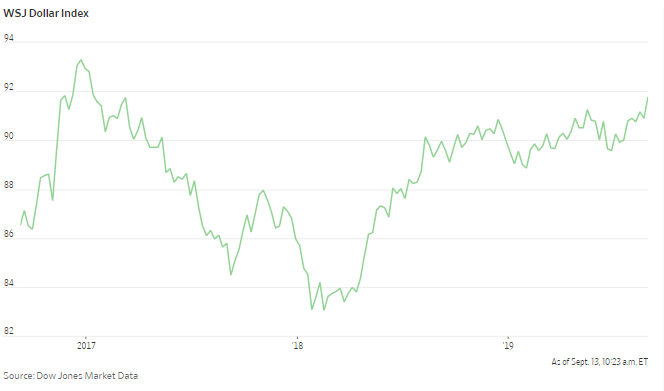
The surge in the US dollar index signals that currencies are playing the most significant role as countries adjust to changing circumstances. The USD has steadily climbed over the past year and is now about 7% higher. Running down a list of US trade partners whose currencies have adjusted, we note that:
- The Chinese Yuan has depreciated slowly, but steadily, in response to US tariffs; the Yuan has just touched an 11-year low ; arguing whether the Chinese authorities are manipulating the currency is really beside the point; the fall in the Yuan is helping to offset US tariffs and there is every reason to expect it to decline further;
- The Euro has steadily weakened as the continental nations slip into recession; yesterday’s announcement of a further drop in the ECB bank rate to minus 0.5% coupled with additional bond-buying will likely ensure further drops in the Euro; Germany has slipped into a technical recession and the political situation in Italy remains very uncertain;
- The Japanese Yen has been rather steady against the USD, however, there are indications that it, too, is slipping; reports out of Japan are suggesting that the Bank of Japan is considering dropping its bank rate further into negative numbers in response to a sluggish economy;
- UK Sterling is totally dominated by the political machinations involving Brexit; regardless of the outcome of the current crisis, we can expect that the British economy will continue to languish, forcing the hand of the Bank of England to cut rates, further weakening the pound;
- Canadian Dollar remains relatively strong as the Bank of Canada continues to maintain that there is no need to cut rates; but the Bank of Canada is running the risk that a strong loonie will hurt the trade sector; the longer Canadian interest rates remain at these levels, the more likely the loonie will experience a sharp downward adjustment; and,
- Emerging market currencies such as India, Turkey, and Indonesia have recently lowered their interest rates and currency depreciations followed immediately.
So, the currency stars are not aligned in favor of a more competitive USD. In addition, the US long term rates have bounced higher over the last couple weeks which will likely put more upward pressure on the dollar, as overseas investors seek higher returns. The US Administration is learning that trade wars are not so easy to win, especially when your adversaries are able to use currency adjustments to offset tariffs.



Comments
Log in or sign up to join the conversation.