JP Morgan raised its S&P 500 target to 8,000, betting on earnings growth over valuation expansion.
A stock market rally usually comes from investors paying more for every dollar of earnings, from the earnings themselves growing, or some combination of the two. JP Morgan (JPM) just raised its S&P 500 target to 8,000 while keeping its forward valuation assumption around 20 times earnings. In other words, the bank is not counting on another big round of multiple expansion to get there. The upside in its forecast is coming from stronger earnings, with improving cloud growth and AI backlogs at the major technology companies helping support that case.
Main Note
Earning The Multiple
Verdict: The story is moving from a speculative bet on artificial intelligence infrastructure to a requirement for measurable earnings and cash flow. JP Morgan is not counting on another big round of multiple expansion to reach 8,000. Instead, the higher target depends much more heavily on stronger earnings, with improving cloud growth and AI demand at the major technology companies helping support that case.
What happened
JP Morgan raised its S&P 500 year end target to 8,000 from 7,800. The bank also lifted its 2026 earnings per share forecast for the index to $365, representing roughly 35% annual growth. It raised its 2027 estimate to $420.
This is not just another target bump. The bank specifically maintained its forward valuation multiple target at 20 times earnings. JP Morgan pointed to higher interest rates, geopolitical tensions and increased equity and debt issuance as reasons not to assume another big round of multiple expansion. Instead, the higher target depends much more heavily on corporate America continuing to deliver strong earnings growth.
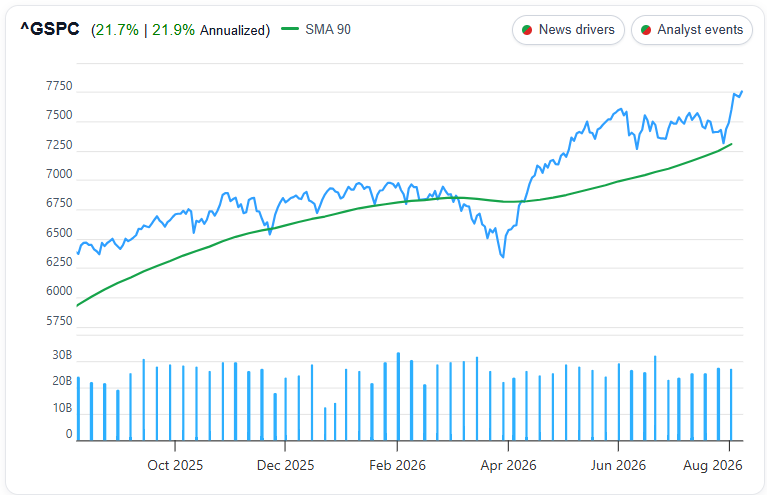
S&P 500 1 Year Price Chart
Why it matters
For the past year, investors have been willing to look past enormous artificial intelligence spending because demand appeared strong. Now the bar is getting higher. These companies need to turn that infrastructure into enough revenue, earnings and cash flow to justify the investment while also absorbing much heavier depreciation expense over time.
What changed in the thesis
The story is moving from simply rewarding artificial intelligence infrastructure spending to asking whether that spending produces enough revenue, cash flow and returns to justify it. JP Morgan is still using about a 20 times forward multiple, so its higher 8,000 target comes from stronger earnings expectations rather than assuming investors will pay an even richer valuation. The hyperscalers matter a lot because cloud growth and backlogs are improving, but the call still depends on broader corporate earnings holding up.
What the market may be missing
The market may be overly focused on the sheer dollar amount of capital expenditures while underestimating how quickly customer demand is showing up. Cloud revenue, operating income and backlogs are all growing quickly, which is evidence that the spending is tied to real demand. But the cash cost of the buildout is enormous. Microsoft is still producing substantial free cash flow, while Alphabet and Amazon have recently seen free cash flow pressured heavily by infrastructure spending. The demand story is getting stronger, but investors still need to see attractive returns on all of this capital.
Valuation and expectations
Keeping the forward multiple around 20 times makes earnings delivery much more important. If earnings growth disappoints, especially at some of the largest companies in the index, the 8,000 target becomes harder to justify. The market could still trade at a higher multiple, but JP Morgan is not relying on that happening in its forecast.
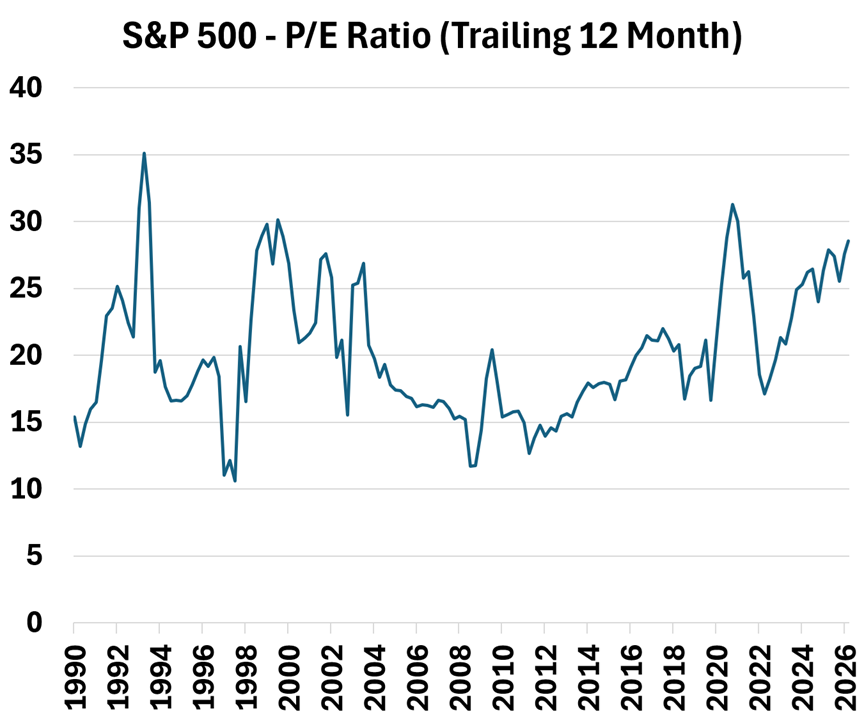
S&P 500 PE Ratio (1990 - 2026)
Bottom line
The market environment is transitioning from building the infrastructure to selling the service. As long as cloud revenue grows fast enough to offset the data center spending, the broad market can drift higher. But the margin for error is shrinking rapidly.
Pre Market Pulse
Stock futures traded modestly higher early Monday, building on Friday momentum.
The 10 year US Treasury yield hovered around 4.60% to 4.65% after dropping last week on soft employment data.
Brent crude oil traded up slightly around $84 per barrel as markets watched shipping tensions in the Strait of Hormuz.
Why it matters this morning
The combination of resilient equities and a 10 year Treasury yield around 4.64% remains supportive for valuations, but it is not a free pass. If yields stay contained, investors have less pressure to mark down the price they are willing to pay for future earnings. But rising oil prices still threaten that stability if they push inflation back up and send yields higher again.
Azure and other cloud services revenue grew 43% in the latest quarter as commercial remaining performance obligations reached $678 billion. Microsoft still generated $19.6 billion of free cash flow even after spending $35.8 billion in cash on property and equipment, giving investors more evidence that its enormous cloud and AI buildout is already being supported by growing demand.
Google Cloud revenue jumped 82% to $24.8 billion. That growth validates the demand story, though the company doubling its quarterly capital expenditure to $44.9 billion pushed its free cash flow into a deficit.
AWS revenue expanded 37% to $42.2 billion, marking its fastest growth pace in 18 quarters. The unit saw operating income rise to $16.6 billion, helping offset concerns about future infrastructure spending.
Group takeaway
The leading cloud providers have a major advantage in scale. Microsoft, Alphabet and Amazon can invest tens of billions of dollars per quarter while serving enormous existing customer bases, and their latest cloud growth and backlog numbers suggest demand is keeping pace. The question now is whether those massive investments ultimately generate returns high enough to justify all of the capital going into them.
What to Watch
The US Consumer Price Index report on Wednesday, focusing on core inflation and tariff sensitive categories.
The Producer Price Index on Thursday for another look at inflation pressures further up the supply chain.
Earnings from Applied Materials (AMAT), Cisco (CSCO) and CoreWeave this week for additional clues about artificial intelligence infrastructure demand.
Bottom line
The math for 8,000 gets much easier if earnings keep beating expectations and the 10 year yield stays contained. A hotter inflation report that pushes yields sharply higher would put pressure on the roughly 20 times forward valuation JP Morgan is using, while weaker earnings would attack the other side of the equation. That is why both inflation and earnings matter from here.
Disclosure:
At the time of publication, the author holds a long position in Microsoft (MSFT) and Alphabet (GOOGL). The author has no position in the other securities mentioned. The author does not plan to initiate or change a position within 72 hours of publication. The author was not compensated by any company mentioned in this article.
Disclaimer:
InvestorsGrow and the Morning Note are published for informational and educational purposes only. Nothing in this email or on InvestorsGrow.com should be considered personalized investment, financial, legal, tax, or accounting advice, or a recommendation to buy, sell, or hold any security. The content is general in nature and does not take into account your investment objectives, financial situation, risk tolerance, or individual needs. Investing involves risk, including the possible loss of principal. Past performance is not indicative of future results. Opinions are as of the publication date and may change without notice. Data and information are believed to be reliable but are not guaranteed. The author, InvestorsGrow, affiliates, and/or contributors may hold, buy, or sell securities discussed. Article-specific positions, compensation, or conflicts are disclosed where applicable. You are solely responsible for your own investment decisions and should conduct your own research and consult a qualified professional before making financial decisions.




Comments
Log in or sign up to join the conversation.