

Just a few short months ago, I was writing about the tight job market and the fact that the number of job openings continued to exceed the number of those unemployed. This had been the case since February 2018, and was a sign of a strong economy. How quickly the tide can go out.
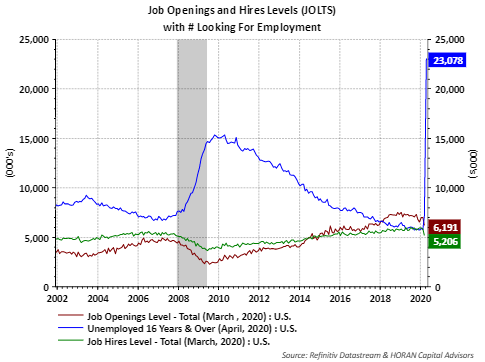
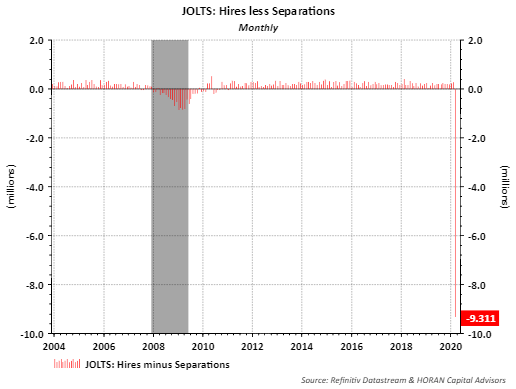
Friday, May 15's Job Openings and Labor Turnover Survey (JOLTS) reported that total separations increased by 8.9 million to 14.5 million in March. Separations include quits (those individuals leaving voluntarily, layoffs, discharges, etc.). Job openings declined to 6.2 million, and hires declined to 5.2 million. Simply looking at the difference between hires and separations in the below chart speaks volumes about the need to get the economy up and running again.
The significant employment contraction is also seen in the participation rate for various age cohorts normalized to February 2008. Even through the Great Financial Crisis (GFC), the 55 years & over age group maintained a steady rate of employment.
The extended "U-shaped" employment recovery after the financial crisis for most age groups is seen in the chart below. Before the onset of the virus shutdown, all but the 16 to 24 year old group was near, or exceeded, the 2008 employment level. Clearly, the last few months have seen a reversal of these employment gains.
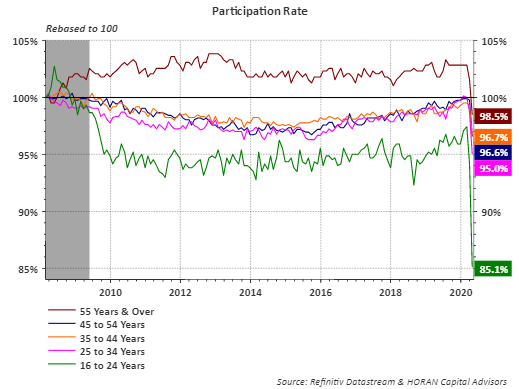
In looking at the absolute participation rate for each age cohort, only the 45 to 54 year old group has stayed near the level reached at its GFC low, after its trough in 2015. The debate now is how quickly these employees are called back to work or find alternative positions.
A broad "U-shaped" employment recovery does not seem to be reflected in current stock prices; however, we believe some industries experience a quicker "V-shaped" recovery, while others experience a more protracted "U-shaped" recovery.


Comments
Log in or sign up to join the conversation.