

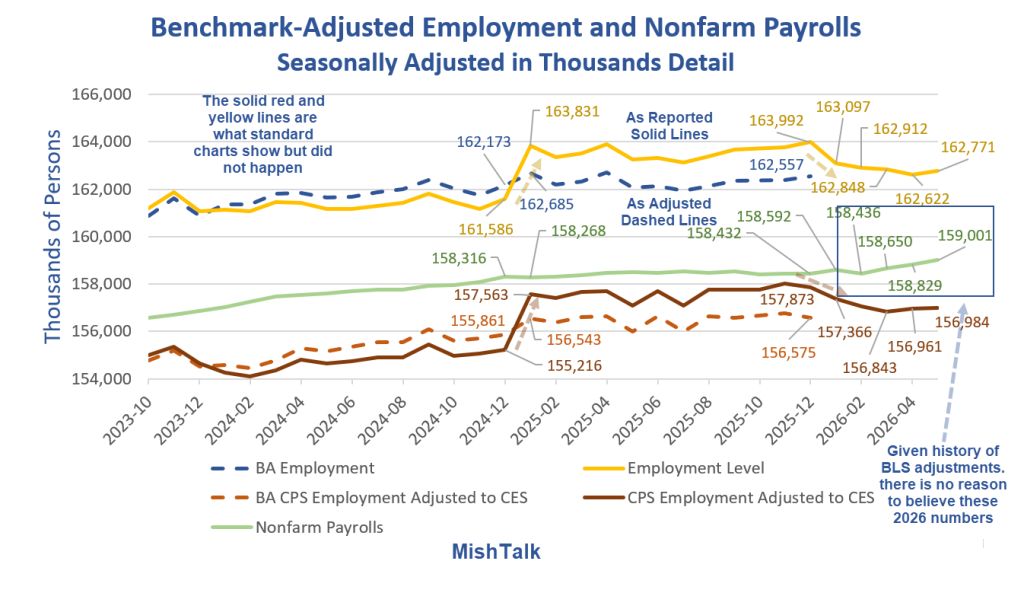
Nonfarm payrolls, employment levels, and adjusted levels, all by the BLS.
Understanding the Lead Chart
If you have seen this explanation, please skip to down to the subtitle “My Charts” to continue reading.
Every January (typically), the BLS has annual revisions to nonfarm payrolls and household population employment. The BLS does not back revise the household charts.
Because the BLS does not back revise, we see ridiculous numbers such as employment rising by over 2 million in a month (first yellow arrow).
To correct for the population adjustments, the BLS provides an adjustment series to normalize employment levels to match nonfarm payrolls. The BLS calls this “experimental” data but the regular posted data is admitted nonsense.
The experimental series is LNS16000000, “Employment Adjusted to CES Concepts“.
For 2024, the BLS admits that it undercounted employment by 2 million. Instead of parsing that out in the correct months, the BLS plowed the entire adjustment into January of 2025.
For 2025, the BLS admits that it overcounted employment by 1.4 million. Instead of parsing that out in the correct months, the BLS plowed the entire adjustment into January of 2026.
We did not suddenly add 2.245 million jobs in January of 2025, all US-Born. (Difference between the dashed blue line and the yellow line).
Moreover, there is no valid historical data on full vs parttime employment, on foreign born employment, and many other BLS data series. And there won’t be. There are no back adjustments key data components.
All posts on foreign-born employment, parttime employment, etc., suffer this flaw. All year-over-year (or December-to January) analysis you find on these stats is permanently flawed.
2025 Experimental Data
In April, the BLS released Experimental series accounting for January 2026 population control effects.
(Official CPS estimates for December 2025 and earlier months have not been revised, in accordance with usual practice.)
Experimental Series
In 2025, BLS produced new experimental time series measures to account for the size and timing of the large population changes reflected in the January 2025 population control adjustment.
The experimental series use the monthly time series (back to April 2020) available from the Census Bureau’s Vintage 2025 population estimates that form the basis of the January 2026 CPS population control adjustment.
The experimental series are smoother over time, as they do not show the annual effects of the population control adjustments that occur each January in the official series.
The experimental series adjusts data back to April 2020, the decennial census reference point.
Standard vs More Accurate Experimental Data
Between December 2024 and January 2025, the standard data shows an increase of 2,245,000. The adjusted data shows a gain of 692,000.
For December 2025, the employment level is a reported 163,992,000 vs the adjusted data at 162,557,000.
By December 2025, the standard data employment level was overstated by 1,365,000. That did not happen in a single month. It was the result of cumulative months of bad data every month for a full year.
All standard year-over-year household data comparisons are nonsense. Comparisons between January and December of the prior year are also invalid.
My Charts
I will continue to use what the BLS refers to as “experimental data” because the official series household data is admitted nonsense.
Here are the latest, and undoubtedly wrong monthly job report details.
Monthly Job Report Details
Nonfarm Payroll: +172,000 to 159,001,000 – Establishment Survey
Civilian Non-institutional Population: +99,000 to 275,054,000
Civilian Labor Force: +83,000 to 170,078,000 – Household Survey
Participation Rate: +0.0 to 61.8% – Household Survey
Employment:+149,000 to 162,771,000 – Household Survey
Unemployment: -66,000 to 7,307,000 – Household Survey
Baseline Unemployment Rate: +0.0 to 4.3% – Household Survey
Not in Labor Force: +17,000 to 104,976,000 – Household Survey
U-6 unemployment: -0.1 to 8.1% – Household Survey
Nonfarm Payrolls Change by Sector
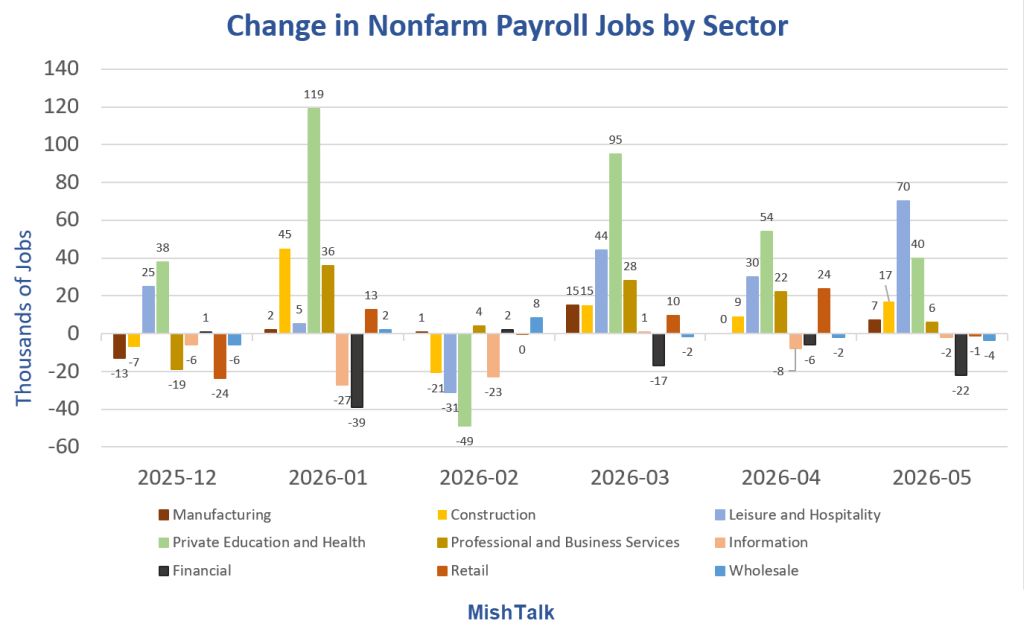
BLS Change in Nonfarm Payrolls by Sector
Nonfarm Payrolls Change by Sector in Thousands
Nonfarm Payrolls: +172
Manufacturing: +7
Construction: +17
Leisure and Hospitality:+70
Private Education and Health Care: +40
Professional and Business Services: +6
Information: -22
Financial: -1
Retail: -4
Wholesale: -4
Government: +52
Government Jobs Breakdown
State: -4
Federal: +1
Local: +55
Monthly Revisions
The change in total nonfarm payroll employment for March was revised up by 29,000, from +185,000 to +214,000
The change for April was revised up by 64,000, from +115,000 to +179,000.
With these revisions, employment in March and April combined is 93,000 higher than previously reported.
This is a rare upward revision to jobs.
Part-Time Jobs
Involuntary Part-Time Work: -137,000 to 4,805,000
Voluntary Part-Time Work: +147,000 to 22,853,000
Total Full-Time Work: -69,000 to 134,173,000
Total Part-Time Work: +266,000 to 28,679,000
Multiple Job Holders: -6,000 to 8,428,000
The above numbers never total correctly due to the way the BLS makes seasonal adjustments. I list them as reported.
These numbers are highly unreliable for reasons noted above. Year-over-year comparisons are invalid, period.
Hours and Wages
Average weekly hours of all private employees was flat at 34.3 hours.
Average weekly hours of all private service-providing employees was flat at at 33.2 hours.
Average weekly hours of manufacturers was flat hours to 40.4 hours.
A tenth of an hour does not sound like much. But multiplied across 158 million, that’s a lot of hours.
Of course, this data is only as good as the data collection.
Hourly Earnings
This data is also frequently revised. Here are the numbers as reported this month.
Average Hourly Earnings of All Nonfarm Workers rose $0.12 to $37.53. A year ago the average wage was $36.28 That’s a gain of 3.4%.
Average hourly earnings of Production and Nonsupervisory Workers rose $0.11 to $32.23. A year ago the average wage was $31.20. That’s a gain of 3.3%.
Unemployment Rate
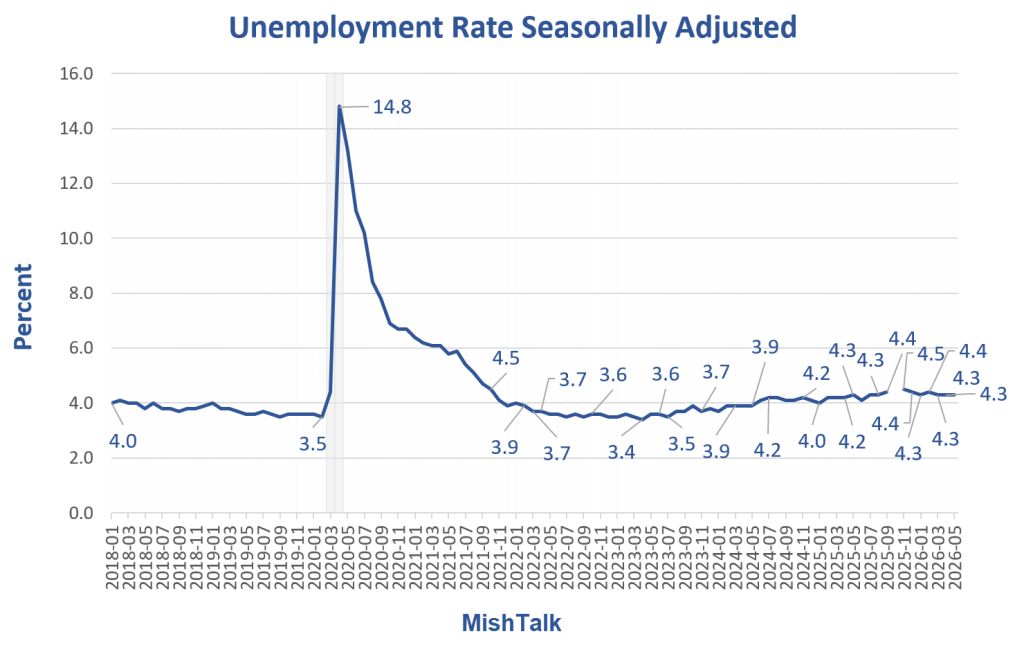
Unemployment rate seasonally adjusted, data from BLS, chart by Mish
Alternative Measures of Unemployment
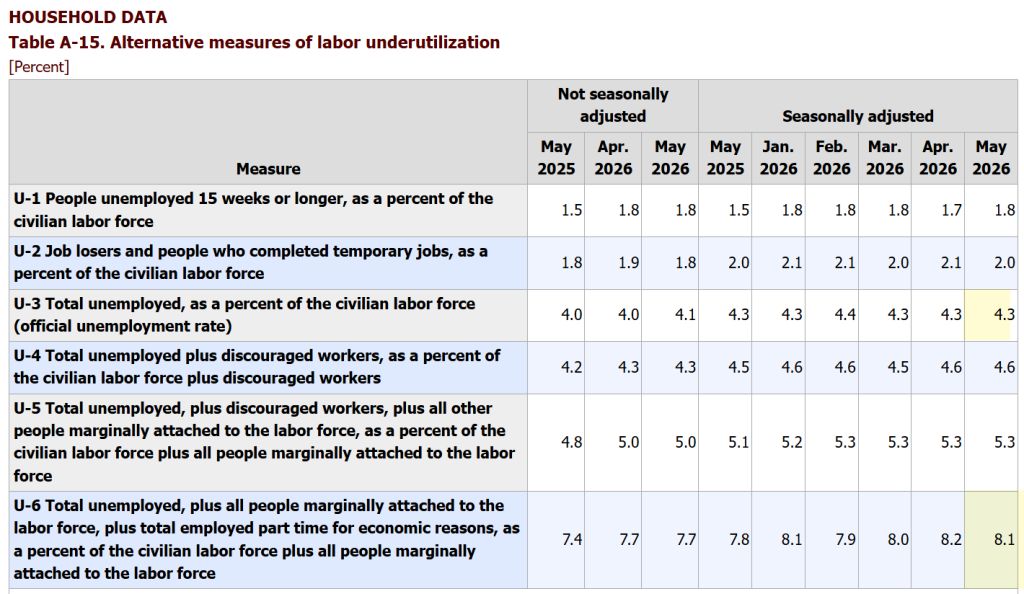
Table A-15 is where one can find a better approximation of what the unemployment rate really is.
The official unemployment rate is 4.3 percent.
U-6 is much higher at 8.2 percent.
Both numbers would be way higher still, were it not for millions dropping out of the labor force over the past few years.
Some of those dropping out of the labor force retired because they wanted to retire. Some dropped out over Covid fears and never returned. Still others took advantage of a strong stock market and retired early.
The rest is disability fraud, forced retirement (need for Social Security income), and discouraged workers.
The entire series is flawed by non-applied annual benchmark revisions.
The series is also flawed by poor response rates, deportations, illegals not answering phones, sampling errors and non-sampling errors.
Birth Death Model
Starting January 2014, I dropped the Birth/Death Model charts from this report.
The birth-death model pertains to the birth and death of corporations not individuals except by implication.
For those who follow the numbers, I retain this caution: Do not subtract the reported Birth-Death number from the reported headline number. That approach is statistically invalid.
Birth-Death Methodology Explained
I gave a detailed explanation of the model and why the usual calculation is wrong in my June 8, 2024 post How Much Did the BLS Birth-Death Adjustment Pad the May Jobs Report?
I repeat, do not subtract the birth-death number from the headline number.
Household Survey vs. Payroll Survey
The payroll survey (sometimes called the establishment survey) is the headline jobs number. It is based on employer reporting.
The household survey is a phone survey conducted by the BLS. It measures employment, unemployment and other factors.
If you work one hour, you are employed. If you don’t have a job and fail to look for one, you are not considered unemployed, rather, you drop out of the labor force.
Foreign-Born Employment
The numbers in my charts are seasonally adjusted. Foreign born employment is not adjusted, compounding comparison errors.
And we have no BLS revised data for foreign born employment. So, all such foreign and US-born comparisons with BLS data remain nonsense.
A second major problem with foreign-born employment is the BLS makes no distinction between US citizens who were foreign born and genuine foreign workers.
More Huge Negative Revisions Are Coming
Q: How do we know that?
A: Highly accurate but lagging QCEW and Business Employment Dynamics (BED) data show what’s coming.
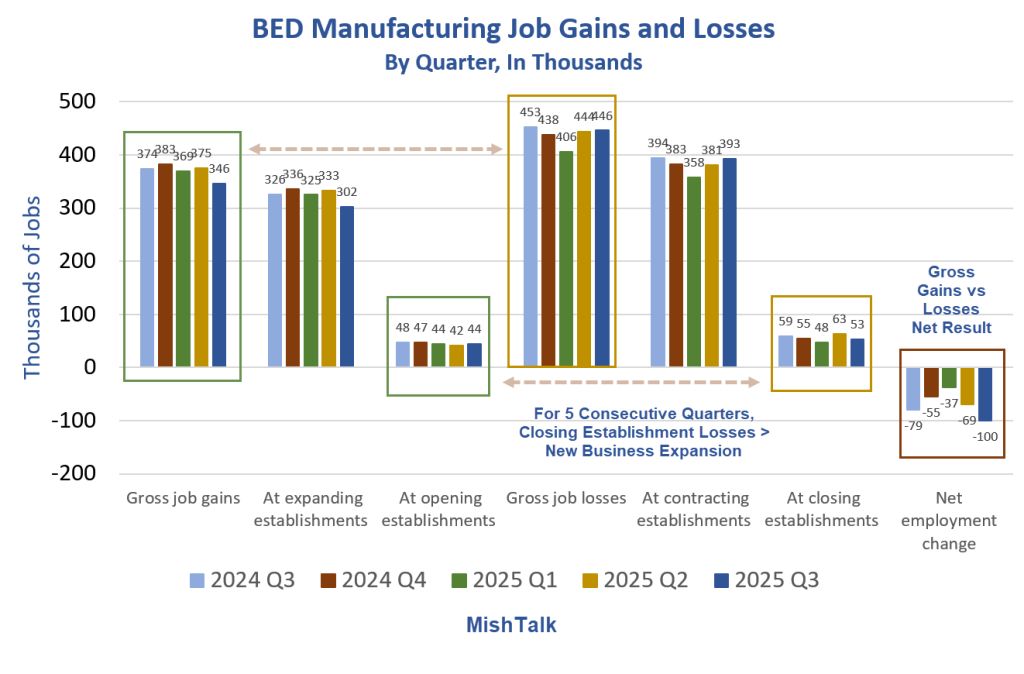
For details, please see my May 4 post Net Job Creation by New Businesses Is Negative Once Again
More jobs are lost in closing businesses than gained in new businesses.
The Business Employment Dynamics (BED) data shows a net loss of 159,000 jobs for 2025 Q3 and a net loss of 321,000 jobs for 2025 Q2.
Negative numbers are not the norm outside of recessions.
The BED and QCEW reports are very accurate but lagging. This is why we know more negative revisions are coming.
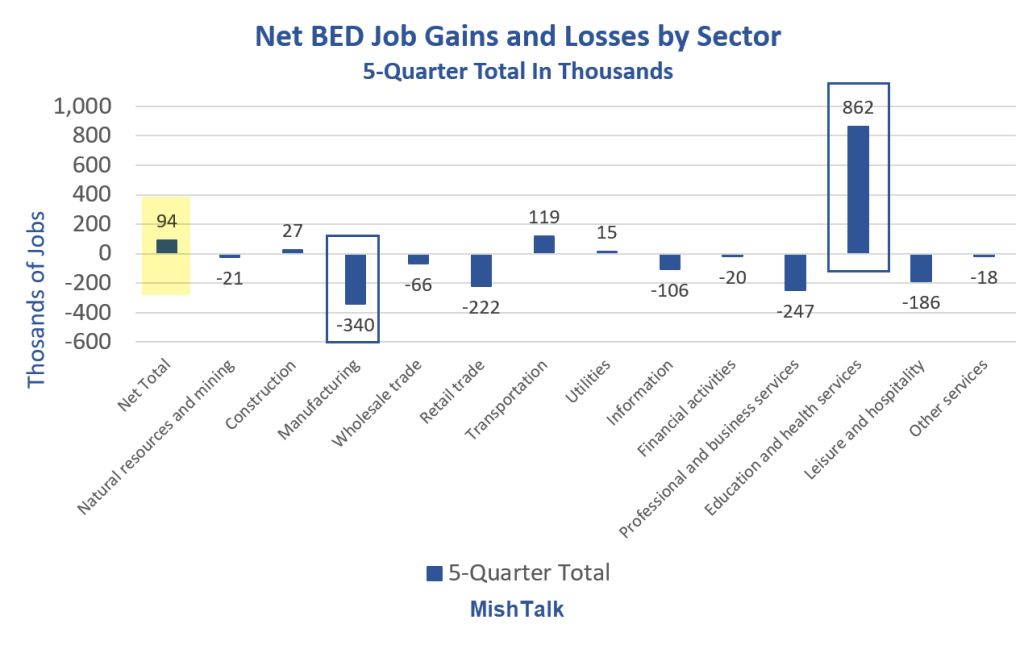
Also note Manufacturing Is the Biggest Net Loser in Jobs, 5 Quarters Total
Here’s a breakdown of BLS Business Employment Dynamics (BED) by sector.
For more manufacturing charts click on the above link.
Final Thoughts
The BLS monthly data is garbage.I do the best with BLS data that I can, or anyone can.
The quarterly QCEW and Business Employment (BED)reports represent a 96 percent sample. But those reports lag by about 5 months.
The QCEW reports have been hugely negative and there is every reason to believe QCEW trends will continue.
The Birth-Death model that feeds the monthly jobs report is bogus. It has been screwed up since Covid, first underreporting jobs then overreporting them.
QCEW and BED data show more jobs are now being lost in closing businesses than gained in new businesses.
Annual revisions have been lower for two consecutive years. And the QCEW and BED reports show more negative revisions are likely. See links below.
Perhaps today’s report is accurate, but there is no valid reason to believe so.
Related Posts
February 11, 2026: BLS Revises Nonfarm Payrolls for 2025 Lower by 1 Million Jobs
For the second year, the BLS annual benchmark revision was hugely negative.
February 27, 2026: BLS Private Payrolls for 2025 Q2 Overstated by ~847,000
The Business Employment Dynamics report shows -321,000 vs Payroll report +526,000. Believe BED.
May 4, 2026: Net Job Creation by New Businesses Is Negative Once Again
More jobs are lost in closing businesses than gained in new businesses.
May 5, 2026: Manufacturing Is the Biggest Net Loser in Jobs, 5 Quarters Total
Here’s a breakdown of BLS Business Employment Dynamics (BED) by sector.

Comments
Log in or sign up to join the conversation.