

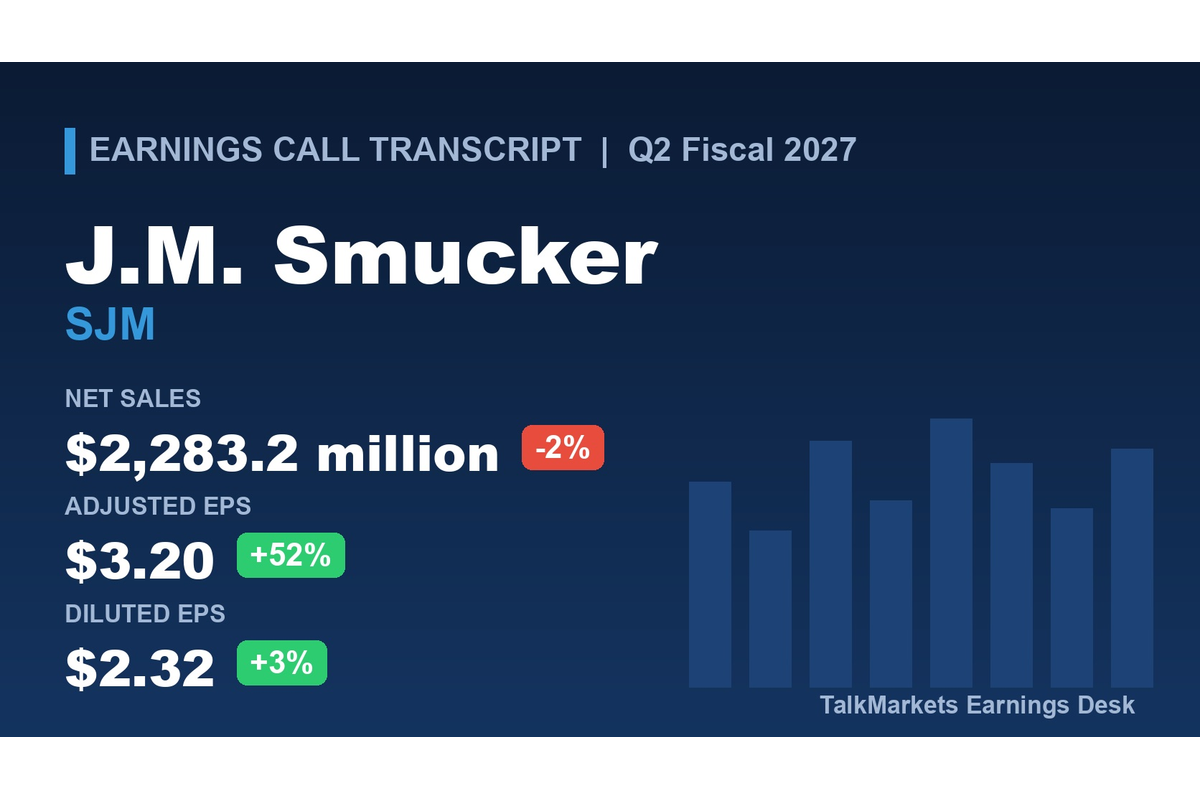
J.M. Smucker's fiscal Q2 2027 net sales fell 2 percent to $2,283.2 million, while adjusted EPS rose 52 percent to $3.20, helped by tariff refunds. Diluted EPS rose to $2.32 from $2.26.
Ticker: SJM
The J.M. Smucker Co. (SJM) reported results on 24 November 2026 for the second quarter of fiscal 2027, the three months ended 31 October 2026. The maker of Folgers coffee, Uncrustables sandwiches and pet snacks saw sales slip on lower net pricing for coffee and dog snacks, but adjusted profit rose sharply. Gross profit included $30.5 million of tariff refunds received in the quarter, worth $0.22 of adjusted EPS.
The key numbers (three months ended 31 October 2026)
Metric | This year | Last year | Change |
|---|---|---|---|
Net sales | $2,283.2 million | $2,330.1 million | -2 percent |
Operating income | $410.7 million | $418.5 million | -2 percent |
Adjusted operating income | $534.6 million | $394.3 million | +36 percent |
Net income | $248.7 million | $241.3 million | +3 percent |
Diluted EPS | $2.32 | $2.26 | +3 percent |
Adjusted EPS | $3.20 | $2.10 | +52 percent |
Gross margin was 38.2 percent against 37.3 percent a year earlier. Cash provided by operating activities was $293.8 million against $346.5 million, and free cash flow was $203.8 million against $280.2 million.
Results by segment
U.S. Retail Coffee: net sales of $807.9 million, down 5 percent, with segment profit up 96 percent to $302.9 million.
U.S. Retail Frozen Handheld and Spreads: net sales of $491.4 million, up 7 percent on higher Uncrustables volume, with segment profit up 12 percent to $113.9 million.
U.S. Retail Pet Foods: net sales of $405.8 million, down 2 percent, with segment profit down 17 percent to $103.2 million.
Sweet Baked Snacks: net sales of $231.0 million, down 10 percent, with segment profit up 54 percent to $33.5 million.
Away From Home: net sales of $220.3 million, down 5 percent, with segment profit down 18 percent to $48.9 million.
Dividend
Dividends declared were $1.12 per share in the quarter, up 2 percent from $1.10. The company also increased its full-year fiscal 2027 adjusted EPS outlook.
CEO Mark Smucker said: "Net sales and adjusted earnings per share exceeded our expectations in the quarter, reflecting the strength of our differentiated portfolio."
Six months so far
For the six months ended 31 October 2026, net sales rose 1 percent to $4,502.5 million, and net income was $573.0 million against $197.4 million.
Source: SEC Form 8-K Exhibit 99.1
Full call transcript
Prepared management remarks
Crystal Beiting (Vice President, Investor Relations and FP&A):
Good morning. This is Crystal Beiting, Vice President, Investor Relations and Financial Planning and Analysis for The J. M. Smucker Company. Thank you for listening to our prepared remarks on our fiscal 2027 second quarter earnings call. After this brief introduction, Mark Smucker, Chief Executive Officer, President and Chair of the Board, will provide a business and strategy update.
Tucker Marshall, Chief Financial Officer and Executive Vice President, Frozen Handheld and Spreads and Sweet Baked Snacks, will then provide a detailed analysis of the financial results and our updated fiscal year 2027 outlook. Later this morning, we will hold a separate, live question-and-answer webcast.
During today's discussion, we will make forward-looking statements that reflect our current expectations about future plans and performance. These statements rely on assumptions and estimates, and actual results may differ materially due to risks and uncertainties. Additionally, please note we will refer to non-GAAP financial measures management uses to evaluate performance internally. I encourage you to read the full disclosure concerning forward-looking statements and details on our non-GAAP financial measures in this morning's press release.
Today's press release, a supplementary slide deck summarizing the quarterly results, management's prepared remarks, and the Q&A webcast can all be accessed on our Investor Relations website at jmsmucker.com.
We invite all interested parties to join us at 9:00 am Eastern Standard Time today for a live question-and-answer session with management to further discuss our second quarter results and outlook for fiscal year 2027.
Please contact me if you have any additional questions after today's question-and-answer session. I will now turn the discussion over to Mark Smucker.
Mark Smucker (Chief Executive Officer, President and Chair of the Board):
Thank you, Crystal, and good morning, everyone.
We are pleased with our second quarter results and the momentum of our portfolio through the first half of the fiscal year. Net sales and adjusted earnings per share exceeded our expectations, reflecting continued consumer demand for our brands and disciplined execution across the organization. Consumers continue to seek trusted brands that deliver quality, value, and convenience, and our portfolio is well positioned to meet those needs.
Our performance reflects the strength of our differentiated portfolio, the progress we are making on our strategic priorities, and the investments we continue to make in our brands and capabilities. Based on our second quarter performance and expectations for the balance of the year, we are raising our full-year adjusted earnings per share outlook.
These results reinforce our confidence in the business and demonstrate the significant progress we continue to make on our three strategic priorities: driving organic volume growth across our key platforms, improving profitability and accelerating earnings growth for the Company, and maintaining a disciplined approach to capital deployment.
Let me begin with our first strategic priority: driving organic volume growth across our key platforms. We continue to prioritize resources behind the Uncrustables®, Café Bustelo®, Meow Mix,® and Milk-Bone® brands, which represent our largest growth opportunities.
Beginning with Uncrustables®, the brand delivered 15% net sales growth at the total Company level, driven by a double-digit increase in volume/mix. The brand achieved record quarterly volume, net sales, and household penetration, reflecting the strength of our proven brand-building model, continued distribution gains, and consumer-led innovation.
The Uncrustables® brand is now the number two brand in the total freezer aisle in the latest 13-week period, and net sales is growing faster than we anticipated. In the second quarter, net sales accelerated sequentially for the brand and exceeded our expectations. Demand is exceeding our available supply and we are now capacity constrained. As previously shared, the second phase of our McCalla, Alabama, facility remains on track to come online toward the end of fiscal year 2027, bringing additional capacity to support the brand's continued growth.
We expect the Uncrustables® brand to deliver net sales growth in the second half of fiscal 2027 and approximately 10% growth for the full year at the total Company level.
Even after surpassing $1 billion in annual net sales, the Uncrustables® brand continues to achieve record results and attract new households. As we bring additional capacity online, build on the launch of Uncrustables® protein, deliver greater convenience through our new fridge friendly benefit, introduce exciting new flavors, and further embed the brand in culture through our marketing, we are well positioned to drive continued growth across more households and occasions.
Our next key growth platform, the Café Bustelo® brand, has achieved a key ambition we set and is now the fourth-largest brand in the at-home coffee category in the latest 13-week period. This is an important milestone and a powerful example of our ability to build brands, expand their consumer reach, and unlock significant long-term growth.
Over the past year alone, the Café Bustelo® brand added nearly 3 million new households and gained dollar share across every roast and ground coffee segment in which it competes. Supported by our proven brand-building model, Café Bustelo® continues to resonate with Gen Z and Millennial consumers and drive strong household penetration growth. With household penetration of only 15%, we see significant runway to reach more consumers and continue expanding the brand nationally.
Next, the Meow Mix® brand continued to deliver positive results in the quarter. As the leader in dry cat food, the brand is benefiting from a growing cat population, particularly among younger generations of pet parents.
To build on this momentum, we launched a new marketing campaign this month. The creative brings the playful personality of the Meow Mix® brand into the world of internet cat culture, while highlighting the mix of flavors and textures cats love. Spanning video, social, and commerce, the campaign is designed to deepen the brand's connection with today's cat parents.
This investment reflects our focus on directing resources toward our largest growth opportunities. Looking ahead, we intend to build on our leadership in dry cat food while expanding the Meow Mix® brand's presence in other attractive segments of the cat category, including wet food and treats.
Finally, for the Milk-Bone® brand, we are encouraged by improving category trends, which, combined with our category leadership and proven innovation pipeline, position us well to drive growth.
The long-term fundamentals of the dog snacks category remain attractive, supported by pet population growth, the continued humanization of pets, and the expansion of e-commerce.
We intend to build on these tailwinds and accelerate the brand's momentum through targeted sales initiatives, marketing, and innovation. Specifically, we are focused on: • Continuing to strengthen the core biscuit business through improved communication of functional benefits, stronger marketing, and a compelling consumer value proposition; • Expanding our presence in premium offerings; and • Accelerating our e-commerce presence as the channel continues to deliver outsized growth.
Together, our key growth platforms differentiate our portfolio and enhance our long-term growth profile. Their performance underscores the strength of our strategy, the quality of our brands, and the significant opportunities that remain ahead.
Turning to our second strategic priority: improving profitability and accelerating earnings growth. Adjusted gross margin increased 700 basis points in the second quarter. Excluding the impact of tariff refunds received, adjusted gross margin increased 570 basis points, demonstrating strong underlying improvement. Adjusted earnings per share increased 52% compared to the prior year, reflecting both the benefit from tariff refunds received and business momentum. These results demonstrate the continued improvement in the profitability and earnings profile of the business.
Finally, our third strategic priority is maintaining a disciplined approach to capital deployment. We remain focused on prioritizing investments in organic growth opportunities, reducing debt, and returning capital to shareholders through dividends and share repurchases, while maintaining our current investment-grade debt ratings.
In the second quarter, we continued to make progress on debt repayment, ending the quarter with a leverage ratio of 2.9x, based on a trailing 12-month adjusted EBITDA of approximately $2.3 billion. We remain committed to repaying at least $500 million of debt in fiscal year 2027, while maintaining the flexibility to evaluate share repurchases.
Overall, our second quarter results demonstrate that the actions we are taking across each of our strategic priorities are working. We are encouraged by the momentum across our portfolio and remain focused on executing our plans and delivering our full-year outlook.
Let me now provide additional perspective on the second quarter performance of our businesses.
In Coffee, net sales decreased 5%, reflecting lower net price realization as we continue to pass the benefit of lower green coffee commodity costs on to consumers. Green coffee deflation is a positive for the underlying business, and consistent with our historical approach, we will continue to adjust pricing as our cost structure evolves. Excluding tariff refunds received, we continue to anticipate a segment profit margin in the high-20% range for the fiscal year.
Our portfolio now includes three of the top four brands in the at-home coffee category, giving us confidence in the portfolio's strength and long-term growth potential. While the Café Bustelo® brand represents our largest growth opportunity, we also see meaningful opportunities to drive relevance and growth for the iconic Folgers® and Dunkin'® brands.
For the Folgers® brand, we have evolved our media strategy in recent years to over‑index with younger consumers. This month, we also launched Folgers® Functional, a new platform designed to make functional coffee more accessible to everyday consumers through clear, benefit-led offerings, including Protein, Focus, Boost and Prebiotic.
For Dunkin'®, we are launching a new marketing campaign this month called "Coffee You Wanna Eat. The campaign is designed to make every cup of Dunkin'® coffee at home feel as enjoyable as the treats that inspire it. It highlights the brand's refreshed packaging and flavor portfolio, while building on our strategy to expand usage beyond traditional coffee occasions and into joyful treating moments.
Together, these initiatives demonstrate how we are leveraging the strength of our leading brands to participate in emerging consumer trends. Through focused brand-building and consumer-led innovation, we see meaningful opportunities to expand usage occasions, attract the next generation of coffee drinkers, and drive sustainable growth across the portfolio.
In Frozen Handheld and Spreads, net sales increased 7%, driven by double-digit growth for Uncrustables® sandwiches, partially offset by declines for Smucker's® fruit spreads and Jif® peanut butter. Net sales growth for Uncrustables® sandwiches was primarily driven by an 18% increase in volume/mix.
We remain focused on scaling the Uncrustables® brand as a key growth platform, while driving profitability and modernizing our category-leading spreads business. For the Jif® brand, we introduced the first major update to its iconic identity in more than 30 years. The refreshed design modernizes the brand's recognizable tri-color mark and uses new packaging imagery to inspire more ways to enjoy Jif® peanut butter. We also launched Jif® SimplyTM, which combines the strong equity of the Jif® brand with a simpler recipe and a taste consumers love.
The platform continues to deliver positive results. More recently, we began airing a new marketing campaign focused on expanding the brand's relevance across more occasions throughout the day.
Across our spreads business, we also have seen encouraging results at a key retailer following shelf resets completed earlier this fiscal year. While still early, this indicates that our focused actions are having a positive impact. We will continue to modernize our spreads portfolio through consumer-led innovation and brand building designed to meet evolving consumer needs.
In Pet Foods, net sales decreased 2%, driven by a decline in dog snacks, partially offset by continued momentum in cat food.
Both categories remain highly attractive, supported by favorable long-term tailwinds within both the cat food and dog snacks categories. These positive tailwinds align well with the strengths of our portfolio and provide meaningful opportunities for premiumization and long-term growth.
We will continue to build on these favorable category dynamics through our category leadership, proven brand-building model, and strong track record of consumer-led innovation.
In Sweet Baked Snacks, net sales decreased 10%, primarily reflecting the anticipated impact of prior-year SKU rationalization. We expect this headwind to moderate as we lap the majority of these actions in the third quarter and fully lap them in the fourth quarter of this fiscal year.
The sweet baked goods category continues to face pressure, including in the convenience channel, which represents approximately 30% of the Sweet Baked Snacks segment net sales.
While there is more work ahead, we are encouraged by the progress of our stabilization plan. Segment profit grew this quarter, and we expect growth for the remainder of the fiscal year. This performance reflects the deliberate actions we are taking to improve margins, strengthen the foundation of the business, and position the Hostess® brand for sustainable, long-term growth.
Finally, in Away From Home, net sales declined 5%, driven by a decline in coffee, partially offset by growth for the Uncrustables® brand.
Coffee net sales were impacted by lower pricing as we passed through the benefit of lower green coffee commodity costs to customers. Net sales for the Uncrustables® brand increased 4%, and demand exceeded available supply.
Based on our strong second quarter profit delivery and visibility into the second half of the fiscal year, we are raising our adjusted earnings per share guidance to a range of $10.80 to $11.20, an increase of $0.25 at the midpoint.
We are pleased with our performance through the first half of the fiscal year and remain confident in the path ahead. We are investing behind our differentiated portfolio, making meaningful progress on profitability, and maintaining a disciplined approach to capital deployment. Together, these actions are strengthening our business and positioning us to deliver sustainable growth and long-term shareholder value.
Before I close, I would like to thank our talented employees for the dedication and commitment they bring to our business every day. Their efforts continue to advance our strategy and position our Company for long-term success.
With that, I'll turn it over to Tucker for additional perspective on our second quarter financial results and fiscal 2027 outlook.
Tucker Marshall (Chief Financial Officer and Executive Vice President, Frozen Handheld and Spreads and Sweet Baked Snacks):
Thank you, Mark. Good morning, everyone.
I'll begin by giving an overview of our second quarter results, then I'll provide additional details on our financial outlook for fiscal year 2027.
Net sales in the second quarter decreased 2%. Comparable net sales, which excludes foreign currency exchange, also decreased 2%.
The decline in net sales reflects a 2 percentage point decrease from net price realization, primarily driven by lower net pricing for coffee and dog snacks. Net sales also reflects a neutral contribution from volume/mix.
Net sales exceeded our expectations in the quarter, driven by better-than-anticipated performance in U.S. Retail Frozen Handheld and Spreads and U.S. Retail Coffee.
Adjusted gross profit increased $144 million, or 18%, compared to the prior year. The increase reflects lower costs, including $31 million of tariff refunds, and favorable volume/mix, partially offset by lower net price realization. Excluding tariff refunds received in the quarter, adjusted gross profit increased $114 million, or 14%, compared to the prior year.
Adjusted operating income increased $140 million, or 36%, reflecting the increase in adjusted gross profit, partially offset by higher SD&A expenses. The increase in SD&A expenses was driven by higher general and administrative, selling, and distribution costs, partially offset by lower marketing spend.
Below operating income, net interest expense decreased $16 million, or 16%, versus the prior year primarily due to reduced debt outstanding. Net interest expense includes $1 million of interest income associated with the receipt of tariff refunds during the quarter. The adjusted effective income tax rate was 24.2%, compared to 24.0% in the prior year.
Factoring in all these considerations, along with weighted-average shares outstanding of 107.3 million, second quarter adjusted earnings per share was $3.20, an increase of 52% versus the prior year. This included a $0.22 benefit from tariff refunds received during the second quarter of fiscal year 2027.
Turning to our segment results, in the U.S. Retail Coffee segment, net sales decreased 5% versus the prior year. Net price realization decreased net sales by 3 percentage points, reflecting lower net pricing across the portfolio. Volume/mix decreased net sales by 2 percentage points, driven by the Dunkin'® and Folgers® brands, partially offset by an increase for the Café Bustelo® brand.
U.S. Retail Coffee segment profit increased 96%, reflecting lower costs, including tariff refunds, and lower marketing spend, partially offset by lower net price realization. Segment profit margin in the quarter was 37.5%. When excluding the impact of tariff refunds, segment profit margin was 34.4%.
In U.S. Retail Frozen Handheld and Spreads, net sales increased 7%. Volume/mix increased net sales by 7 percentage points, primarily reflecting an increase for Uncrustables® sandwiches, partially offset by a decrease for fruit spreads. Net price realization decreased net sales by 1 percentage point, reflecting lower net pricing for peanut butter and fruit spreads.
U.S. Retail Frozen Handheld and Spreads segment profit increased 12%, driven by favorable volume/mix, partially offset by higher marketing spend.
In U.S. Retail Pet Foods, net sales decreased 2% versus the prior year, reflecting lower net pricing for dog snacks. Volume/mix was neutral to net sales, as an increase for cat food was mostly offset by a decrease for dog snacks.
U.S. Retail Pet Foods segment profit decreased 17%, primarily driven by higher costs and lower net price realization, partially offset by favorable volume/mix.
In the Sweet Baked Snacks segment, net sales decreased 10%. Volume/mix decreased net sales by 11 percentage points, reflecting decreases for snack cakes, breakfast, and donuts. Net price realization increased net sales by 2 percentage points, driven by higher net pricing for donuts.
Segment profit increased 54%, reflecting lower costs, lower marketing spend, and higher net price realization, partially offset by unfavorable volume/mix. The improvement in segment profit reflects the actions we are taking to stabilize the Sweet Baked Snacks segment, including the closure of our Indianapolis manufacturing facility last fiscal year.
Lastly, in Away From Home, net sales decreased 5%. Net price realization decreased net sales by 3 percentage points, driven by lower net pricing for coffee. Volume/mix decreased net sales by 2 percentage points, as a decrease for coffee was partially offset by an increase for Uncrustables® sandwiches.
Away From Home segment profit decreased 18%, reflecting lower net price realization and unfavorable volume/mix.
Second quarter free cash flow was $204 million, compared to $280 million in the prior year, reflecting a decrease in cash provided by operating activities and an increase in capital expenditures as compared to the prior year. Cash provided by operating activities was $294 million, as compared to $347 million in the prior year, and reflects an increase in cash used for income and other taxes, as well as lower net income adjusted for noncash items, partially offset by less cash required to fund working capital.
We finished the quarter with a cash and cash equivalent balance of $44 million and a total net debt balance of $6.7 billion. Our trailing twelve-month adjusted EBITDA is $2.3 billion. Based on this, our leverage ratio currently stands at 2.9x net debt to EBITDA. This leverage profile provides increased financial flexibility as we continue to balance organic investment, ongoing debt reduction, and payment of quarterly dividends, while maintaining the flexibility to evaluate share repurchases.
Let me now provide an update on our outlook for fiscal year 2027.
We continue to operate in a dynamic and evolving external environment, including geopolitical, macroeconomic, and policy changes, as well as changes in consumer behaviors, that could impact our fiscal year 2027 outlook. This guidance reflects the Company's expectations based on its current understanding of these factors and does not assume any impacts from new tariffs, changes to existing tariffs, or changes to the tariff refunds received this fiscal year.
We are reaffirming our full-year net sales outlook of a decrease of 1.0% to 2.0% compared to the prior year. At the midpoint of our net sales guidance range, our outlook assumes an approximate 1.5% decrease in net sales from net price realization, primarily reflecting anticipated green coffee deflation and our expectation to pass lower costs through to consumers. Volume/mix is anticipated to be approximately flat to the prior year.
We are raising our full-year adjusted gross profit margin expectation to approximately 39.0%, which now reflects $147 million of tariff refunds received through the first six months of the fiscal year.
Excluding tariff refunds received, we continue to expect mid-single-digit cost deflation this fiscal year, driven by green coffee. Excluding green coffee, tariff expenses, and tariff refunds received, we continue to anticipate mid-single-digit inflation across the remainder of our cost basket.
SD&A expenses are projected to increase by approximately 8.0% versus the prior year. Total marketing expense is estimated to be 5.7% of net sales, an increase of 60 basis points or approximately $45 million versus the prior year.
We now anticipate net interest expense of approximately $330 million, a $5 million benefit versus previous expectations. Our adjusted effective income tax rate is anticipated to be 24.2%, along with a full-year weighted-average share count of 107.3 million.
Taking all these factors into consideration, we are raising our expected full-year adjusted earnings per share to be in the range of $10.80 to $11.20, an increase of $0.25 at the midpoint of the guidance range versus previous expectations. Our updated guidance includes a favorable net benefit of approximately $0.75 related to the receipt of tariff refunds, which reflects the $1.06 benefit from tariff refunds received this fiscal year, net of planned investments.
We are reaffirming our free cash flow outlook of approximately $1.1 billion. We continue to anticipate capital expenditures of approximately $325 million.
Other key assumptions affecting free cash flow include: depreciation expense of approximately $290 million, amortization expense of approximately $230 million, share-based compensation expense of $45 million, and other noncash charges of $35 million.
Turning to the third quarter, net sales is expected to decline by a mid-single-digit percentage compared to the prior year. This reflects an approximately 4% decline in net price realization, primarily reflecting lower green coffee costs being passed through to consumers through trade investments. Volume/mix is expected to decline by a low-single-digit percentage.
Adjusted earnings per share is expected to decrease mid-single-digits, primarily driven by a double-digit increase in SD&A expenses, partially offset by higher adjusted gross profit and lower interest expense.
Overall, our strategy continues to deliver results. As we look ahead, we remain focused on executing against our fiscal 2027 priorities, investing behind our key growth platforms, and maintaining financial discipline. We are confident these actions will continue to strengthen our business and support sustainable, long-term shareholder value creation.
In closing, I would like to thank our employees for their continued dedication to the Company and commitment to excellence. Their passion for our Company and the actions they take each day position us for continued success. Thank you.
Question and answer session
Operator:
Good morning and welcome to The J.M. Smucker Company's fiscal 2027 second quarter earnings question and answer session. This conference call is being recorded and all participants are in a listen-only mode. Please limit yourself to two questions and recue if you have any additional questions. I will now turn the conference over to Crystal Beiting, Vice President, Investor Relations, and Financial Planning and Analysis. Thank you. You may begin.
Crystal Beiting (Vice President, Investor Relations and FP&A):
Good morning, and thank you for joining our fiscal 2027 second quarter earnings question and answer session. I hope everyone had a chance to review our results as detailed in this morning's press release in management's prepared remarks, which are available on our corporate website at jmsmucker.com. We will also post an audio replay of this call at the conclusion of this morning's Q&A session. During today's call, we may make forward-looking statements that reflect our current expectations about future plans and performance.
These statements rely on assumptions and estimates, and actual results may differ materially due to risks and uncertainties. Additionally, we use non-GAAP results to evaluate our performance internally. I encourage you to read the full disclosure concerning forward-looking statements and details on our non-GAAP financial measures in this morning's press release. Participating on this call are Mark Smucker, Chief Executive Officer President and Chair of the Board, and Tucker Marshall, Chief Financial Officer, Executive Vice President, Frozen Handheld and Spreads and Sweet Baked Snacks.
We will now open the call for questions. Operator, please queue up the first question.
Operator:
Thank you. The question and answer session will begin at this time. If you're using a speaker phone, please pick up the handset before pressing any numbers. If you have a question, please press star 1 on your telephone keypad. If you wish to withdraw your question, please press star 2. For operator assistance, press star 0. As a reminder, please limit yourself to two questions during the Q&A session. Should you have additional questions, you may re-queue and the company will take questions as time allows.
Our first question is coming from Andrew Lazar of Barclays. Please go ahead.
Andrew Lazar (Barclays):
Thanks so much. Good morning. Wishing you all a nice holiday. Maybe to start, a question we've been getting quite a bit this morning is around full year guidance. The company beat second quarter expectations by some $0.45, excluding the tariff refund. And it's taking up full year guidance by about a dime at the midpoint, again excluding the tariff refund. And I don't think there's a change in full year sales, inflation, or SD&A guidance.
So I guess the question is whether the more subdued back half EPS outlook is really an expected change in the trend. From timing related elements or maybe just general conservatism given the operating environment.
Company Executive:
Andrew, good morning. It's great that we were able to deliver another strong quarter of financial performance, both at the top line and the bottom line, demonstrating our commitment to growing our key brands, improving profitability, and really delivering balanced cash flow over time. And as you think about the full year guidance, we did not change our top line, despite over delivering our second quarter performance from a top line standpoint, really due to volume strength and Uncrustables, along with ongoing momentum in our coffee portfolio.
But in our back half, we will not have enough capacity on Uncrustables to meet ongoing demand, although we will still grow the Uncrustables brand approximately 10% year over year. Growth will just come slower at the back half, so not as much upside on the Uncrustables story, but still a very positive story. And we've also recognized some softness in our pet portfolio and Sweet Baked Snacks portfolio, although they continue to perform well.
And we're also acknowledging a little bit of softness and away from home from a top line standpoint due to the Uncrustables capacity constraints and some aspects of our liquid coffee portfolio. As you think about the bottom line, we were able to raise our adjusted earnings per share guidance by 25 cents. You're seeing 15 cents of that coming through the net benefit of tariffs received in our second quarter and 10 cents on base business momentum.
And as you noted, we did deliver about a 40 cent beat to expectations in our second quarter x tariffs. And as you think about locking in 10 cents of benefit to the full year, really you see the implications of back half sales about a dime. And then you have 20 cents of costs that are really timing related from the second quarter into your back half. Some of that relates to coffee cost favorability experienced in our second quarter that will come back in our third.
And some of that is also additional inflation that we are absorbing in our story largely coming through the freight area. And then lastly, as we do have some timing of SD&A spend from our second quarter into the back half, largely in support of ongoing marketing on behalf of reinvesting in growing our brands.
Andrew Lazar (Barclays):
Great. That's really helpful. Thank you. And then part of this, I guess you covered a little bit. But third quarter sales are expected to decline at a mid single digit rate, even with strong coffee and Uncrustables momentum. Street was looking for organic in the third quarter to be down maybe 3 percent or so.
I'm just curious if any change versus expectations from last quarter is just kind of always the way you envision the cadence of sales for the year, just given the flow through of lower pricing on coffee and obviously capacity constraints on Uncrustables. Thank you.
Company Executive:
Yeah. I mean, coffee continues to perform in line with expectations. We're very pleased with the story. Frozen handheld spreads also continues to be a very strong story as well, even despite some of the capacity constraints that brand is growing year over year as noted. But I would also just acknowledge that we've taken we've taken some top line out of pet and SBS and away from home, as I've noted. And you're seeing that largely come through in your third quarter.
But overall, the total company story remains very positive.
Company Executive:
Andrew, if you think about stepping into the fiscal year since the beginning of the fiscal year, we've been able to improve both our top line and bottom line outlook and also our free cash flow outlook. So we really believe that we're delivering in line with expectation.
Andrew Lazar (Barclays):
Thanks so much.
Operator:
Thank you. The next question is coming from Peter Galbo, a Bank of America. Please go ahead.
Peter Galbo (Bank of America):
Hey, good morning, guys. Thanks for taking the question. Mark, I was I was hoping to start on the Uncrustables kind of capacity constraint. Seems like a relatively high class problem, but, you know, having grown, I think, Uncrustables is kind of low teens in the first half. It implies kind of high single digits in the second half to get you to the 10 for the year. I guess the question is, is you start to unlock more capacity at McCalla.
I just if you can give us any more detail kind of what that might look like as we get into fiscal twenty eight, what the incremental capacity might might be, and then how we might think about, you know, as that comes online, some of the phasing elements for next year, even if it's just a first half, second half look here.
Mark Smucker (Chief Executive Officer):
Thanks Mark here. Yeah, that's Tucker already mentioned. We're really pleased with the progress on Uncrustables. And I don't think we're going to give you a specific target at this point, but we're continue to be very bullish on the Uncrustables growth story. First and foremost, consumers continue to gravitate toward the brand and help drive demand that did exceed our expectations, obviously.
And what's supporting that demand also is that we have the whole formula right, meaning that we continue to gain distribution across channels and in freezer space, the breadth of our offerings, whether it be flavors, protein, the fridge friendly, all of that on the innovation side. Our marketing investments continue to be solid. We've got the price pack architecture right.
And so all of those things add up to a very solid formula that actually caused us to, with that re acceleration, for us to accelerate also turning on the second phase of McCalla. The other thing I would highlight is that in the other two facilities, we continue to do work. And the teams there are doing a great job unlocking a little bit of additional efficiency, which is helping to feed more sandwiches into the supply.
And so as we bring on McCalla sort of toward the end of the fiscal, that should support further growth in 28. And we will share more with you guys as we approach the end of the fiscal and what we expect for 28.
Peter Galbo (Bank of America):
Great. Thanks for that, Mark. Tucker, maybe as a follow up, a question is just raising the EPS kind of for a second quarter in a row. But you did maintain the free cash flow guidance. I want to understand kind of what went into that. And maybe as a corollary, you were a bit firmer, I feel like, in your prepared remarks about potential for share repurchase. So just any update there in terms of what we might expect. Thanks very much.
Tucker Marshall (Chief Financial Officer):
Yeah, Peter, really free cash flow outlook of 1.1 billion and maintaining that outlook continues to be a really strong and positive story for the company. You know, our commitment to a balanced capital deployment model where we can reinvest in the business and return capital to shareholders. You know, we did raise at 25 cents at the midpoint of guidance, you know, that might equate to 35 to 40 million dollars worth of additional income.
When you consider that it just, you know, we felt more that it was rounding. And to your point, as we continue to generate strong cash flow, deliver against the business, reinvest in the company, support the dividend and achieve our leverage profile and debt pay down objectives. That does provide strategic use of cash. And in the past, share repurchases have been considered for strategic use of cash, all in support of managing and delivering shareholder value.
Operator:
Thank you. The next question is coming from Tom Palmer of JP Morgan. Please go ahead.
Tom Palmer (JPMorgan):
Good morning. Thanks for the question. I wanted to maybe just start off asking on marketing a bit. I think more of a step up was planned initially for to queue any color on why it's kind of getting pushed out into three queue. I think about the step up. I think one of the areas that was highlighted previously was really to support Uncrustables. But has this changed at all, given it's constrained and maybe you don't want to create incremental demand versus where it sits today? Thanks.
Company Executive:
Tom, we remain committed to reinvesting in our brands. And this is a great time to make sure that we keep advancing our key growth platforms for the company. And obviously, we've laid those out along with supporting all of our brands. And on a year over year basis, we have called out that marketing will be up year over year, and it continues to be up year over year. And we also had timing from our second quarter into the back half, just around our marketing spend and initiatives.
So we can work with you in the follow ups just through the cadence of flow of marketing for the year. But the great thing is, is we've been able to deliver both top line and bottom line performance while also reinvesting these marketing dollars in support of the long term health of these brands.
Tom Palmer (JPMorgan):
Okay, thank you for that. Second, just on the kind of net to gross tariff benefit, it looked like the marketing spend was unchanged for the year. There was kind of a seven cent gap between the net and gross tariff benefit.
What is the incremental investment, we should be thinking about for that delta and then when we think about kind of lapping the tariff benefits next year, are you guys thinking more about the, the net impact so like the the base off which you grow next year would be take out kind of the the net piece of the tariff and then grow off that.
Company Executive:
Tom, as you've noted to date through our first and second quarter we've received $1 six of adjusted earnings per share and tariff refunds that's sort of the gross amount. The net amount after reinvestment is 75 cents that we've called out in our guidance. That would be the one time sort of non recurring or lapping effect for for next fiscal year. In terms of what is the difference between the 106 and the 75 cents.
I would just acknowledge that in there we've talked coming out of our first quarter and really consistent where we are now is just continued net planned investments, largely through SD and a coming through administrative support. To some extent marketing you also have a little bit of pre production expense and support of ongoing manufacturing for a McCalla facility so pretty consistent with coming through and you probably got a little bit of rounding as well.
Tom Palmer (JPMorgan):
Understood. Thank you.
Operator:
Thank you. The next question is coming from Chris Carey of Wells Fargo, please go ahead.
Chris Carey (Wells Fargo):
Hi everybody thanks for the questions. The first question is on coffee margins. Did all of the tariff refund flow through coffee. And even if I assume that it does feel like margins are are tracking quite a bit better than where you had expected, you know, fiscal Q2 in the back half of the year.
Can you just contextualize that for us, is that the right characterization, and perhaps a little bit of this is to do with the phasing that you mentioned on coffee costs between fiscal Q2 fiscal Q3 really trying to understand, you know, where coffee margins are going, you know, into the back half the irrelevant to the fiscal Q2 underlying.
Company Executive:
Chris, we continue to be pleased with the performance of our overall coffee portfolio. And as you've noted margins did come in a little stronger in our second quarter. One component of that was tariff refund so of the approximate 30 million that we received in the second quarter. I would say the predominance of those came through our coffee portfolio.
And then, as you also we acknowledge in our commentary that coffee had a favorable cost outlook compared to expectation or cost finish compared to expectation in our second quarter that will kind of reverse itself in our third quarter and back half coffee margins will probably be in the mid to high 20s. And over the long term we remain committed to a high 20s margin on this business.
Chris Carey (Wells Fargo):
Understood. The second question is on the sweet baked snacks business. You talked about SKU rationalization impacting fiscal Q2 moderating into fiscal Q3 and then lapping in the fiscal Q4. I think there had been a prior expectation for the segment to flatten out from a revenue perspective on a year for year basis. What is the current expectation for the business and how should we think about the slope of improvement and fiscal Q3 and fiscal key four as you start to work through these SKU rationalization initiatives.
Thanks so much.
Company Executive:
Yeah, Chris, the great thing is is that we are seeing signs of stabilization and our sweet baked snacks portfolio. We see great momentum on the donuts aspect of the portfolio, and we've delivered around $30 million of segment profit for our, you know, third consecutive quarter. As you've noted in the quarter we were down double digits, but we are lapping SKU rationalization of a year ago, we will begin to move beyond SKU rationalization lapping in our back half.
But we would anticipate in our back half that the top line for sweet baked snacks be down low single digits. That might be a little bit worse than expectations coming into the year, but as we called out in our in our guidance discussion, we recognize a little bit of sweet baked snacks softness in top line, but we're still committed to delivering that bottom line performance.
Chris Carey (Wells Fargo):
Okay, understood. Thank you.
Operator:
The next question is coming from Robert Moscow of TD Cowan, please go ahead.
Robert Moscow (TD Cowen):
Thank you. I think another one of the striking things about the really strong results is that pricing and coffee is holding up a little bit more than, than, than I think what you forecasted and, and I can also see it in the Nielsen tracking data. You know, retail prices are coming down a little bit, but not, not quite as much as what I would have thought. I'm wondering, are we going to see a bigger step down in third quarter as more discounting hits the market.
And then another element of this could be just the mix, you know, the Cafe Bustelo doing so well, maybe that's influencing the results too. Thanks.
Mark Smucker (Chief Executive Officer):
Hey, Rob, it's Mark. You're correct. You should see there, there is a bit of a lag between what is reflected on shelf, and what we're selling to our retailers at so you probably will see some step down as we go through the year.
And just, you know this, but just reminding the group that, you know, we did not take a list price decline earlier in the year, just because of some of the volatility but as we have benefited from some relief on the commodity we've passed through some of that.
Obviously in, in through trade and other than the other levers we have on the portfolio generally and then Gustavo specifically, you know, we do remain really pleased with the performance and we, we do believe there will continue to be momentum on coffee. We are investing in Folgers and Folgers is holding up nicely. We've launched some new products around some functional benefits is, you know, the product line is actually called Folgers functional.
So we are continuing to invest in our largest brand, as well as Bustelo which does continue to have very strong momentum. And then lastly on Dunkin' as was in the prepared remarks, although we did see a little bit of softness on Dunkin'. We're turning on a new campaign right now, really focused on our lineup of flavored coffees and then continue to make sure that we get the pricing right on that on that brand across the portfolio.
Robert Moscow (TD Cowen):
Okay, thank you very much.
Operator:
Thank you. The next question is coming from David Palmer of Evercore ISI. Please go ahead.
David Palmer (Evercore ISI):
Thanks. Just a follow up on some of those questions regarding Uncrustables spending. I would imagine it might be lower than you might have been planning at the beginning of the year, given the capacity constraints. You know, as you think about other parts of the portfolio and where you're sort of ready with product innovation and other marketing news, where do you see the highest ROI?
You know, you're going to be spending up in the second half, presumably it's not as much on Uncrustables and trying to think about where you see the best ROI in your portfolio, you know, perhaps even not just the second half, but even looking into the fiscal 28.
Mark Smucker (Chief Executive Officer):
David, thanks. It's Mark again. You know, let me start with some of the innovation that you referenced. You know, we refreshed the Jif brand, we launched a simpler ingredient line of Jif, which is obviously meeting consumer needs. Innovation always has a high ROI, you know, as we launched, you know, a few quarters ago, gravy burst and then some more treat related things on meow makes you I see good performance there. Any investment on Bustelo tends to to return nicely.
And then as you know, Uncrustables, just making sure that we have the right level of investment, given that we are somewhat capacity constrained going forward. So and then maybe just one other thing of note that we are focused on is we had a pretty solid Q1 on Milk-Bone and a bit of softness this quarter that was somewhat timing related.
But we are looking to bring on new innovation and Milk-Bone that is around a simpler ingredient deck around core biscuits and then continuing our premiumization journey through the soft and chewy, which is again has a very solid ROI because that meets that the consumer premiumization trend.
David Palmer (Evercore ISI):
Thank you for that. That's helpful. I wonder just generally speaking about the coffee side of the business, aside from tariffs, which are obviously one offs, are there any steps you think that you are taking or can take to make the profit dollar trend and the sort of the violence and volatility of that trend go down over time?
I know there's pass-through dynamics that can't be, and obviously top line volatility that's going to happen, but going forward, how do you think about potentially mitigating any sort of retracement in the future in terms of profit dollars in coffee?
Company Executive:
David, I think it's fair to say that margins do tend to fluctuate. As Tucker referenced a few minutes ago, we tend to target sort of the high 20 segment profit margins on coffee, but always recognize that there are puts and takes. We tend to benefit when there is deflation, right, as do our retail customers generally, but we continue to believe it's important to pass along price benefit to the consumer to ensure affordability.
But nonetheless, I think the short answer to your question is that we have a very sophisticated hedging program. We use all financial instruments available to us to make sure that we achieve our annual financial plan. So in other words, we try not to speculate and we make sure that we use those financial instruments to lock in a physical cost on green coffee that would allow for us to deliver or beat our annual financial plan.
David Palmer (Evercore ISI):
Makes sense. Thanks.
Operator:
Thank you. The next question is coming from Max Gumport of BMP Paribas. Please go ahead.
Max Gumport (BNP Paribas):
Hey, thanks for the question. You noted that the spread business has seen encouraging results. A key retailer following shelf resets completed earlier this year. I was hoping for a bit more color on what the shelf is. Tell them if you think other retailers could follow suit given the metrics you've been trading. Thanks very much.
Mark Smucker (Chief Executive Officer):
Sure. Max is Mark. We have had some solid success, particularly on fruit spreads and actually more to come as it relates to our fruit spreads business. We're continuing a modernization journey on fruit spreads, and we do expect those efforts to continue to help stabilize the business over time. A piece of that, a component of that, is actually the shelf set itself. Similarly true on peanut butter.
In some ways, similar in the sense that we refresh packaging, we're launching items that the consumer wants in terms of simpler ingredients. And ultimately, sort of being the leader in these categories, we do have a keen understanding of how the consumer shop that these categories and try to make sure that we work with the retailers to optimize their sets so that they maximize sales on the category, not just our brands.
Max Gumport (BNP Paribas):
Okay, great. And then turning back to inflation, so you reaffirmed your mid single digit inflation guide, excluding the impact of green coffee, tariff expenses, and tariff refunds. But it also sounds like you are seeing increased inflation, particularly coming from freight. So is it just a matter of you've moved higher within that mid single digit range, or are there any other offsets that you haven't discussed yet? Thanks very much.
Company Executive:
Max, the way that you laid that out is correct. As we stepped out of the second quarter, absent the implications of green coffee deflation or a tariffs, the balance of the portfolio was seeing mid single digit inflation and again that's in our mind a range. So now we're probably pushing to the higher end of the range. And again, a component of that is freight and freight impacts total company.
Max Gumport (BNP Paribas):
Okay, great. I'll leave it there. Thanks very much.
Operator:
Thank you. The next question is coming from Peter Grom of UBS, please go ahead.
Peter Grom (UBS):
Great. Thank you. Good morning, everybody. I wanted to ask just on the earnings cadence.
I know there's a lot of moving pieces, but if I'm not mistaken I think the expectation earlier in the year was around the shape of earnings is that you would see some growth consensus this morning had some mid single digit growth that you now expected to see a decline so you maybe just talk about what shifted relative to your expectations and is it simply the timing of the investment that you alluded to, or are there other factors driving that.
Tucker Marshall (Chief Financial Officer):
Yeah, Peter, I would take a step back and say, we stepped into this fiscal year with a midpoint of guidance of $10. We now have an outlook for $11 and we've increased that by $1 and two quarters, driven by tariff refunds and base business momentum. And we always knew that the front half or first part of our fiscal year was going to be an important component to deliver.
And then obviously to finish the back half strong as well but we knew the earnings momentum was stronger in the front half than the back half. We're over delivery in the second quarter. We've locked in $0.10 of that over delivery, but we have some of that coming back in the back half in the form of timing of cost timing of investment, and also just an acknowledgement of where we stand from a sales standpoint, but we've still improved the outlook from the beginning of the year.
As you think about the third and fourth quarter, we gave a point of view of where we would be down year over year and our prepared remarks kind of that mid single digits. And I would say that your third and your fourth quarter are going to look pretty pretty consistent or in a similar ballpark.
Peter Grom (UBS):
That's super helpful, Tucker. And then I guess maybe one follow up in your response to Andrew's question, you talked about how coffee and frozen head all over for well but you took some, I think you've mentioned top line growth out of pet, sweet based action away from home. You provided some color on sweet based action. Can you maybe just talk more specifically around how your expectations for pet and away from home have evolved?
Company Executive:
Yeah, I mean, the pet portfolio continues to be a very strong category that we participate, the momentum on Meow Mix continues to be very strong. We just took a little bit of risk out of the back half on dog snacks, but as Mark acknowledged the innovation coming forth in the dog snacks portfolio continues to be very strong and positive. And then in sweet baked snacks, you know, they continue to navigate a pretty tough category.
But where we have the right to win where we're delivering and we're performing well donuts is one aspect of it. As you know, the convenience channels about 30% of that portfolio and it remains challenged. So we just took a little bit of top line risk out of the back half. But the great thing is, is we're demonstrating signs of stabilization and we're delivering consistent profit performance.
Peter Grom (UBS):
Great. Happy Thanksgiving, everybody. I'll pass it on.
Operator:
Thank you. The next question is coming from Alexia Howard of Bernstein. Please go ahead.
Alexia Howard (Bernstein):
Good morning, everyone. Can I just ask about competitive dynamics in coffee? You've obviously got pricing coming down, but I think your volumes are slightly negative as well. Is there something going on in the category or is it also the fact that you've got coffee drunk away from home pressuring the sector?
Mark Smucker (Chief Executive Officer):
Alexia, Mark, I would maybe separate the away from home for the moment and just really focus on the retail segment, which obviously is much larger. Again, our performance is very solid and there are some competitive dynamics, but overall we tend, we're winning, right? And we continue to demonstrate performance both, and I highlighted earlier, Folgers and Bustelo having three of the top four brands in the category.
Acknowledging there has been a little bit of pressure on Dunkin', but our actions line up well, just launching this new campaign as well as managing profit as, excuse me, managing relative pricing to ensure that we continue to win on Dunkin'.
There was a little bit of softness in one cup, but I would just go back to highlight just both our continued investment in all three of our brands and the way that particularly Bustelo and Folgers respond to those investments as well as innovation continues to allow us to lead in the category.
Alexia Howard (Bernstein):
Thank you. And then as a follow up, and this is maybe an extension of some previous questions, if you had to prioritize the top two or three uncertainties for the back half, what are the things that are still quite wide ranging in their potential outcomes? Is it freight cost inflation? Is it the volumes in certain segments? How would you characterize those? Thank you, and I'll pass it on.
Company Executive:
Yeah, Alexia, what I would offer is that we feel as though our guidance range, both the top line and bottom line, is balanced to deliver our back half performance in this uncertain environment. And I think we've got great momentum in the portfolio as we've come through the first two quarters. Acknowledging that I think what we're going to navigate is just making sure that we have the right price cost relationship and coffee.
We continue to advance the momentum on crustables as you think about ensuring the ongoing performance of our cat food portfolio, but also acknowledging to the strength of Milk-Bone in the story, and then also coming through and just making sure that Sweet Bake Snacks delivers against its financial objectives. But we're navigating the industry like any other player in the industry, but the great thing is we've continued to perform, and we have had the opportunity to raise our guidance over the last two quarters.
Alexia Howard (Bernstein):
Thank you. I'll pass it on.
Operator:
Thank you. The next question is coming from Steve Powers of Deutsche Bank. Please go ahead.
Steve Powers (Deutsche Bank):
Great, good morning. Thank you. Dr. Mark, you know, when the dust all settles on the fiscal year, is there a way to be, you know, I guess more specific as to where you expect the coffee segment growth to net out on the year and the relative balance between volume and price contribution?
Mark Smucker (Chief Executive Officer):
Yeah, as we think about the coffee story, and we think about sort of the net for the full year. You know, it continues to, it will continue to be gone in which coffee will will decline. It'll decline probably just below mid single digits.
Steve Powers (Deutsche Bank):
Very good. And then on the Uncrustables capacity constraints and that that franchise has grown more robustly than you had originally called for coming into the year which has which has been talked about the good problem to have. Are there any incremental costs that have crept into the outlook in the back half because of those capacity constraints or is this really a top line consideration in the back half?
Company Executive:
In respect to Uncrustables, there's there's no incremental costs that have crept in as a result of delivering stronger top line performance than expected. But we are advancing costs in support of bringing on additional capacity associated with our McCullough facility which we refer to as phase two. And we've referenced those costs coming out of our first quarter earnings call. And we're spending those in the spirit of bringing that capacity online by the end of this year for the benefit of next fiscal year.
Steve Powers (Deutsche Bank):
Okay, very good. But nothing incremental to those, the coffee you already called out a quarter ago. Correct? No, correct. Okay. Thank you.
Operator:
Thank you. The next question is coming from Scott Marks of Jeffries. Please go ahead.
Scott Marks (Jefferies):
Good morning. All thanks very much for taking your questions. Wanted to just ask quickly about transformation initiatives and what's been a big topic of discussion in the past, haven't haven't heard as much about it recently wondering if you could just update us on how you're thinking about that and ways of working and any other initiatives in the pipeline.
Company Executive:
Yeah, Scott. As you know, cost and productivity continue to be at the forefront of our story and enables us to reinvest in the portfolio or the business and enables us to deliver against our financial algorithm. Under Rob's leadership, we continue to advance those programs and we will continue to provide updates as we come through various forums with the sell side community or investor community. But in order for us to deliver against our year over year story, it is a key component.
Scott Marks (Jefferies):
Okay. Understood. Appreciate the thoughts there. And then maybe secondly, just thinking about Milk-Bone and just the category that they're playing in. I think there's definitely been some volatility over the past couple of years. And you talked about some of the initiatives you're putting in place, some of the innovations. Wondering if you can kind of give us a sense of maybe how has that category evolved?
What do you think has worked for you over the past couple of years and maybe what are you changing that really hasn't been a driver of improvement?
Company Executive:
Great question. So we still feel very encouraged by the dog snacks category. It's long term trajectory continues to be positive. Pet trends continue to be positive. What we view as temporary softness in the category is largely driven by the fact that it is a discretionary category and that pet parents being a little bit under pressure, yet resilient, tend to be a bit more cautious or have been treating their dogs with a bit less frequency. So there can be a bifurcation between premium and value.
I think the reason that we continue to feel positive about our dog snacks trajectory over time is that we play across that value spectrum, right? Biscuits are a more value oriented segment within the category. And then some of the soft and chewy and some of the longer lasting chews and other items like that in the more premium segments still have a place. And so, you know, we outperformed the premium innovation with the launch of our peanut buttery bites.
We are going to continue to push out on those platforms in the premium space. And we mentioned in the last quarter that we're focusing also on the value equation on dog biscuits and some new innovation will be coming to market that does have simpler ingredients and a little bit different profile in that part of the segment, which we believe will continue to support sales.
So over time, we do believe that this category will maintain growth and we have to continue to focus on both, not only the innovation, but making sure that we're investing in this brand.
Scott Marks (Jefferies):
Appreciate it. We'll pass it on.
Operator:
Thank you. The next question is coming from Rob Dickerson of US Bank Corp. Please go ahead.
Rob Dickerson (US Bancorp):
Great. Thanks so much. Mark, you know, just as you said, you play across the value spectrum, right? Coffee and pet. I mean, I also argue kind of, you know, on the affordable side and retail frozen handhelds and spreads. And then in the prepared remarks, I believe Tucker kind of mentioned earlier to a little softness and traffic on the store side.
So, you know, it's just the kind of overarching question, you know, kind of where the consumer is now kind of any type of, you know, kind of general kind of movement you've seen in that purchase activity. And I'm really asking too, because quite frankly, you know, your demand construct and on the volume side collectively is doing a little bit better, right, than some prior quarters and maybe some peers. So, you know, clearly you're investing in the brands, excuse me, consumers are reacting to those brands.
But do you see anything, you know, kind of in that bifurcation on the value side, you know, as we now go into the holiday period. Thanks a lot.
Company Executive:
Rob, I don't think there's a fundamental shift in sort of the way the consumer is behaving. I think over the last few quarters has been relatively consistent where consumers are just being a little bit more choosy in terms of where they're selling or spending their dollars.
That gives us confidence in our portfolio, both from the sense of that, you know, the playing across that spectrum of value, but also the fact that our portfolio is very complimentary of itself in the sense that we were meeting multiple day parts, you know, breakfast, you know, local categories that are both food, beverage.
So we feel really good about the complimentary and sort of diverse nature of our portfolio and the ability to capture different consumer moments and we believe that's why our portfolio will continue to win in this environment in a more focused way.
Rob Dickerson (US Bancorp):
Okay, great. And then just a quick follow up for Tucker. I may have missed it. This was looking for kind of any update on the gross margin guidance and believe you kind of provide it and around Q4 then around Q1. And then obviously we're over delivering given carefree phones but just on a base level kind of if there's an updated expectation. That's all. Thanks a lot.
Tucker Marshall (Chief Financial Officer):
Yeah, Rob. So our current outlook is 39%, approximately 39%. And when you isolate the tariff impact to the gross margin, it's about 1.7%. So the base business is about 37.3%. So that just gives you a construct of where that is. That compares coming out of the first quarter, about 10 basis points worse. And that 10 basis point impact is largely due to some incremental costs largely coming through freight that we're absorbing in our story. So that hopefully just gives you a construct of the margin.
And as we go through the follow up calls we're happy to walk through any quarterly cadence that helps.
Rob Dickerson (US Bancorp):
Yeah, no problem. Basically no change. Thank you.
Operator:
Thank you. I will now turn the conference call back to management to conclude.
Company Executive:
Thank you all for joining us this morning. As we shared today, we are pleased with our second quarter results and the momentum of our business through the first half of the fiscal year. Our differentiated portfolio, meaningful improvement in profitability, and disciplined execution of our strategic priorities reinforce our confidence in achieving our full year outlook. This confidence is reflected in our increased full year adjusted earnings per share guidance.
Looking ahead, our strategy is working and the strong foundation we have established positions us to deliver long term growth and create shareholder value. As always, I want to thank our outstanding employees for their continued contributions and dedication to our company. We wish all of you a very happy Thanksgiving and enjoyable holiday week. Have a great day.
Operator:
Thank you everyone. This concludes our conference call for today. Thank you all for participating and have a nice day. All parties may now disconnect or log off the webcast.
Comments
Log in or sign up to join the conversation.