

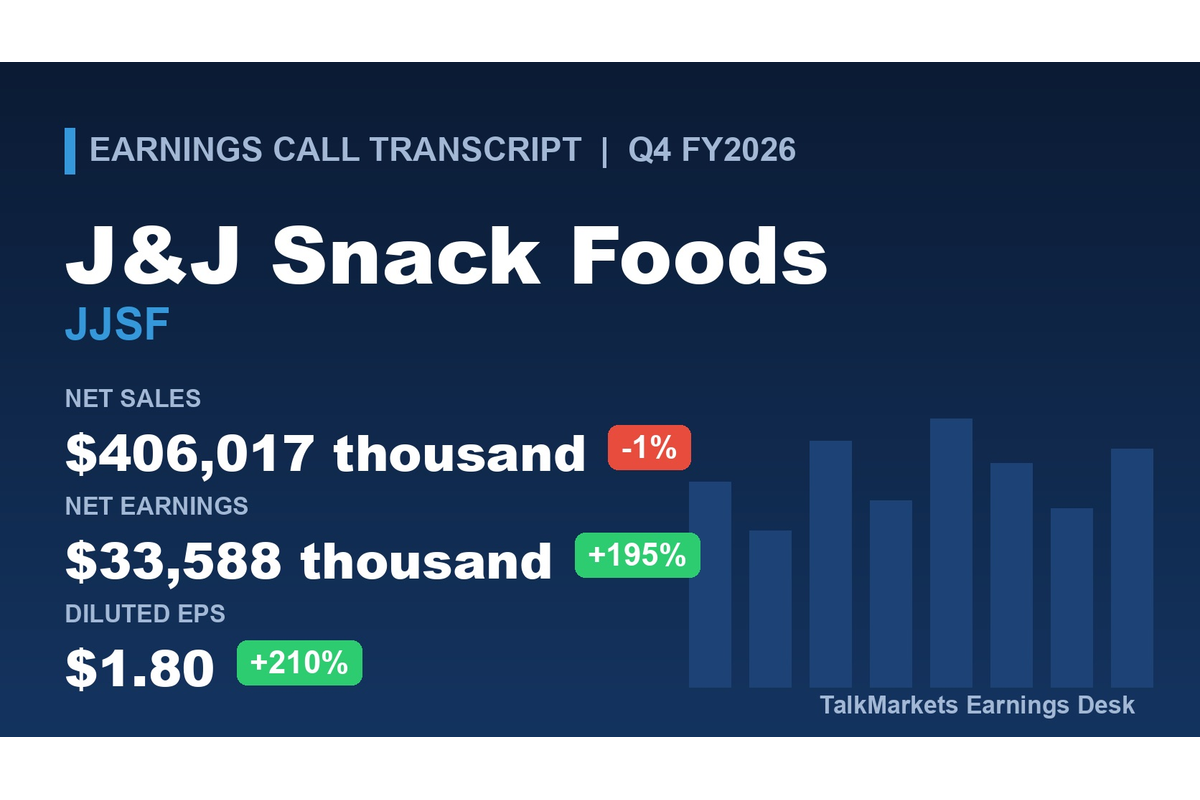
J&J Snack Foods' Q4 fiscal 2026 net sales slipped 1% to $406.0 million, while net earnings rose 195% to $33.6 million and diluted EPS reached $1.80, helped by a $16 million insurance gain.
Ticker: JJSF
J & J Snack Foods Corp. (JJSF) reported results on 18 November 2026 for the fourth quarter ended 26 September 2026. Gross margin improved to 33.7% from 31.7%, supported by Project Apollo plant consolidation, mix improvements and raw material deflation, while distribution costs rose sharply on higher freight and fuel rates.
The key numbers (fourth quarter fiscal 2026, $ thousands)
Metric | This year | Last year | Change |
|---|---|---|---|
Net sales | $406,017 | $410,243 | -1% |
Gross profit | $136,882 | $130,233 | +5% |
Operating income | $44,899 | $11,467 | +292% |
Net earnings | $33,588 | $11,381 | +195% |
Diluted EPS | $1.80 | $0.58 | +210% |
Adjusted diluted EPS | $1.39 | $1.58 | -12% |
Adjusted operating income was $34.5 million, compared with $37.7 million, and Adjusted EBITDA was $53.3 million, down 7%. Operating expenses included a net non-recurring gain of approximately $11.9 million, largely from a $16 million gain on final insurance proceeds related to the Holly Ridge plant fire. Distribution expenses increased 21.6% to $51.3 million.
Results by segment
Food Service: net sales $240.2 million, down 7.4%, with anticipated bakery reductions about half of the decline. Operating income was $19.8 million.
Retail Supermarket: net sales $60.2 million, up 17.1%, driven by frozen novelties and churros. The segment posted an operating loss of $1.5 million.
Frozen Beverages: net sales $105.7 million, up 6.1%, with beverage sales up 19%. Operating income rose to $21.4 million.
Cash and buybacks
The company ended the quarter with cash of $90.3 million and no long-term debt. Fourth quarter operating cash flow was $69.7 million and capital expenditures were $17.6 million. During fiscal 2026, J&J Snack Foods repurchased 854,208 shares for $74.7 million.
President and CEO Dan Fachner said the quarter showed momentum building as the sales environment improved, and that the company realised the full Project Apollo run rate target of $25 million of annualized savings.
Full fiscal year 2026
For the full year, net sales were $1,520.6 million, down 4%, net earnings were $71.5 million, up 9%, and diluted EPS was $3.78, up 13%.
Source: SEC Form 8-K Exhibit 99.1
Full call transcript
Operator:
Good day, and thank you for standing by. Welcome to the J&J Snack Foods fourth quarter fiscal year 2026 earnings conference call. At this time, all participants are in a listen-only mode. After the speaker's presentation, there will be a question and answer session. Please be advised that today's conference is being recorded. I would now like to hand the conference over to your first speaker today, Reed Anderson, with ICR. Sir, please go ahead.
Reed Anderson (ICR):
Thank you, operator, and good morning, everyone. Thank you for joining the J&J Snack Foods fiscal 2026 fourth quarter conference call. Before getting started, let me take a minute to read the safe harbor language. This call contains forward-looking statements within the meaning of the private securities litigation reform act of 1995. All statements made on this call that do not relate to matters of historical facts shall be considered forward-looking statements, including statements regarding management's plans, strategies, goals, expectations, and objectives, as well as our anticipated financial performance.
This includes, without limitation, our expectations with respect to the success of our cost savings initiatives and customer demand improvements in the sales channels in which we operate. These statements are neither promises nor guarantees and involve known and unknown risks, uncertainties, and other important factors that may cause results, performance, or achievements to be materially different from any future results, performance, or achievements expressed or implied by the forward-looking statements.
These factors and other items discussed in our annual report on form 10(k) and our other filings with the Securities Exchange Commission could cause actual results to differ materially from those indicated by the forward-looking statements made on the call today. Any said forward-looking statements represent management's estimates as of the date of this call today, November 18, 2026. While we may elect to update forward-looking statements at some point in the future, we disclaim any obligation to do so even if subsequent events cause expectations to change.
In addition, we may also reference certain non-GAAP measures on the call today, including adjusted EBITDA, adjusted operating income, or adjusted earnings for share, all of which are reconciled to the nearest GAAP measure on the company's earnings press release, which can be found in the investor relations section of our website. Joining me on the call today is Dan Fachner, our Chief Executive Officer, along with Sean Monsell, our Chief Financial Officer. Following management's prepared remarks, we will open the call for a question-and-answer session.
With that, I would like to turn the call over to Mr. Fachner. Please go ahead, Dan.
Dan Fachner (Chief Executive Officer):
Good morning, and thanks everyone for joining today's call to discuss our fourth quarter results. As we signaled on the last call, the sales environment improved in the fourth quarter, and our transformation initiatives continued to support our performance. Gross profit increased $6.6 million to $136.9 million, and gross margin expanded 200 basis points to 33.7%. Adjusted EBITDA came in at $53.3 million compared to $57.4 million last year, and adjusted earnings per share were $1.39 versus $1.58 a year ago.
Distribution costs were the primary headwind to earnings in the quarter, up 21.6% or $9.1 million due to significantly higher freight and fuel costs. Net sales were $406 million, down 1%. Food service net sales declined 7.4% as solid growth in core pretzel and churro products was more than offset by anticipated reduction in bakery as well as continued softness in cookies and handhelds. Retail sales grew 17.1%, while frozen beverage sales were up 6.1%, driven by outstanding beverage volume growth.
Looking at segment results, in food service, churros increased about 10% as we re-introduced churros for a club's cafe. We expect these sales to continue for the foreseeable future. With potential for the business to become permanent. Soft pretzel sales also grew, which included the success of our pretzel bun promotion with a major QSR. We were pleased to see the super pretzel brand front and center nationwide, and we received great consumer feedback. In retail, net sales increased 17.1%, driven by promotional activity and seasonal churro sales.
Syndicated data for the 13 weeks ending October 4th continued to show good momentum across many of our retail brands. Dogsters' retail sales were up 28% and track channels. Retail Dippin' Dots sales were up more than 90%, and Luigi's was up about 9%, while Super Pretzel was up 3%. The high temp Dippin' Dots product is now in about 7,300 stores. In frozen beverage, beverage dollar sales rose 18.6%, more than offsetting the decline in machine and service sales.
Beverage strength was led by theaters and supported by amusement, convenience, and other channels. We continued to expect the close the service revenue gap and fiscal 27. Distribution costs remain our biggest challenge. We have taken action to mitigate some of the pressure by maximizing load sizes and reducing distance of haul wherever we can. We have more initiatives underway for fiscal 27. However, we still expect distribution cost pressure to persist for the foreseeable future.
Briefly looking at full year results, adjusted EBITDA was 176.4 million, down approximately 2.4% from 180.9 million last year. Net sales declined 4%, with the anticipated reduction in bakery sales representing an approximate 3% headwind for the year. We made significant progress on our strategic plan for fiscal 26. Notably, we achieved our targeted run rate of 25 million of annualized savings under Project Apollo.
Our gross margin expanded by 210 basis points to 31.8% for the year enabled by Project Apollo as well as favorable mix improvements as we focus on our core products. We successfully launched several new products as part of our strategic plan, including retail Dippin' Dots, Dogsters sandwiches, protein pretzels, and Luigi's Mini Pops with better for you attributes. We expect these sales to continue to build in the coming year. We continue to see growth in food service pretzel sales for the fiscal year up about 5%.
The beverage component of our frozen beverage business rose 9.7%, underpinned by higher theater traffic as well as other channel growth. We remain focused on growing gallon volumes. Retail sales grew 4% as we increased promotions to support volume, innovation, and to protect shelf space. Although top-line growth was successful, we plan to modify our promotional activity in 27 to better balance volume and financial performance.
We bought back 74 million in stock and finished the year with no debt and more than 90 million of cash on the balance sheet. Now, looking ahead, we are entering fiscal 27 with some real momentum. Regarding the top line, we are expecting to return to growth in fiscal 27 through a combination of core volume growth, innovation, mixed improvements, and pricing. Growth will include several product launches, such as new high-temp Dippin' Dots flavors for retail, Dr.
Pepper and Icy, new Luigi's tubes at retail, super pretzel buns for retail and food service, which leverage the success of the recent promotion with a major QSR, and super pretzel branded Bavarian pull-aparts for food service, a product that I'm really excited about in 27. Frozen Beverage has an encouraging setup for the coming year. Although we had strong movie performances in the back half of fiscal 26, the outlook for 27 is quite promising. The lineup includes new movies from the Jumanji, Spider-Man, Sonic, and Shrek franchises.
The box office that aligns to our fiscal year is projected to increase about 3% versus 26. We are making progress on our plan to close the service revenue gap and expect to be there by the second quarter. We are seeing encouraging activity with new and existing partners across theaters, convenience, and entertainment venues. The team continues to be focused on growing gallon volumes through promotional activity and new account tests in place. The West Coast QSR test continues, but the timeline has been longer than anticipated.
However, we are pleased to share that we are launching new business with a major convenience chain in Mexico with the rollout to be completed in the second half of fiscal 27. We are implementing the new Apollo initiatives that will drive approximately 5 million of incremental annualized benefits, building on the 25 million we implemented in fiscal 26. We are targeting 3 million in manufacturing savings and 2 million in distribution savings. We expect to be materially complete during the fiscal third quarter.
Ingredient costs are expected to be moderately inflationary in fiscal 27 with pressure from packaging, shortening, oils, and flour more than offsetting lower chocolate costs. Finally, we continue to evaluate options for some of the non-core components of our portfolio and will continue to drive margin improvements as seen this past year. I'll now hand things over to Sean, who will walk you through the numbers in more detail. Sean?
Chief Financial Officer:
Thanks, Dan, and good morning, everyone. Building on what Dan covered, our fourth quarter results reflect the continued benefit of our transformation initiatives and an improved sales environment. Food service segment net sales declined 19.1 million or 7.4 percent to 240.2 million, with approximately half of the decline associated with anticipated reductions in our bakery business, which is now materially behind us. We saw growth in both churros and pretzels, but this was more than offset by softness in handhelds and cookies.
Food service segment operating income of 19.8 million was down 2.3 million or 10.4 percent, as higher distribution costs more than offset and improvement in gross profit. Retail segment net sales increased 8.8 million or 17.1 percent to 60.2 million. Growth was primarily driven by frozen novelties in retail churros. Retail segment operating income decreased 3.9 million, driven primarily by higher promotional investment, higher distribution costs, and favorable insurance recoveries in the prior year. Frozen beverage segment net sales increased 6.1 million or 6.1 percent to 105.7 million.
Beverage sales increased 18.6 percent, but were partially offset by lower machine and service sales. Frozen beverage segment operating income increased 2.7 million to 21.4 million, as higher gross profit outweighed distribution cost pressure. Consolidated gross margin improved 200 basis points to 33.7 percent, supported by plant consolidation savings, mixed improvements, raw material cost improvements, partly offset by higher promotional investment in retail. Total operating expenses were 92 million or 22.7 percent of sales, compared to 29 percent in the prior year quarter.
Operating expenses in the quarter included a net non-recurring gain of approximately 11.9 million, largely driven by a 16 million dollar gain from insurance proceeds. Prior year quarter operating expenses included non-recurring operating expenses of approximately 24.8 million, driven primarily by plant closure expenses. Selling and marketing expenses increased approximately 1.6 percent, or 500,000, to 33.1 million, representing about 8.2 percent of sales, compared to 7.9 percent in the prior year.
Distribution expenses increased 21.6 percent, or 9.1 million, to 51.3 million, and accounted for 12.6 percent of sales, compared to 10.3 percent in the prior year period, driven by higher freight and fuel costs. We expect distribution costs to remain elevated in fiscal 2027. Administrative expenses increased 15.3 percent to 22 million, or 5.4 percent of sales, and included 2.7 million of non-recurring legal expenses. Excluding non-recurring items, administrative expenses increased about 1.3 percent. Adjusted operating income was 34.5 million, compared to 37.7 million in the prior year.
Adjusted EBITDA was 53.3 million, down 7.1 percent from 57.4 million last year. The effective tax rate for the quarter was approximately 25.7 percent, as compared to 4.8 percent in the prior year quarter. The lower effective tax rate in the prior year quarter primarily reflected a change in estimate on our blended state's tax rate, and the corresponding impact on the valuation of our net deferred tax liabilities.
On a reported basis, earnings per diluted share were $1.80, compared to $0.58 per share last year, with the current quarter benefiting from a non-recurring insurance gain in the prior year affected by non-recurring plant closure expenses. On an adjusted basis, earnings per share were $1.39, compared to $1.58 a year ago. Our balance sheet remained strong, with 90.3 million of cash and no debt at quarter end. During the quarter, we generated approximately 69.7 million in operating cash flow, and invested 17.6 million in capital expenditures.
For the full year, we generated 170.2 million of operating cash flow, and invested 70.9 million in capital expenditures. We repurchased 74 million in stock during fiscal 2026. That concludes our prepared remarks, and we're now ready to take your questions. Operator?
Operator:
Thank you. As a reminder to ask a question, please press star 1-1 on your telephone and wait for your name to be announced. To withdraw your question, please press star 1-1 again. Please stand by while we compile our Q&A roster. Our first question is going to come from the line of Todd Brooks with Benchmark StoneX. Your line is open. Please go ahead.
Todd Brooks (Benchmark StoneX):
Hey, thanks. Good morning, and congrats on the results in the quarter, and getting off on the right foot here going into the new fiscal year. So good to see.
Company Executive:
Thank you, Todd.
Todd Brooks:
A couple questions, if I may. And Sean, I think this would probably be helpful for everybody. Can you frame up the thoughts on distribution costs and how we should be thinking about it in '27? I know the situation is fluid. I know there's a diesel component, but there's also just kind of the cost of lanes and routes now because of some driver pressure that may not go away.
Can you maybe walk us through if you put it in a percent of sales basis or something along those lines for how much incremental pressure you would expect on the distribution line? And you hinted at maybe steps to mitigate some of that. Can you review the work that's being done there as well?
Dan Fachner:
Yeah. Hey, Todd. This is Dan. That's a great question and one we really need to focus in on. And I'm going to turn this back over to Sean to do that in just a moment, but kind of wanted to start off with just a few comments. Fiscal '26, we thought was a really strong year for J&J snack foods and with the trends improving in the fourth quarter even. We set out to expand margins and reduce expenses and refocus on the business on the core.
And the team really delivered. I'm proud of what the team accomplished and really optimistic about '27. We're encouraged by the momentum and expect top line growth this coming year. The planned bakery is now behind us and that removes that headwind. Our new product initiatives are performing well. We're coming to market with some new products in addition to that. We see new business opportunities across the portfolio.
And at the same time, as you just talked about, we're realistic about some of the challenges ahead, really particularly those distribution costs. However, we expect that to remain elevated through the year. But our network initiatives should help offset some of those costs and then with pricing and volume growth, which we see is real, we believe that we can still expand our margins. So with that, I'm going to let Sean dig into some of the details that you just asked about and talk about those distribution costs.
Chief Financial Officer:
Yeah. Good morning, Todd. Yeah. So obviously, we're up 21.6% distribution costs in the quarter. Most of that was really driven by freight and fuel. And it's really the freight costs that's having the biggest impact on the P&L. As it stands today, we have seen some declines in diesel prices this quarter. We hit a record or near record here and unfortunately in the quarter of over $6, I see the EIA is reporting that's just below $6 a gallon now.
So we do expect to see some fuel relief. As it relates to freight, at least for the foreseeable future, it does feel like it's going to remain elevated. We are taking some steps to mitigate that pressure. Essentially, the teams have been working on reconfiguring our pallet sizes to ensure that we're packing as much as we can on a truck and reducing the number of trucks that we have to utilize to get our products to market.
We've even moved a small quantity of product to rail transportation to take advantage of some savings. And there's some instances where we've been able to shift production from within our manufacturing network just to get closer to the customer. So for now, it feels like it's going to remain elevated. And I think that once we get to the second half, once we get to about Mayor's unit next year, we'll start to lap the impact.
Teams are really heavily focused on that, Todd, and we'll continue to monitor and watch it closely and pull every level that we can.
Todd Brooks:
That's great. And just to show on the shape of it, maybe expect the year-over-year pressure in the first half, and then we get back to a neutral to maybe slightly favorable place in the second half of the year then.
Company Executive:
Yeah, that's right. We do see a chance for there to be some favorability in the second half.
Todd Brooks:
Okay, great. And then, Dan, I want to follow up with you because you have pointed to being able to drive organic revenue growth in fiscal '27 and another strong roster of innovation that you laid out earlier. You made a comment on the call, though, that there could be more evaluation of non-core portfolio items. So I want to understand within that guidance for organic growth in the business, through the bakery rationalization. That's my understanding.
What else are you looking at in the portfolio, and would the organic growth actually be some element of basis points stronger, but you are expecting to rationalize some of the other business lines in '27?
Dan Fachner:
Yeah, you know, I don't expect there to be any further rationalization, Todd, in our business. We're going to continue to evaluate the areas of our business that aren't core. We're seeing some really great growth within our core business today, and you even saw that over this last quarter with some great growth in churros and pretzels. But we're going to continue to evaluate opportunities and possibilities for some of those products that don't sit within our core, but that will not include skew rationalization in 2027.
Todd Brooks:
Okay, great to hear. Thanks. I'll hop back into the queue, guys.
Company Executive:
Thank you.
Operator:
Thank you. And one moment for our next question. Our next question is going to come from the line of David Shachno with William Blair. Your line is open. Please go ahead.
Analyst (William Blair):
Hey, David Shachno on for John Anderson. Congrats on the nice quarter, and thanks for taking our question here. So gross margin was solidly above last year. I think you said 200 basis points. I had a consensus too. Could you give us a sense, even ballpark, how much of that came from Apollo versus mix and raw material deflation? And then you mentioned the prepared remarks. I think you said you expect raw material inflation for fiscal 27.
Wanted to get a sense if that's more back half weighted, given the tailwinds this past quarter? Or do you expect kind of that inflationary pressure right away end up persist throughout the year? And then one follow up after that.
Company Executive:
Great, David. Good to talk to you. Thank you for being on today. Tell John we missed him. Thanks for pointing out that gross margin. You know, we talked a lot about over the last few years about growing the margin and getting it back into that 30s range and then with goals to get even above that at some point. So really proud of what the team accomplished this year by driving the gross margin and expect that we can continue to do that this next year.
It did raise about 210 basis points for the year. I think we ended the year somewhere around 31.8 and proud of being able to do that. Hopefully next year we can get ourselves into that 32 range or above. We do have some inflationary issues and I'm gonna let Sean discuss those with you as we get into 27.
Chief Financial Officer:
Yeah, that's right. So, you know, if you think about the Apollo impact that was just, you know, was about almost 20 million dollars in the fiscal year that we achieved behind the Apollo initiatives. Remember, we were about three and a half million in the first quarter and then we got up over four million in savings from the plant consolidation. And then we hit the full run rate there in the second half.
So close to 20 million dollars worth of impact that's going to be, you know, sustainable in those earnings. As far as the inflation is concerned, you know, we do see that more of a back half probably kicking in a little bit more in the second and the third quarter, but we don't see the intensity of that inflation kicking in as you want.
Analyst (William Blair):
Got it. That makes sense. And then one other thing here. Can you help us understand what list price increases you've taken or announced for fiscal 27? I know historically IC pricing comes beginning of the calendar year, I believe, but wanted to understand where else more broadly if it's IC and other things too. More broadly, you know, which segments are they in market yet? Kind of plans for the upcoming year across the portfolio there.
Company Executive:
Yeah, great. Thank you, David. We do have plans for a price increase this year. Those will take in effect in January with the IC and the dip and dots were probably somewhere in that 3% range. Snack food side will be a little bit more surgical, but we'll be by the time that we get that included with IC and dip and dots, probably an overall increase of around the two and a half percent range, something in that neighborhood.
Analyst (William Blair):
Two and a half percent for the total company?
Company Executive:
For the total. Yeah, total overall.
Analyst (William Blair):
Got it. Great. I'll pass it on then. Thank you.
Company Executive:
Thank you, David.
Operator:
Thank you. And one moment for our next question. Our next question will be from the line of Scott Marks with Jefferies. Your line is open. Please go ahead.
Scott Marks (Jefferies):
Hey, good morning, all. Thanks very much for taking questions here. Just wanted to follow up on the conversation you just had, just about the pricing impact as we think about that for fiscal 27. What are you anticipating on the volume side now that you're through the SKU rationalizations? You have these innovations coming to market. Jerry, if you're baking in any elasticity impacts or just overall how we should be thinking about that dynamic.
Company Executive:
Yeah, we think we'll have positive volume impact in the year. We like some of the great things that we're doing with our core products. We've mentioned that already and they'll continue to grow. What I really like is our innovation this past year and some more innovation coming the following year. And one of the things that Linwood Mallard always reminds us of on innovation is it kind of grows over a two, three year period.
And so we think that that will be a positive impact on our growth this coming year. Somewhere in the neighborhood, I think innovation will add somewhere in the neighborhood of 1%. So when you kind of think about the pricing and the innovation and getting our service revenue back to even and we think that will happen in the second quarter, we think we'll be somewhere in that low to mid single digit growth rate for next year.
Scott Marks:
Okay, great. Appreciate the color there. Thank you for that. The next thing maybe that I want to ask about just as we think about the food service segment, I know you call about some of the pressure and cookies and handhelds continuing. As we think about maybe go forward trajectory within that segment specifically, what should we be taking into account as we look ahead through this fiscal year?
Company Executive:
Yeah, well, the great thing about the food service is that's the area where we had that, you know, heavy skew rationalization and that's coming to win. So we feel good about that. We have some really good growth going on in our core products with more pretzel growth and the turbo growth. Both of those, you know, we had a big QSR that ran a pretzel bun promotion with us that had super pretzel front and center, which was great.
We've got a new piece of business with churros back in a retail club store that's doing really well for us. I think food service is on its way to having a decent year and the real key is getting the rationalization behind us. Those two areas that we talked about with cookies and handhelds, it's a major customer where that business has just been down and our anticipation is it will continue to be down over this next year.
Scott Marks:
Okay, thanks for that. And maybe if I could just squeeze in one more. Project Apollo, you talked about kind of phase two picking in and I know there's been discussions about like what happens beyond Apollo, how do you continue to improve the automation and the network and the efficiency. Wonder if you can just tell us maybe, you know, a little bit longer term, how you're thinking about kind of even the next phase beyond what's in place for this year.
Company Executive:
Yeah, so this next phase that we've just launched the incremental 5 million, you know, 3 million coming from manufacturing efficiencies and 2 million coming from further distribution optimization. You know, as it relates to, you know, what's happening in the plants, you know, the team has a number of projects that are going to drive that 3 million dollars. You know, it's a handful of items that are really going to be driving, you know, a reduction in waste, higher up time. And we feel pretty good about it.
We're also going to be rolling out this year where it's actually underway now the rollout is what I call some, you know, some plant floor systems that will help us in that cause. We're rolling out Red Zone. I think that, you know, most folks are familiar with that system. We're also making some improvements to our warehouse management tools. And that's going to help to drive some of those savings. Both of those initiatives will help really drive plant efficiency projects inside the plant.
Red Zone gives us real time information on the line where people have handhelds and able to see it and then post it around the building. We're pretty excited about it. It's a program that's used a lot in the industry and manufacturing and something that I think will be very helpful for us this coming year.
Scott Marks:
Okay. Appreciate it. Thanks. I'll pass it on.
Operator:
Thank you. Thank you. And I'm showing no further questions and I would like to hand the conference back over to Dan Fachner for closing remarks.
Dan Fachner:
Great. Thank you, operator. Thanks, everyone, for your questions. Stepping back, I think the fourth quarter results show that the strategic plan is working. The team at J&J is embracing the plan and executing with excellence. Gross margin expanded again, the sales environment improved across our core products, and we are managing through distribution cost pressures. We enter fiscal 27 with a stronger core portfolio, a more efficient cost structure, and a strong balance sheet, and we expect to return to top line growth.
So thank you again for your support, and we look forward to catching up again next quarter. Thank you very much.
Operator:
Thank you for your participation in today's conference. This does conclude today's program. You may now disconnect, everyone. Have a great day.
Comments
Log in or sign up to join the conversation.