

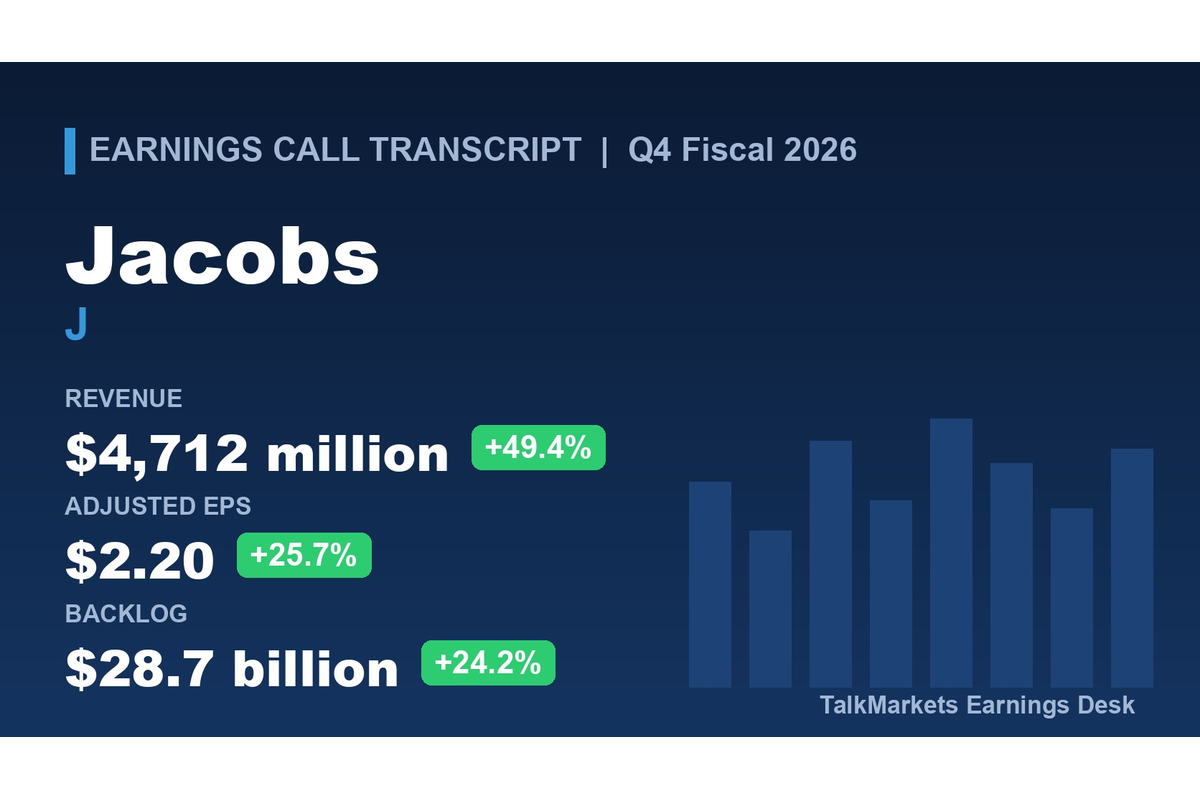
Jacobs' fiscal Q4 2026 revenue rose 49.4% to $4,712 million and adjusted EPS rose 25.7% to $2.20. Backlog reached $28.7 billion, up 24.2% year on year.
Ticker: J
Jacobs Solutions Inc. (J) reported results on 23 November 2026 for the fourth quarter of fiscal 2026, the three months ended 2 October 2026. The engineering and consulting company said both segments delivered strong results, with revenue growth in Infrastructure & Advanced Facilities led by the Life Sciences, Semiconductor, Energy & Power, Water and Data Center sectors. All figures below are for continuing operations.
The key numbers (three months ended 2 October 2026, in thousands except per share)
Metric | This year | Last year | Change |
|---|---|---|---|
Revenue | $4,712,279 | $3,154,644 | +49.4% |
Adjusted net revenue | $2,594,821 | $2,242,246 | +15.7% |
GAAP net earnings | $165,890 | $138,036 | +20.2% |
GAAP diluted EPS | $1.40 | $1.05 | +33.3% |
Adjusted EBITDA | $420,755 | $323,507 | +30.1% |
Adjusted EPS | $2.20 | $1.75 | +25.7% |
Adjusted EBITDA margin was 16.2%, against 14.4% a year earlier.
Results by segment (in thousands)
Infrastructure & Advanced Facilities: adjusted net revenue of $2,229,943, against $1,923,785, with segment operating profit of $313,280, against $254,032.
PA Consulting: revenue of $364,878, against $318,461, with segment operating profit of $79,909, against $71,997.
Backlog, cash and capital returns
Total backlog was $28,652 million at 2 October 2026, against $23,064 million a year earlier, up 24.2%. The fourth quarter book-to-bill ratio was 1.0x, and 1.1x on adjusted net revenue. Jacobs ended the year with $1,258 million in cash and cash equivalents. In the quarter it spent $107 million on share repurchases and paid $42 million in cash dividends to shareholders. Capital returns through repurchases and dividends totalled $887 million in fiscal 2026.
Chair and CEO Bob Pragada said: "We finished FY26 on a high note with robust fourth quarter performance across all key metrics as both segments delivered strong results."
Full year
For fiscal 2026, gross revenue was $15.8 billion, up 31.1%, and adjusted net revenue was $9.6 billion, up 10.3%. GAAP net earnings were $385 million, up 23.0%, and GAAP EPS was $3.37, up 30.6%. Adjusted EBITDA was $1.4 billion, up 17.5%, and adjusted EPS was $7.32, against $6.12, up 19.6%. The fiscal year book-to-bill ratio was 1.4x.
Source: SEC Form 8-K Exhibit 99.1
Full call transcript
Operator:
Hello, everyone. Thank you for joining us and welcome to the Jacobs fiscal fourth quarter and full year, 2026 earnings conference call and webcast. After today's prepared remarks, we will host a question and answer session. If you would like to ask a question, please press star one to raise your hand. To withdraw your question, press star one again. I will now hand the conference over to Bert Subin, senior vice president of investor relations. Please go ahead.
Bert Subin (Senior Vice President of Investor Relations):
Thank you, operator, and welcome, everyone. Following market close, we issued our earnings announcement, filed our Form 10-K, and posted a slide presentation on our website, which will reference during the call. I would like to refer you to Slide 2 of the presentation for information about our forward-looking statements, non-GAAP financial measures, and operating metrics. Now, let's turn to the agenda on Slide 3. Speaking on today's call, we'll be Jacobs chair and CEO, Bob Pragada, and CFO Venk Nathamuni.
Bob will begin by providing comments in the business, as well as highlights from our fourth quarter and fiscal year results and a recap of notable words. Venk will then provide a detailed review of our financial performance, including commentary and end market trends, cash flow, balance sheet data, and our FY27 outlook. Finally, Bob will provide closing remarks, and then we'll open up the call for questions. With that, I'll turn it over to our chair and CEO, Bob Pragada.
Bob Pragada (Chair and Chief Executive Officer):
Good afternoon, everyone, and thank you for joining us to discuss our fourth quarter and fiscal year 2026 business performance. We delivered very strong results in Q4, finishing FY26 on a high note. I'll quickly highlight three key takeaways for the quarter. First, during Q4, we achieved record quarterly net revenue in both I&AF and PA Consulting segments, with double-digit organic net revenue growth and solid sequential improvement from Q3.
Second, our adjusted EBITDA margin expanded 100 basis points, quarter on quarter, to more than 16%, driven by our highest quarterly operating margin in I&AF since becoming a segment in FY24. And third, we see strong momentum heading into FY27 as our nearly $29 billion of backlog and our growing pipeline of opportunities set us up for another year of top tier organic net revenue growth.
Then we'll walk through our FY27 guidance in detail shortly, but at the midpoint of our guidance, we are positioned to deliver at or above the high end of our FY29 net revenue growth target when excluding the extra week in FY26. As a result, in FY27, we expect to grow adjusted EPS by double digits, a mark we have achieved each year since the separation of our critical mission solutions and cyber and intelligence businesses.
Notably, our FY26 adjusted EPS exceeded our FY23 adjusted EPS even though the separation removed more than one third of our adjusted net revenue. That's a testament to our strong organic growth, continued margin expansion, and disciplined capital allocation over the last two years. Turning to slide four, we provide a detailed overview of our quarterly and full fiscal year results.
In Q4, we grew adjusted EPS by 26% year over year, which was primarily driven by 16% net revenue growth and a quarterly adjusted EBITDA margin of 16.2% up approximately 180 basis points year over year. For the full year, we grew adjusted EPS 20% as a result of strong top line growth and margin expansion paired with our declining share count.
Reflecting on our expectations, last quarter, we guided to an adjusted EPS range of $7.20 to $7.30 for FY26, and we were able to finish the year above the high end of that range at $7.32 after increasing the midpoint of our adjusted EPS guidance three times throughout the year. Turning to slide five, I'd like to highlight a few notable project awards from Q4. In the critical infrastructure end market, Jacobs was selected by American Electric Power to support one of the nation's largest transmission modernization programs.
Through a five-year partnership, we will provide end-to-end project delivery services across AEP's expanding transmission portfolio, helping advance grid infrastructure investments across seven states as a part of their $37 billion capital investment plan. This is a marquee win for Energy and Power team that sets the group up for strong growth in FY27 and FY28. In Water and Environmental, Jacobs has secured a place on Anglian Water's 10-year major projects framework for AEP-8 and 9.
The framework will provide capacity for major water and wastewater projects across the region with initial work including coastal water quality improvements and urban drainage projects to reduce storm overflow spills and strengthen flood resilience. Additional major investment is expected towards the end of AEP-8 and through AEP-9. We continue to see strong growth in the UK water sector on the back of new projects and expanded frameworks as a part of this AMP cycle.
Also in Water and Environmental, we have been awarded new work on BP's Hastings on Hudson site, addressing contamination in the surrounding uplands and the Hudson River. Our team is bringing together design, safety, schedule and cost planning to advance the site's long-term cleanup in a cost-effective way. Shifting to life sciences and advanced manufacturing, Jacobs was selected by Santa Fe to serve as the EPCM partner for its new state-of-the-art insulin manufacturing plant in Frankfurt, Germany.
The project will support production of multiple insulin products and strengthen supply reliability for patients around the world. Building on nearly 80 years of delivering the most innovative infrastructure to manufacture the world's most important therapies, this award reinforces our position as a leading provider of complex science-based solutions and reflects our ability to deliver large-scale mission-critical investments from early project development through startup. Finally, PA Consulting was selected as part of Sydney Airport's professional services framework, which is planning for future growth and increased passenger demand.
The framework will support major programs that contribute to the airport's long-term development. This win reflects how we bring end-to-end capability to clients' challenges across the asset lifecycle in the transportation sector. In summary, these awards help illustrate our differentiated and diversified model and underscore the growth opportunity ahead of us. Now, I'll turn the call over to Venk to review our financial results in further detail.
Venk Nathamuni (Chief Financial Officer):
Thank you, Bob. During FY26, we delivered on our commitment to drive profitable growth. The combination of more than 10% organic net revenue growth and approximately 90 basis points of margin expansion helped solidify another year of double-digit growth in adjusted EPS, with Q4 adjusted EPS growth accelerating to 26%. As we now shift our focus to the new fiscal year, we believe our business is well positioned to capitalize on various ongoing capital cycles, and I'll walk through what underpins that confidence shortly.
Now, please turn to slide number six, what I'll go through our results for Q4. As I just highlighted, we finished fiscal year 2026 on a strong note. In the fourth quarter, gross revenue increased 49% year-over-year and adjusted net revenue, which excludes pass-through revenue, grew by 16%. Even excluding the impact of the extra week during Q4, net revenue would have grown high single digits year-over-year. Q4 adjusted EBITDA with $421 million, growing 30% year-over-year.
Our adjusted EBITDA margin during Q4 came in strong at 16.2%, which is an increase of approximately 180 basis points, which is the same quarter last year. As a result, adjusted EPS rose to $2.20, our highest quarterly adjusted EPS since the CMS separation. Our discipline cost management contributed to the best operating margin for I&AF since becoming a segment in FY24, both during the quarter and for the full fiscal year, and we are well positioned to build on this momentum in FY27.
Consolidated backlog was up 24% year-over-year to $28.7 billion, putting our trailing 12-month book to build at 1.4 times or 1.2 times on a net revenue basis. Notably, net revenue and gross profit and backlog increased 10% and 15% respectively year-over-year during Q4, highlighting our strong sales performance. Moving on to slide 7, I'll quickly recap fiscal year 26 results. FY26 total gross revenue increased 31% year-over-year with adjusted net revenue rising more than 10%.
Excluding the extra week in FY26, net revenue growth was still about the high end of our long-term target of 6% to 8%. Revenue growth and higher margins resulted in adjusted EBITDA and adjusted EPS, increasing 17% and 20% respectively for the full year. We're very pleased with our FY26 results and expect to build on this well-laid foundation in the new fiscal year. Regarding our performance by end market and infrastructure and advanced facilities, let's now turn to slide 8.
At a high level, net revenue growth during FY26 was aided by very strong demand in the life sciences and advanced manufacturing end market, with critical infrastructure also outpacing our long-term target. Revenue growth for water and environmental was more modest with the environmental market facing headwinds as we had previously communicated, but we now see a path to improvement in this end market during fiscal year 27. Focusing on Q4, net revenue in our life sciences and advanced manufacturing end market grew 54%.
It ramped up from already very strong performance in Q3. During the quarter, we saw robust net revenue growth across the portfolio with a solid uptick in life sciences activity. As we enter FY27, we believe we're well positioned to achieve double-digit net revenue growth in the end market for the full fiscal year. In critical infrastructure, net revenue increased 8% year over year.
During the quarter, our energy and power offering led with strong double-digit growth and services in the transportation sector continued to grow year-on-year, but at a more measured pace versus Q3. Growth in these sectors was partially offset by slight softness in cities and places as we're deploying more of our engineering resources from this sector into advanced manufacturing in order to support demand there. Net revenue for our water and environmental end market grew more than 6% year-on-year in Q4.
Demand across water and environmental remained mixed with continued solid demand in the water sector, partially offset by softer revenue performance in environmental. Looking ahead, we believe underlying growth for this end market will improve as new projects in the environmental sector ramp up through the year. In summary, we're seeing favorable demand trends across most of our portfolio. Demand in the life sciences and advanced manufacturing end market remains robust, and we anticipate this will be our fastest growing end market over the coming quarters.
On slide 9, I will provide a brief overview of our segment financials. In Q4, infrastructure and advanced facilities adjusted operating profit increased 23% year-on-year with limited impact from FX. In FY26, adjusted operating profit increased 13% year-over-year. Infrastructure and advanced facilities results were aided by both revenue growth as well as margin expansion. Now, moving to PA Consulting's performance, revenue increased 15% year-on-year in Q4.
This contributed to an 11% increase in operating profit, which includes a roughly 50 basis point adverse FX impact on an operating margin of 22%. PA revenue rebounded strongly in Q4 as political uncertainty in the UK moderated, and as programs in the life sciences, energy and utilities, and transportation sectors ramped up. Encouragingly, we're seeing more opportunities to partner in engagements, which is expanding PA's presence with clients that I&AF serves.
As we look ahead to fiscal year 27, we anticipate PA's revenue growth will be in the mid-single-digit range on a like-for-like basis. Turning now to slide 10, we provide an overview of cash generation and our balance sheet. For fiscal year 26, we generated $871 million of adjusted free cash flow with $237 million generated during Q4, a strong finish to the year.
Solid free cash flow performance and our high-quality balance sheet enabled us to repurchase $721 million of our shares, as well as pay out $166 million in cash dividends. For the second year in a row, we returned over 100% of our adjusted free cash flow during the fiscal year, and we have now returned approximately $2 billion of capital back to shareholders over the last two years.
We were also able to refinance our debt in conjunction with the PA Consulting transaction back in the spring with extended our maturities, increased the proportion of our debt that was fixed, and kept our weighted average interest rate in the low 5% range. Following the PA transaction, we've been able to return significant amounts of capital back to shareholders while maintaining a net leverage ratio of 1.6 times as of fiscal year end.
We're pleased to be already in line with a long-term net leverage target of 1.5 times, one year ahead of schedule. Finally, please turn to slide 11 for our FY27 outlook. We expect adjusted net revenue to range from $10 billion to $10.35 billion, adjusted EBITDA margin to range from 15.4% to 15.7%, adjusted EPS to range from $8.05 to $8.45, and free cash flow margin, which is free cash flow divided by adjusted net revenue to range from 8.5% to 9.5%.
Notably, our outlook for FY27 implies low to mid teens year-on-year growth in adjusted EPS at the midpoint. We provide relevant assumptions on the right side of the page to help with your modeling. One item to be mindful of is the fact that in FY27, we will return to a 52-week fiscal year, whereas FY26 was a 53-week fiscal year, creating a full-year revenue headwind of slightly less than two points with all of that impact being absorbed during Q4.
As it pertains to Q1, we forecast our adjusted EBITDA margin will be in a range of 14.6% to 14.9% with year-over-year organic net revenue growth of approximately 8%. Furthermore, we expect our Q1 tax rate to be roughly 27% and our quarterly free cash flow to be about $200 million. In summary, FY26 was a very strong year as we continue to deliver profitable growth.
For reference, we finished FY24 with around $1.06 billion in adjusted EBITDA and were on track to outpace that mark by upwards of $500 million at the midpoint of our FY27 guidance. Our strategy is working and we're focused on executing on the opportunities in front of us during the new year. With that, I'll turn the call back over to Bob.
Bob Pragada (Chair and Chief Executive Officer):
Thank you, Venk. In FY26, we delivered at or above the high end of our outlook on every key financial metric, with our organic net revenue performance leading our peer group by a wide margin. And we see that continuing in FY27. The momentum in the business is as high as I've ever seen in my career. And the pipeline of opportunities continues to expand. Importantly, I would like to thank our 50,000 colleagues for their contributions to such a strong 2026. Operator, we'll now open the call for questions.
Operator:
We will now begin the question answer session. Please limit yourself to one question and one follow up. If you would like to ask a question, please press star one to raise your hand. To withdraw your question, press star one again. We ask that you pick up your handset when asking a question to allow for optimum sound quality. If you are muted locally, please remember to unmute your device. Please stand by while we compile the Q&A roster.
Your first question from the line of Andy Capilowitz with Citi. Your line is now open. Please go ahead.
Analyst (Citi):
Hey, yes. Good quarter. Good.
Bob Pragada (Chair and Chief Executive Officer):
Thanks, Andy. Bob, Bob, maybe just talk about your visibility toward continued back leg growth. Obviously, back leg growth of 24% of your year is strong. But I feel like you did announce a lot of wins over the last quarter. And I think your growth spoke to Bill was only one time. So did you have anything that was slower than you thought of? What's your confidence level regarding continued back leg growth from here? Yeah. So, Andy, maybe I'll start off and then I'll growth revenue basis.
It's the reason why we report on the trailing 12 months as well. It tends to be a little lumpy on the timing of awards. But we do see awards in Q1 really stacking up nicely for us. So our confidence level with what we're already seeing in the current quarter coupled with the fact that our pipeline continues to grow at a really rapid pace is kind of my first comment.
My second comment is the net revenue growth even on a quarter basis as well as on a trailing 12 month was strong. So our fee revenue continues to grow at a 1.1, 1.2 type level in the quarter and then even higher in a trailing 12 month. So we're very confident.
Analyst (Citi):
Yeah. I mean, obviously very strong growth in life sciences and advanced manufacturing. So it sort of begs the question, as you've been taking on these bigger contracts in that part of the business, and particularly maybe on large data centers, how have you been able to adopt that to these larger contracts to make sure you continue to deliver the consistent margins that it looks like you did in Q4?
Company Executive:
Yeah. So maybe a couple comments there, Andy. One is that our risk profile and the EPCM delivery that we've delivered successfully over decades, that has not changed. And we continue to feel strongly about that delivery approach.
I think probably the deeper reason is that the level of capital that our clients are deploying, specifically on the private sector side, is higher than we've ever seen in the speed by which our clients want to see the return on that capital is reason why that integrated delivery model that we've done so well at over the years has been kind of the, has been really where we've been focusing in on. So we're not getting over our skis.
We're doing exactly what we've done for years, and we're really continuing to deliver for our clients.
Analyst (Citi):
Appreciate all the color.
Operator:
Your next question from the line of Sabat Khan with RBC Capital Markets. Your line is now open. Please go ahead.
Analyst (RBC Capital Markets):
Hey, thanks. And good afternoon. Maybe just following up on the last question, I think it might have been vanked that mentioned in the earlier comments that life science and advanced manufacturing will be the fastest growing segment, just hoping you could dig a little bit into the two sub sectors. You know, is it maybe life sciences leading?
Will it be the advanced manufacturing leading and maybe just kind of the magnitude of the growth or, you know, over the course of the year, how we should expect the two silos to contribute to the top end growth? Thanks.
Company Executive:
Yeah, so maybe I'll start off and then maybe I'll talk a little bit about life sciences and semi and then you talk a little bit about data centers kind of being steady for us. Life sciences and semi really, which are a majority of that that vertical Saba are growing at a very strong pace in the bookings that we've had specifically in life sciences have really outpaced during the year.
So that is going to be a continued growth driver for us and we see some real strong tailwinds there. With regards to data centers, steady business for us, as you know, it represents about 5% of our overall business and it's a minority of that vertical, but still growing at a very fast rate. The world continues to need and have a high level of demand for compute and we've been very selective in that space as well.
And so we see that overall is a very, very strong, strong vertical force. Yeah, and if we just add a couple of things to it. So one of the life sciences, it's not just the top line goal, but also the diversification of the customer base. So we're getting a lot of different, you know, customers providing us the business and we see good visibility there.
And then on the data center piece, you know, these are still very resource-contrained markets and the ability for us to be able to use our global delivery and the experience that we have overall in life sciences and manufacturing to the data center market really differentiates us from the standpoint of being able to deliver those quality services with, you know, good outcomes for the client.
Analyst (RBC Capital Markets):
Great, thanks. And then just as a follow up on the margin side of things, a couple of years into your sort of post-spin journey on the margin front, can you just talk about what are the biggest margin buckets that are left and the ones that you expect are going to contribute for the sort of next one to two years you're given that you're into the margin of prospects?
Company Executive:
Yeah, Saba, thanks for the question. I would say, first of all, just to provide some context over the last couple of years, we have grown our margins by roughly 200 basis points within FY25 and FY26. And, you know, based on what we're guiding, you know, it's about 75 basis points per year of continued margin expansion through the strategy cycle. So in terms of the key margin drivers, what you've seen over the last year and a half or so has been primarily given by operating leverage.
And, you know, we've talked, especially at the invested day back in February of 2025 for specific buckets that drive margin expansion. One is operating leverage which will continue to maintain and deliver on. As the business grows, we should be able to drive, you know, good efficiencies there. The three other buckets that we talked about in terms of global delivery, as you've seen, global delivery has been a very, very solid driver of margin expansion for us.
And with the mix of the business more than the life science and advanced manufacturing, that continues to be a strong table for us. And then outside of that, we talk about commercial models and mix. So obviously on the mix side, you know, it's what happens in terms of consulting with the P acquisition that should help us with continued margin expansion.
And then the commercial models, you know, it's the ability for us to require some of the costs as it relates to far raised and so forth, as well as, you know, how we drive the business between fixed price and cost reimbursement. So we have a multitude of factors that allow us to continue to try the margin expansion. And we feel pretty good about the trajectory and being able to meet or beat the targets for FY29.
Analyst (RBC Capital Markets):
All right. Thank you.
Company Executive:
Welcome.
Operator:
Your next question from the line of San Gita Jane with KeyBank capital markets, your line is now open. Please go ahead.
Analyst (KeyBanc Capital Markets):
Great. Thank you for taking my questions. I want to follow up on a response thought that you used to Andy's question on one key award stacking up nicely. Can you elaborate a little bit on the end markets where you're seeing the most momentum here?
Company Executive:
Yeah, across the board San Gita, it's clearly life sciences and advanced manufacturing continue to be strong tailwinds. We will have some really nice bookings in the water and environmental world. As well as energy and power, we have the nice wind that we announced publicly here with American electric power and really getting into the transmission and distribution renaissance that's happening here in the US. But we also have some additional E&P wings that we'll be announcing as well.
So overall, a really diversified set of bookings that are stacking up for Q1 and early Q2 as well.
Analyst (KeyBanc Capital Markets):
Got it. And then maybe to rank, you highlighted how much stock you bought back in the last couple years and your share comes down a decent amount. How are you thinking about capital allocation now through your 2029 planning period? Are you still going to paradise buybacks or do you have other things that you would like to deploy capital to?
Company Executive:
Yeah, thanks for the question, San Gita. Again, just for context, we've returned close to $2 billion over the last couple of years with all buybacks and dividends. And as we laid out again in February of 2025, we said we were making a commitment to returning at least 60% of our free cash flow in the form of buybacks and dividends. And as you know, dividends have been growing at double digits and buybacks have been close to 100% of that of free cash flow.
So the way we think about it is we are maintaining the commitment to returning at least 60% of our free cash flow.
Analyst (KeyBanc Capital Markets):
Carter, thank you so much.
Company Executive:
Welcome.
Operator:
Your next question from the line of Stephen Fisher with UBS. Your line is now open. Please go ahead.
Stephen Fisher (UBS):
Thanks. Good afternoon and congrats on the year. Just wanted to follow up again on the life sciences advanced manufacturing growth. Just curious how to frame where we might be going from here again as the fastest of the segments. But are we still building momentum off of that 54% growth or is this possibly a peak growth rate? And then just sort of how to bridge the 16% growth rate in Q4 down to the 8% in Q1?
Just wondering if that's being conservative or was there something in Q1 comms last year to point out?
Company Executive:
Yeah, so Steve, I'll take the life sciences thanks to manufacturing. We had a peak or not. And then to talk about the growth rates. But we've got a strong pipeline, pipelines that are in excess of 50% year on year growth. And the bookings are continuing to follow. So don't want to say is it a peak or not. I'll just say that it's really strong and it's diversified, right?
This is not this is across life sciences, across advanced manufacturing and being driven by not just what we're seeing around GOP ones or or ADCs or others. But really what AI is doing for our clients business in driving molecules to be released and need for manufacturing in the marketplace or in advanced manufacturing chip design or advanced node chip design. So that's really driving our business. And those long-term relationships that we have with our clients is really, really paying off.
So maybe you'll talk about the growth rate.
Company Executive:
Yeah, actually Steve, I'm so glad that you asked that question. Just glad if I said for everybody. So for context, Fi26 had 53 weeks and Fi27 will have 52 weeks. So just an extra week in Fi26 accounted for roughly, call it seven, seven and a half points of growth. So when you take that out of the mix, it's essentially the 16% is equivalent to call it eight, eight and a half percent.
So fast forward to Q1 of Fi27, the 8% growth is actually indicative of a pretty balanced growth throughout the year. So we've guided for 48% in terms of the reported number. But when you adjust it for the 52 week, which is one less week, it actually translates to about 8% and a little over 8% growth. So we're actually guiding for the full year to be close to the high end of our long-term target.
And specifically for the first quarter, we're also guiding it for it to be 8%. So you'll see a much more balanced progression throughout the year. And that's what we feel really good about in terms of ending in Fi27.
Stephen Fisher (UBS):
Good point, makes sense. And then just can you give us a sense of how meaningful the revenue generation is expected to be from digital tools in 27 versus 26? And how much broader is it than digital twins and perhaps streetlight data, which I'm assuming were sort of the biggest drivers of digital revenues in 26?
Company Executive:
Yeah, Steve, I'd say it is more of a catalyst driver rather than looking at it as a vertical on its own. If you looked at it just on a year on your basis, it's growing at double digit rate. But it's catalyzing something that, in fact, it's growing at 30% and it's almost $300 million worth of business force.
But what it's doing from our competitive win rate, as well as what it's doing in driving that overall top line growth rate, as well as margin expansion that Venk was just talking about, is probably the bigger element that we focus in on trying to get greater insights and better solutions for our clients.
Stephen Fisher (UBS):
Terrific. Thank you.
Operator:
Your next question from the line of Jamie Cook with Truist Securities. Your line is now open. Please go ahead.
Jamie Cook (Truist Securities):
Hi, good evening and congrats on a nice quarter and a nice year. I guess just my first manufacturers and it's not manufacturing, it sounds like that's one of the buckets that's contributing to your solid margin performance. Just wondering what was implied in growth for that business relative to when you establish your longer term guidance and wondering if that could be potential upside to your margin guidance as that's growing at a faster pace.
And then just my second question, just from like a risk perspective, obviously a lot of concern in the market about post midterm elections, data center, et cetera, just what you're hearing from your customers, any particular customers you're aligned at, aligned with it, there could be risk of projects sort of push outs and just, I guess, your view on how it could potentially impact your data center business. Thank you.
Company Executive:
Thanks for the nice comments there, Jamie. So I'll take the first question, which is about what was imputed in the Fi 25 strategy outlook. I'd say, obviously, life sciences and advanced manufacturing has come in stronger than we expected, but the way we think about our margins is that it's much more driven by the type of service that we offer as opposed to specific end markets. Obviously, there's leverage in the model as the revenue continues to grow to set it based.
And that's one of the reasons I'd say we feel very good about our margin trajectory going forward. But suffice it to say that there's still a lot of tailwinds for us from a margin perspective. It's not necessarily from an end market mixed perspective, as much as how we drive the business internally and how we price our services and such.
Company Executive:
And then Jamie, on the midterms, we actually see it as net positive. Overall, as far as it applies to our infrastructure business, we've already started to get some positive feedback on things like transit, as well as stability in the environmental market, which we've been vocal has been a bit volatile over the course of the last 18 months. So we're already starting to see at least some the narrative changing and some positive tailwinds there, which regards to data centers.
I think we've been vocal about there being in need for some guardrails, as well as some clarity around those more speculative builds versus those that have power consumption and water utilization in the planning process. And we've been selective around those clients that we choose in that sector. So those have continued, and we do not see that slowing in the near term. In fact, as a result of the midterms, probably putting a little bit more clarity and structure around it.
Jamie Cook (Truist Securities):
Thank you and congratulations.
Company Executive:
Thanks.
Operator:
Your next question from the line of Andy Whitman with Baird, your line is now open. Please go ahead.
Analyst (Baird):
Great. Thanks for taking my question, guys. I guess I wanted to drill in a little bit first on the critical infrastructure portion of I&AF. Obviously, the energy and power is growing. You mentioned cities and places. I guess, I think infrastructuralizing like transportation infrastructure is another kind of group inside of that that you guys have talked about in the past. Amy, could you talk about the relative sizes of these saw the segments under critical infrastructure and specifically comment on what you're seeing in transit?
Bob, you just alluded to the transit side, but I'm just wondering about other surface transportation. Are you seeing this still as a challenging thing? Is the wrap-up of IIGA's funding and certainly you have built America 250? How is that playing in and what's the outlook for surface transportation in your outlook here for 2027?
Company Executive:
Andy, on the first part of your question, the transportation component of that vertical is by 50%, and we are seeing in its global, right? There is a higher percentage in the US. Surface transportation continues to be, I'd characterize it as solid.
Areas in the US where we've probably seen a little bit of softness around rail and other multi-modal transit is where the previous question, probably seeing some nice tailwinds from a pipeline standpoint, start to show they've been in the pipeline, but they've been slower to move, so we see that moving forward as well. On the other elements of that vertical, there's a key element here.
Cities and places has been a bit soft as a vertical, but if you look at how much of our capability set in cities and places that's actually feeding the life sciences and advanced manufacturing growth, it's pretty pronounced. We had probably over a very high percentage, we were talking like 1400 people plus that were in cities and places and badges, but they're working on life sciences and advanced manufacturing work.
That's where from a vertical revenue standpoint, you start to see a little bit of softness there, but overall, it is driving the growth of the entire company, and then E&P continues to be strong, double digit growth, not just in the quarter, but also for the overall year.
Company Executive:
Hey, and if we just add, you ask about the outlook as well. Obviously, critical infrastructure and transportation in particular had a very solid FY26. We had highlighted that the overall long-term growth rate for that business is quite a mid to high single digits, so that's what we're guiding to in FY27, so double digit growth and life sciences and advanced manufacturing, and mid to single digits growth in critical infrastructure plus water and environmental. That's how we should model it going forward.
Analyst (Baird):
That's helpful. Then I guess just from my follow-up, I wanted to ask a little bit about I guess these would be more model focused questions, but it looks like the cash conversion at the midpoints around 94, 95%, which is, I guess not that different from what you guys have talked about in the past. I was just wondering, as you think about that, Venk, are there one-time cash costs associated with business integrations or transactions that we should be thinking about?
I mean, PA now was a few quarters ago. You're not really integrating anything here, and so have you comment on cash one-timers, as well as anything that could flow through the income statement in terms of what we should think about the impact to the 2027 gap versus adjusted results. I'd be helpful on that.
Maybe if you wanted to comment, then you gave us one Q, and you said the revenue growth was more even this year, but if you wanted to comment just on first half, second half seasonality this year, because your business always has some degree of that, and it sounded like you saying it's a normal year, maybe it'd be helpful just to refresh everybody about what normal looks like if you wanted to.
Company Executive:
Okay, happy to. A lot of questions there. Sandy, at a big picture level from a free cash flow perspective, we moved away from pre-cash flow conversion, because in a free cash flow margin, our view is kind of the best metric to take into account all the cash items, whether it's restructuring or not. So from that standpoint, we feel really good. I mean, obviously, we reported just a free cash flow of 9.1% for the year.
We did get a benefit from something that moved from Q1 to Q4, but when you look at the guidance for our fiscal year 27, we feel pretty good about 9% free cash flow margin at the midpoint, and that includes any restructuring costs and so forth. So from the standpoint of restructuring, clearly, as you pointed out, we did the PA acquisition, the remaining 35% that we can already own in fiscal 26, and some integration costs associated with that.
There will be some continued integration costs, somewhat at this similar level, or maybe slightly lower from between Fi26 and Fi27, but all of that is imputed in our free cash flow guidance. So that's as clean a number as it gets, and that'll essentially drive how we think about not only working capital improvements, but also cash collection. And then your last question about the first half of the second half dynamics.
So as you already pointed out, last couple of quarters, there was some end of seasonality, and we're trying to mitigate that seasonality with the guide that we provided for Q1 with revenue of 8%. So we expect to see more of a steady eddy 8% revenue growth between Q1 through Q2, Q3, and Q4, and it'll be a kind of a linear progression. So even on the margin front, as you'll recall, we've guided for margins of what 14, 14, 14, 7.
That's almost 120 basis point year and year increase from what we did the same quarter last year. So you'll see, again, a steady progression in margins between Q1, Q2, Q3, and Q4. So that is not as back up loaded as last year was. So the Q1 margin guidance was 14, 6 to 14, 9, and for the full year, obviously, we're guiding to 15, 5, 5 at the next point.
Analyst (Baird):
Okay, that's super helpful. Thanks a lot, Kat.
Company Executive:
Welcome.
Operator:
Your next question from the line of Chad Dillard with Bernstein, your line is now open. Please go ahead.
Chad Dillard (Bernstein):
Hey, good evening, everyone. So, thank you. We're talking about the four pillars of margin expansion. One of them was raising the mix of fixed price work. So I just want to get an update on just where you are on that journey. How is it tracking on your versus your expectations? And maybe a little bit more on what it's specifically doing to achieve that goal.
Company Executive:
Yeah, so Chad, I'm glad you asked the question. So from the, when it comes to the type of contracts that we do, cost-free and versatile versus fixed price, it can vary from quarter to quarter year to year. Now, one thing to keep in mind, as a matter of fact, we have a disclosure about 10k on this specifically, our mix is right now roughly 75, 25. Now, keep in mind that cost reimbursable can be higher margin than corporate average.
So it's not necessarily the type of service that we provide. It's ultimately what is specific to that particular contract. And as you see, one of the reasons the mix increased more towards the cost-free versus model is that as we do a lot of these projects and life sciences and water and data center, it's a pathway element to it as well.
So ultimately, the way to think about our business is how do we optimize for specific contracts, such that we're getting the highest margin, not necessarily how much is cost-free versus how much is fixed price.
Chad Dillard (Bernstein):
Gotcha, that's helpful. And then just going back to the advanced facility, I think in a prior question, we called out a 52% growth rate in the pipeline. But I was hoping you could break it down between US versus non-US and take through those three verticals from a geographic standpoint.
Company Executive:
Yeah, I'd say the US continues to grow at a faster rate. Overall, our pipeline tracks to the balance of our business, which still continues to lean more towards the US at about 60, 65%.
Chad Dillard (Bernstein):
Great, thank you.
Company Executive:
Welcome.
Operator:
Your next question from the line of Michael Duttis with Vertical Research. Your line is now open. Please go ahead.
Analyst (Vertical Research):
Good evening, gentlemen. Just want to check on PA Consulting and the assimilation of the acquisition in March and how that's going and what opportunities you might see in the next couple of years and support some better growth outside of the UK market.
Company Executive:
Yeah, so like I said, the integration continues to go well. We're hitting on the milestones that we anticipated, both on the cost as well as on the revenue side. Say what gets us excited about the revenue synergies, clearly momentum in the UK, but in the US, specifically around health and life sciences, transportation, and energy and utilities, are three areas that we've really, really focused in on.
Broadly, doesn't matter if it's in Europe or in the US or actually even in Australia that we announced one of the project rewards, the digital and data integration has been really exciting. And now this is what catalyzes kind of revenue growth and not just for PA, but probably even more so for overall the enterprise at the Jacobs level. So overall things are going well.
Company Executive:
Hey, Mike, if I could just one thing on the modeling side, if you look at the PA business, just given the holiday season in the UK, so think of it more like a first half phenomenon in terms of the growth. So you'll see some steady increase in revenue year on year growth, but it'll be look at it compared it from H1 and H2 versus in the prior years, as opposed to this particular quarter.
Operator:
The line is now open for additional questions. If you would like to ask a question and are not already in the queue, please press star one to raise your hand. To withdraw your question, press star one again. Your next question from the line of Jerry Revick with Wells Fargo. Jerry, your line is now open. Please go ahead.
Analyst (Wells Fargo):
Yes, I good evening. I'm wondering if you could just talk about on the semis part of the business as well as life sciences since you sized the data center pieces for us. Can you just talk about where your revenue burn is in semis and life sciences versus prior cycle levels? Looks like we're setting up for additional sites in semis and there's groundbreaking that's accelerating in life sciences.
I'm wondering if you could just double click for us in terms of the size of those businesses today and the ramp into this fiscal year.
Company Executive:
Yeah, I'd say overall for the vertical, Jerry, but two thirds of that business is in the life sciences space growing at a very fast rate. And the pipeline is growing at greater than 50% right now. So in diversified, as we said earlier, across not just GOP ones, but anybody drug conjugates as well as still APIs that are being manufactured, not only in the US, but in Europe as well.
So overall strong business there, semi, that has been a business for us that both in the logic as well as on the memory side, always very strong. But what we're seeing right now in high bandwidth memory continues to be a big driver with now some capital announcements that are coming out from the logic side as well in the US. And so overall, we're feeling very strongly about both of those subvertibles.
Analyst (Wells Fargo):
Okay, super. And can I ask on the data center side, do with the large customer that you have, it looks like the plan is for roughly 50% project scope growth or revenue growth, I should say 27 versus 26 based on the site plans. Is that the way we should be thinking about the revenue ramp on that part of the business? And there was also a discussion on your customer's earnings call about some disagreements around buildings.
Can you just clear that out for us from a Jacobs standpoint as well?
Company Executive:
Yeah, we've got several data center clients, Jerry. So I'm not sure what that is, but if I were to kind of caveat where the enterprise level clients versus the hyperscalers, it's pretty balanced about 5050. So can't speak to the comment that you were making going on the client's call, but we're not in any kind of dispute or whatnot. We're progressing well on the jobs that we're on.
Analyst (Wells Fargo):
Yeah, it was around the magnitude of charges for change orders on how they to be specific.
Company Executive:
Okay, terms are agreement or confidence on that. So we're sorry, keenness with the question.
Analyst (Wells Fargo):
All right, thank you.
Operator:
There are no further questions at this time. I will now turn the call back to Bob Pragada for closing remarks.
Bob Pragada (Chair and Chief Executive Officer):
Well, thank you, everyone, for joining our earnings call. For those that celebrate, have a great Thanksgiving. And we'll talk with many of you in the coming weeks. Have a restful rest of the week. Thanks, everyone.
Operator:
This concludes today's call. Thank you for attending. You may now disconnect.
Comments
Log in or sign up to join the conversation.