


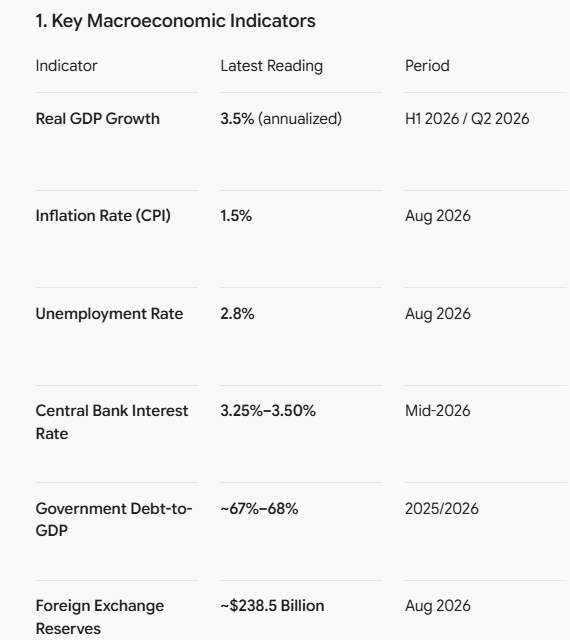
The Israeli economy continues to surprise on the upside with GDP expanding by 15.4% annualized in the second quarter. Much of this explosive growth takes its strength from a rebound following the second Iranian war in February. On a comparable year-over-year basis, the economy still registered a very respectable growth rate of 3.2%.The labour market remains very tight—unempolyment is 2.8% . The inflation rate is running at 1.5%, largely on the strength of the shekel keeping import prices down. The Bank of Israel has cut its policy rate three times this year, and borrowing costs are 3.25% -3.5%. Government debt-to-GDP remains comparatively low at 67%. Lastly, foreign exchange reserves are at an all-time high of US$ 24i billion this summer. These conditions are the envy of most industrialized countries.
But a closer look reveals an economy more than ever dependent on production from overseas.The value of goods and services actually produced within Israel barely increased between the two periods; meanwhile the value of goods and services produced by Israeli companies operating overseas was substantial and growing . Excluding that overseas income, the domestic GDP barely expanded by 1%, rather than the actual rate of 3.2%. Increasingly, the nation derives more of its income from overseas production, a phenomenon characteristic of a multinational corporation.
This most revealing information on the Israeli economy comes from recent data provided by the official Census Bureau of Statistics (CBS). To start, GDP conventionally measures income generated domestically. In addition, Israelis earn income from overseas investment and from working abroad. Gross National Income GNI combines these two income streams to reveal a much stronger economy than the domestic by itself. In other words, the Israeli economy outside the narrow confines of the nation’s borders is a major source of the nation’s income.
Many Israeli-owned companies in defense, pharmaceuticals, digital and hardware manufactured products outside the country. Conceptually, when an Israeli-owned firm produces products overseas—-under joint venture arrangement— that counts as an export in the GDP accounts, even though the product never entered or exited from Israel. When an Israeli-owned firm produces goods abroad and sells them, the transaction can appear in Israel's national accounts as an export even though the goods never physically cross Israeli borders. Israel still benefits from these companies through corporate tax revenue and taxes. Today, about 20% of all corporate profits originate from overseas operations.
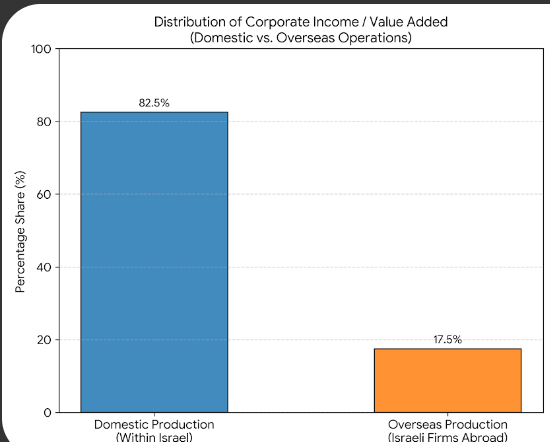
Israeli corporations are well known in the high-tech sector, much of which originates from operations in the US and Europe. Israel has a steady current account surplus and a net international investment position—-- i.e. the country is a net exporter of capital to the world.
The fact that so much Israeli-owned production takes place out of Israel has important policy implications. The central bank is less concerned over the rate of inflation domestically affecting exports. The economy is clearly at full employment, and that would normally lead to wage pressures and rising consumer prices. Wages are rising but inflation is tame.
In sum, the Israeli economy is in a sweet spot. Domestic economic conditions are stable, featuring low inflation and full employment .Consumers are bouncing back quickly from the temporary slow down during last winter’s hostilities. And, most importantly, Israeli-owned businesses are able to generate production offshore, contributing to additional domestic income. Even if the domestic market were softened further, the Bank of Israel has room to cut rates further without the worry of stirring up inflation.


Comments
Log in or sign up to join the conversation.