

The ISM price index is the highest since August 2022.
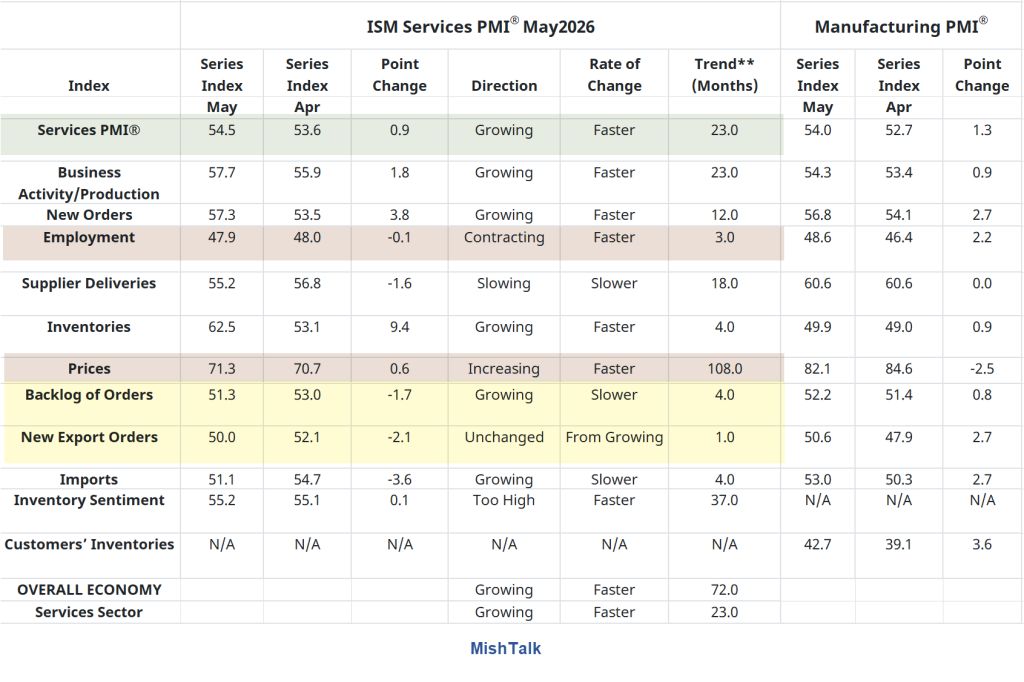
ISM services chart and excerpts by permission of the Institute for Supply Management.
The May 2026 ISM® Services PMI® Report shows production is expanding faster but employment is in negative territory for the third month.
Economic activity in the services sector continued to expand in May, say the nation’s purchasing and supply executives in the latest ISM® Services PMI® Report. The Services PMI® registered 54.5 percent, the 23rd consecutive month in expansion territory.
The report was issued today by Steve Miller, CPSM, CSCP, Chair of the Institute for Supply Management® (ISM®) Services Business Survey Committee: “In May, the Services PMI® registered 54.5 percent, an increase of 0.9 percentage point compared to April’s figure of 53.6 percent. The Business Activity Index remained in expansion territory in May, increasing 1.8 percentage points to 57.7 percent from April’s reading of 55.9 percent. The New Orders Index registered 57.3 percent, 3.8 percentage points above April’s figure of 53.5 percent and 2.6 percentage points higher than its 12-month average reading of 54.7 percent. The Employment Index contracted for the third month in a row with a reading of 47.9 percent, a 0.1-percentage point decrease from the 48 percent recorded in April; of the four subindexes that make up the composite PMI®, it is the only one that remains below its 12-month moving average,” says Miller.
“The Supplier Deliveries Index registered 55.2 percent, 1.6 percentage points lower than the 56.8 percent recorded in April. This is the 18th consecutive month that the index has been in expansion territory, indicating slower supplier delivery performance. (Supplier Deliveries is the only ISM® PMI® Reports index that is inversed; a reading of above 50 percent indicates slower deliveries, which is typical as the economy improves and customer demand increases.)
“The Prices Index increased to 71.3 percent in May, 0.6 percentage point above April’s figure of 70.7 percent and recording its highest reading since August 2022 (72.6 percent). The index has exceeded 60 percent for 18 straight months, increasing its 12-month average from 67.7 percent to 68 percent. Diesel, gasoline, oil and related commodities were once again most frequently mentioned as up in price in May.
Miller continues, “May’s Services PMI® is the fifth month in a row with an increase in the 12-month PMI® average, up 1.1 percentage points from 51.7 percent in December 2025 to its current 52.8 percent. The Prices Index increased to 71.3 percent, its highest reading since August 2022 (72.6 percent). In this month’s report, petroleum-related products were mentioned as a commodity up in price, a dynamic panelists had not yet reported in April. The Supplier Deliveries Index continued to indicate slower performance; while it eased by dropping 1.6 percentage points in May, its reading of 55.2 is still 2.1 points above its 12-month average.
“Business activity hit its second highest reading since achieving the same reading of 57.7 percent in October 2024, and the New Orders and Supplier Deliveries indexes hit their third highest readings in that time frame. The Employment index, however, hit its second lowest reading since September 2025, 0.5 percentage point below its 12-month average. Respondents commented frequently that their companies had instituted hiring freezes or were not backfilling vacated positions, however, most industries reported that they were holding flat in employment month over month. Respondents reporting that new orders were higher than last month most frequently attributed this to seasonality.
“For the third month in a row, no commodities in the report listed as down in price, with multimonth runs of being up in price for aluminum, copper, diesel, gasoline, software licensing and transportation. Although the Inventories index hit its highest level ever, tied with its reading in May 2010, the Inventory Sentiment was only 0.2 percentage point above its 12-month average. Despite the 9.4-percentage point increase in the Inventories Index compared to April, a 0.1 percentage point increase in the Inventory Sentiment Index indicates respondent confidence that business activity will remain strong amid higher costs, so expanding inventories are not of concern.”
What Respondents Are Saying
“We are seeing the dual effects of the administration’s tariff policy dynamics and the conflict in the Persian Gulf affect our pricing. Suppliers across numerous industries are trying to pass price increases for fuel surcharges and increased input costs for resin-based products and the like. This is the definition of inflationary pressure starting to affect us. We expect significant cost increases to impact us by late second quarter (Q2) and definitely in Q3.” [Accommodation & Food Services]
“Starting to see increased supply constraints and associated price increases, especially for construction materials and computers like laptops and tablets.” [Educational Services]
“Patient volumes and activity remain high, employment is steady and supply chains are operating effectively. There are some product lines on allocation as a direct result of the Middle East conflict; however, the current state is manageable. Another concerning factor on the horizon: the current drop-out rate on Affordable Care Act (ACA) health insurance plans after the federal subsidy was eliminated as of January 1. Year-to-date dropout rates are approaching 14 percent, indicating we may be seeing a potential increase in uninsured patients in the foreseeable future. The short-term forecast is cautious optimism.” [Health Care & Social Assistance]
“The groundwood paper market remains tight. The announced sale of Norpac to International Paper has caused some tightness. We figure intellectual property issues will eventually take Norpac out of the book market. Freight remains expensive, with gas prices and fuel surcharges starting to come through.” [Information]
“Effective commodity prices (oil) have increased about 20 percent so far in 2026.” [Mining]
“Due to rising fuel costs, a major distributor has decided to hold freight with resellers until a new contract is negotiated that addresses these increased expenses. Unfortunately, this means there will be delays that will impact our internal projects.” [Public Administration]
“Supply chain reliability for aviation parts and consumables has generally improved, but volatility in jet fuel prices — driven by geopolitical and logistics disruptions — continues to complicate forecasting and inventory planning. Wage inflation and a tight labor market for skilled personnel are increasing supplier service costs, and growing sustainability expectations are raising demand (and cost) for sustainable aviation fuel, with availability still uneven by region. Overall, conditions are more stable than during the peak of supply chain disruptions, but elevated fuel, labor and sustainability-related costs remain key factors shaping our purchasing strategy and industry outlook.” [Transportation & Warehousing]
“Inflationary pressures continue to impact pricing in certain categories. General concern over supply continuity due to unprecedented demand continues in the utility space.” [Utilities]
“Capital expenditure energy projects continue to be delayed or revamped based on macroeconomic factors. Data center power generation projects are driving demand and reducing available inventory across the piping market.” [Wholesale Trade]
That is a nasty set of comments. It’s similar to the ISM manufacturing comments but services are much more important to the economy.
Odds are Kevin Warsh’s first move as Fed chair will be to hike interest rates. That’s certainly not why Trump appointed him Fed chair.
Related Posts
June 3, 2026: How the War in Iran Is Contributing to Soaring Food Prices
Fertilizer, diesel, and natural gas all have an impact on food. The impact first shows up in producer prices, then consumer prices.
May 28, 2026: Inflation Expectations Surge in Two Distinct Consumer Confidence Surveys
57% of consumers say high prices are eroding their personal finances.
May 28, 2026: PCE Inflation Spikes Again, Year-Over-Year Highest Since May 2023
Year-over-year PCE inflation jumped to 3.8 percent. The Fed wants 2.0 percent.
June 2, 2026: Trump’s Economic Director Claims Real Incomes Are Going Up
Let’s do a fact check on the administration’s claim.

Comments
Log in or sign up to join the conversation.