

Has Wells Fargo gone from being "the best thing since sliced bread" to "toast"?
Wells Fargo (WFC) did some incredibly stupid things that came to light last fall. A bank that was a key contributor to the opening of the West and a proponent of fair business practices, and the least-fined major bank coming out of the banking fiasco of the recent recession, screwed up.

Under its now-fired Chairman and CEO John Stumpf and his over-zealous protégé Carrie Tolstedt, WFC employees were encouraged to open and rewarded for creating 2 million phony bank accounts. Wells has been fined $185 million -- so far -- for these transgressions. They have however “clawed back” incentive pay and bonuses – so far -- of $69 million from Stumpf and $63 million from Tolstedt. Leaving aside the question of why WFC believes it had to pay so much money for individuals fomenting such malfeasance that $132 million is considered only a partial pay-back, they are at least mitigating some of those fines.
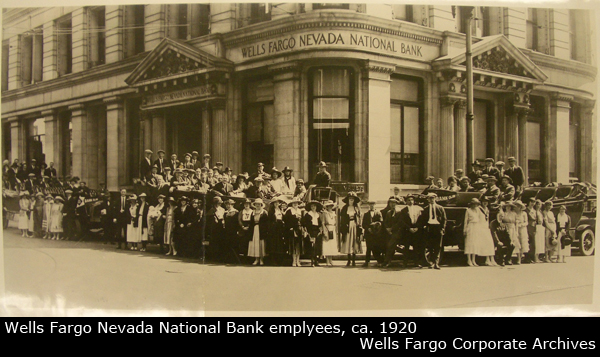
More importantly, Wells still has a retail franchise with more branches than any other US bank. This is quite the competitive advantage. As commercial and individual customers seek to borrow before future rate rises, WFC has deep pockets well-replenished by its many depositors nationwide. Barring another Great Recession, I believe interest rates will increase steadily in the next 1-2 years which in turn will increase Wells Fargo’s margins.
In addition, as the nation’s largest mortgage originator, Wells will benefit as more Millennials seek to buy homes and more individuals become re-employed. (See article here on the likely real estate recovery.)
This is the third-largest bank in the country and the one which, until recently, employed the sharpest executives and managers. I believe that this recent scandal was a one-off and the bank is now committed to restoring its customers’ faith and moving forward with the strengths its size and geographic reach provide. This, too, shall pass.
At this price WFC enjoys an operating margin of 37% and a net margin of 25%, an ROE of 10% and an ROA of a little more than 1%. It sells at 12.85 times earnings and pays a healthy dividend yield of just under 3%.
I began buying shares (this time) in one of my personal accounts at $54.75. I averaged down on Thursday after the revenue was reported for the first quarter as just a hair below the year-ago period and earnings just a hair above, buying at $51.75.
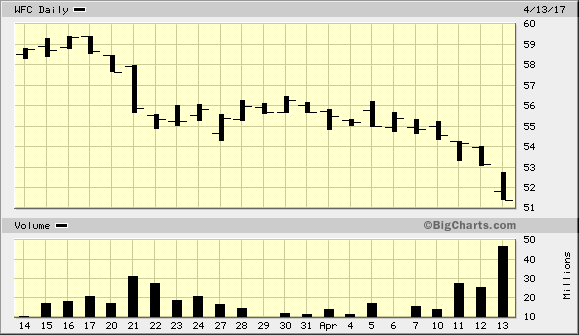
I have chosen to go the relatively conservative route of buying the common shares. However, I’ve also previously owned shares of the Wells Fargo TARP warrants and may again. For those of a more speculative bent these might be appropriate. During the past month when the common fell 12%, the warrants plunged 30% in 30 days. That’s the joy and the heartache of leverage.
The warrants (WFC.WS on BigCharts) are currently trading at $18.20. Their strike price is $34.01. That means there is a remarkably small premium to pay for this warrant. (Think of it as a call option that expires in October of 2018.) Adding$ 34.01 and $18.20, we see that the premium is just 86 cents to control a share of WFC from now until October of 2018. (34.01+18.20 = 52.21; 52.21-Thursday’s close at 51.35 = 86 cents.)
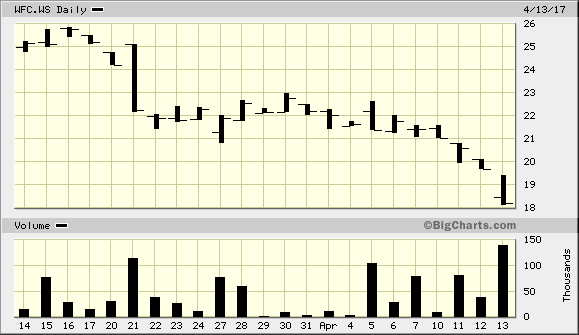
The downside? If WFC closes in Oct 2018 at $34.01, a common shareholder has lost a good chunk of money. The warrant holder, on the other hand, has lost absolutely everything.
Of course, if WFC recovers just to $60, the common holder buying at $51.50 makes $8.50; the warrant holder is awarded $26 per warrant, or roughly the same dollar amount from $18 that the common shareholder makes spending nearly three times as much. A caveat: leverage cuts both ways!! And you must be right on the direction of the stock and the timing. And – there are other adjustments that are too detailed to spin us around for this short article but these performance adjustments could make the warrants even more worthwhile.
If you are spending mad money, I would personally rather spend it on a leveraged way to play a great company than an unleveraged way to buy a lesser company. In either case, however, let the buyer beware…


Comments
Log in or sign up to join the conversation.