

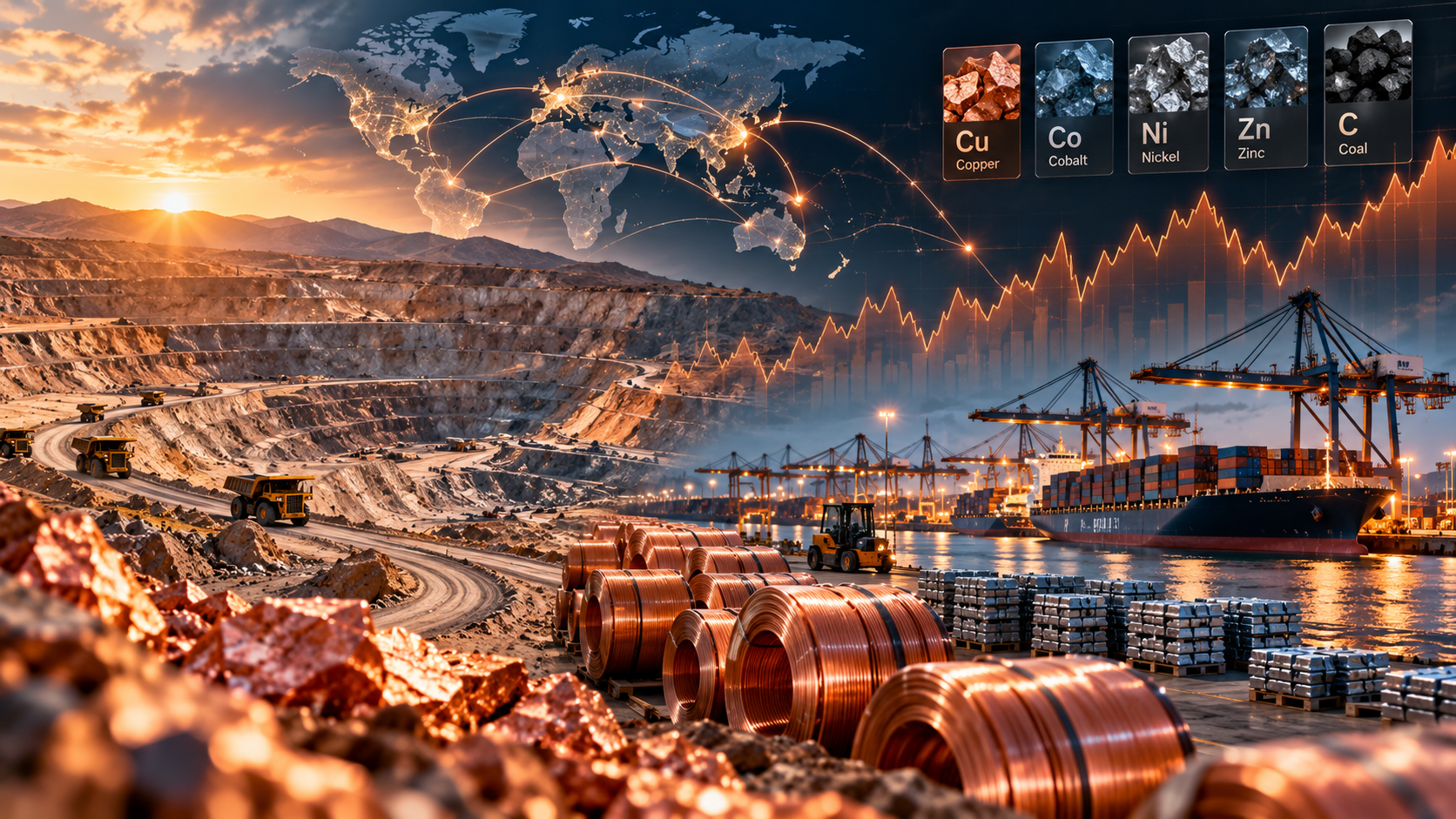
"The hardest part of compounding isn't finding something that grows. It's having the patience to leave it alone." - Warren Buffett
This thought from Mr. Buffett is the crux of intelligent, non-frenetic investing. I believe Glencore (GLNCY) today exemplifies this kind of investing.
Doing scrupulous research, finding quality in a sector that has decades or centuries of products that have staying power, and holding for the long haul (or at least for a year and a day to enjoy better tax treatment!) seem to be a lost art.
I'm updating the reasoning and results from my first purchase of Glencore in January of this year. Venezuelan Oil: Who Wins? Who Loses? (GLNCY). During this time, Glencore is up a little more than 18%, compared to the S&P 500, which is up a little under 14%. But my Glencore holding lets me sleep well at night, without all the Sturm und Drang of the index. (I followed up on my initial recommendation just three weeks later: Of The World’s Five Biggest Copper Producers, Only GLNCY Is Still A Buy).
Here's what we will review today:
What is Glencore? What does it do?
What are Glencore's compelling attributes and advantages?
Who are Glencore's top competitors?
What risks are there in owning Glencore going forward?
What is Glencore's current valuation?
What is Glencore? What does it do?
Glencore (the name is an abbreviation of "GLobal ENergy COmmodity REsources") was founded in the 1970s as primarily a global trading firm, a company that's brilliant at arbitraging valuable metal XYZ at one price and selling it at a higher price. This required a stellar overview of who needed what, how fast, and how badly.
The company collected the sharpest traders who knew their business to a "T." Later on, these same men and women recognized that if they added logistics and transportation, they could gain additional income. They were then not just trading a valuable commodity but also transferring the product to the buyer's preferred destination. And just after that, Glencore became big and powerful enough to invest in mining the important commodities they were already trading and shipping.
In May 2011, Glencore became a publicly traded company, making it easier for corporate and individual investors to benefit from its three core competencies: mining, trading, and logistics.
What does Glencore do today? It mines for precious and non-precious minerals and other commodities.
It then trades those items and many others from scores of other companies on a vast scale, then transfers the product for a whole other cohort from the seller—either Glencore itself, a client company, or a client nation—to the processors and ultimate users of the copper, zinc, cobalt, gold, grains, oil, gas, etc.
What are Glencore's Compelling Attributes and Advantages?
Glencore is the No. 1 public global commodity trader. It is the world's largest trader of copper, cobalt, and nickel, whether public, private, or nationally owned.
Glencore is a top‑five global copper producer and trader, with an 18% market share.
Glencore is the world's No. 1 producer of zinc. It's also a major miner of nickel, cobalt, coal, and more.
Glencore notes that it is "one of the world's largest and lowest-cost producers" of ferrochrome.
Glencore is one of the few companies that have combined mining, trading, and delivering products on a massive scale.
Glencore holds the dominant pole position in the Asia‑Pacific logistics network.
Glencore's trading arm is one of the largest participants in LME (London Metal Exchange) contracts for industrial metal futures.
Glencore is at the forefront of digital trading platforms.
Glencore is a major player in precious metals trading.
Glencore is consistently one of the world's largest thermal coal producers and traders.
Glencore does not have a major position in iron and steel, but it does have key positions in the metals used in steel production:
Nickel: 70,000–80,000 tonnes (2026 guidance)
Zinc: 700,000–740,000 tonnes (2026 guidance).
Cobalt: 35,000 tonnes — Glencore is the No. 1 industrial cobalt miner globally.
Steelmaking coal. Glencore describes itself as "one of the world's largest producers and exporters of seaborne traded thermal and steelmaking coal." In 2025, they produced 98.0 million tonnes of energy coal and 32.5 million tonnes of steelmaking coal.
Glencore doesn’t just mine and trade the world’s essential commodities; it also transports them from the mine to the refiner, from the refiner to the customer, and so on.
Glencore is brilliant logistically, with wide and deep supply chains across at least 35 producing and consuming countries, shipping more than 40 other commodities beyond those above. And lest their vessels might sail empty after a key delivery, their scrap and recycling division is growing by leaps and bounds.
Who are Glencore's top competitors?
Trading industry analysis firm Spherical Insights lists 19 competitors by largest 2025 revenue like this:
Top 20 Companies Leading the Commodity Trading Services Market
Vitol Group (privately held)
Glencore plc
Trafigura Group (privately held)
Mercuria Energy Group (privately held)
Gunvor Group (privately held)
Cargill Incorporated (privately held)
Archer Daniels Midland Company (ADM)
Bunge Global SA (BG)
Louis Dreyfus Company
Koch Industries, Inc.
Mitsubishi Corporation (MSBHF)
Marubeni Corporation (MARUY)
Sumitomo Corporation (SSUMY)
Itochu Corporation (ITOCY)
Freepoint Commodities LLC
Castleton Commodities International LLC (CCI)
Hartree Partners LP
Engelhart Commodities Trading Partners (ECTP)
BP Trading & Shipping (BP)
Shell Trading & Supply (SHEL)
If you want to invest in international trading of essential commodities, I believe Glencore is the way to go.
When it comes to metals trading only, Glencore is still No. 1 globally.
When we move on to discussing metals and metals-related mining, we should consider the following as current competitors:
Freeport‑McMoRan (FCX)
BHP (BHP)
Rio Tinto (RIO)
Southern Copper (SCCO)
Teck Resources (TECK)
Vale (VALE)
Anglo American plc (NGLOY)
Glencore's competitive position:
In copper, Glencore is stronger than Rio Tinto and Anglo American but comparable to Freeport and BHP in diversified copper portfolios. Southern Copper is less diversified but is the big dog, with a concentrated top position.
In other mining, BHP and Rio Tinto are strong in iron ore, but Glencore doesn't go head-to-head there. It mines, trades, and delivers the steelmaking coal that enables steel production. Vale is a strong competitor in nickel, but importantly, none of these competitors have a trading arm. Glencore’s hybrid miner + trader + logistics model is unmatched.
It takes more than finding the commodity and mining it. Without the trading arm, all these major companies will have to pay a trader and a logistics supplier to get their metals to market. Except Glencore, which does it all in-house.
What risks are there in owning Glencore going forward?
It takes geopolitical intelligence, market intelligence, and good ol' street savvy to do what Glencore does. Along the way, you assess risk, decide on a course of action, and pursue it—being ready to back away and having a Plan B if things go south.
One risk with Glencore is that the company might have to deal with regimes that are less-than-good neighbors. Until sanctions were imposed on Russia, Glencore did business there. Poof! Being a solid corporate citizen, that income stream disappeared.
Another risk: The world needs cobalt for many of today's and future applications.
Cobalt around the world (World Population Review)
If you want cobalt, you need to be in the Democratic Republic of the Congo (DRC) in southern Africa. Its 6 million metric tons in the ground dwarfs Australia's 1.7 tonnes of known reserves. A revolution, an assassination, an arbitrary price change, or a failure to honor contracts can happen at any time when dealing with some regimes.
Another risk? There will always be ESG controversies (Environmental, Social, and Governance). For instance, Glencore deals in coal. Some people find that anathema, even if coal produced the electricity to make the turbine blades for wind systems or other renewables. Others note that the other side of this argument is that coal is both abundant and efficient.
Valuation
Calling out what I like best about the following valuation metrics (all relative to the rest of the Materials Sector)...
Even though it's non-GAAP, I prefer to see a low PEG ratio relative to peers. Glencore succeeds in keeping my attention here. I also like to see those A-pluses next to EV/sales, both Forward and Trailing Twelve Months. I especially like the A-pluses given to price/sales, both forward and trailing twelve months. This is a great indicator of success when viewed alongside the rest of the companies in the highly competitive Materials Sector. I'm disappointed in the trailing price/cash flow numbers. I would like to see this number come way down going forward. Nothing beats free cash flow as an indicator of continuing success.
The Bottom line
Summing up, Glencore is the No. 1 public (and No. 2 overall) global commodity trader, a top-5 copper miner, the No. 1 cobalt miner, a large nickel producer, the No. 1 zinc producer, a large coal producer, and a highly successful logistics and transportation operator.
I issued Strong Buy recommendations in my two previous analyses. At this price, I see this small pullback in September as a fine time to suggest another Strong Buy for those with the patience to grow their portfolios in a steady, not volatile, manner!

Comments
Log in or sign up to join the conversation.