

A recent research letter from the Federal Reserve, Bank of San Francisco, came out positively in favor of negative interest rates, stating that “negative rates may be an effective monetary policy tool to help ease financial conditions”[1]. The report becomes even more controversial, given that the European Central Bank has encountered an outburst of criticism amongst EU members for creating negative rates throughout the entire yield curve. In particular, German bank officials have argued strenuously that negative rates hurt savers and impair commercial bank lending. The barrage of attacks after the most recent cuts by the ECB has shaken the EU banking community. Although the research paper comes with an explicit disclaimer that the findings does not necessarily reflect the views of the regional bank or the Board of Governors, it does indicate that the Fed is keenly aware of what negative interest rates are doing to the EU economies and the prospects of introducing negative rates in the US.
The research letter starts out by acknowledging the reality that, despite the presence of historically low-interest rates in the developed world, it is increasingly more difficult to “provide adequate monetary stimulus during a future economic downturn”. Simply put, central banks are running out of runway to achieve lift-off. The research goes on to measure the response time of government bond yields in four European countries and Japan once a negative bank rate was announced.
(Click on image to enlarge)
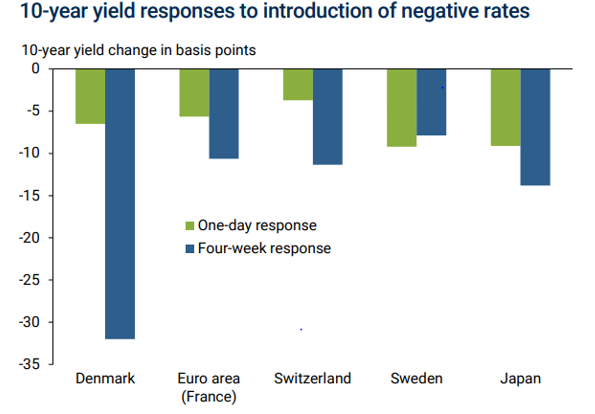
The research note finds that within a four-week window, long- term bond yields dropped dramatically and provided the sustained effect that is needed to stimulate economic expansion. This points out that negative rates are not just a theoretical construct but a practical tool to lower rates along the entire spectrum and thus ease financial conditions almost immediately. Also, rates tend to remain in negative territory for several years thereafter. One explanation for the rapid response time is that negative rates signal to investors that the central bank authorities expect growth to weaken and prices possibly to deflate over the longer term.
The paper concludes that central banks who have not introduced negative rates can take ‘comfort from this evidence there appears to be room below zero for additional economic stimulus’. Is this a green light for negative rates should the U.S. economy enter a recession?
[1] Federal Reserve Bank of San Francisco, Jens H.E. Christensen, “Yield Curve Responses to Introducing Negative Policy Rates” October 15,2019



Comments
Log in or sign up to join the conversation.