

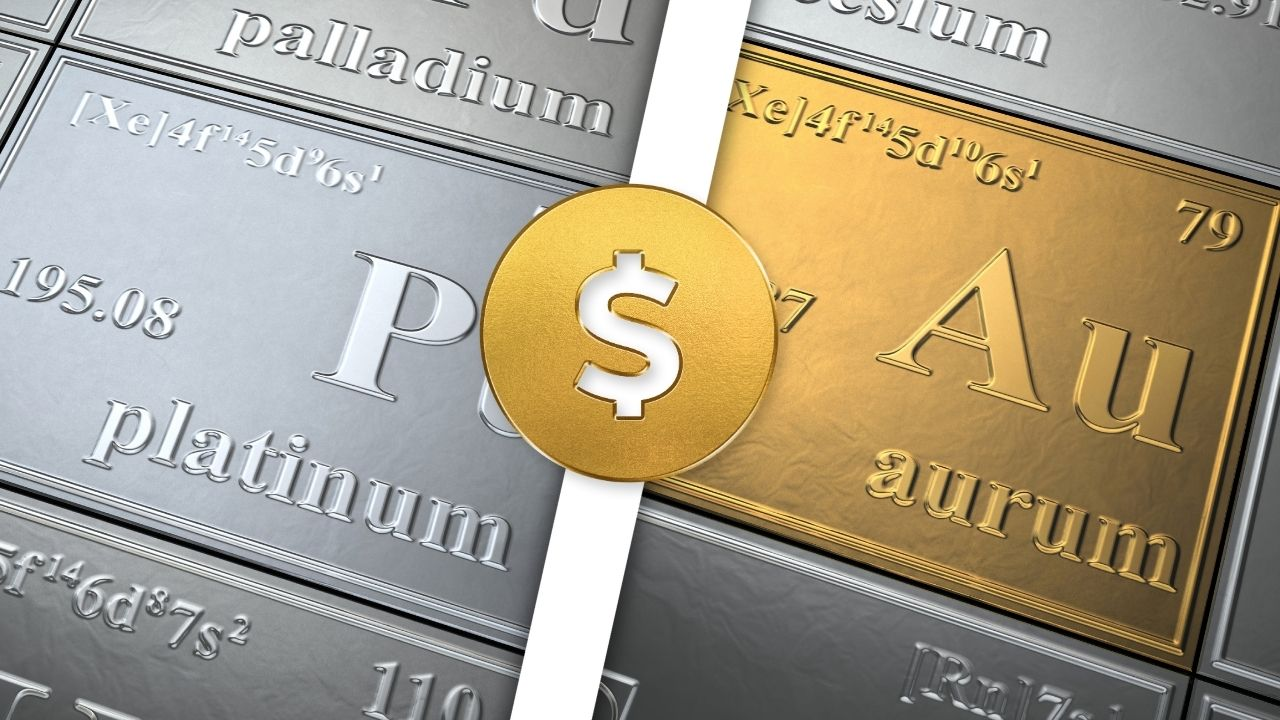
Gold costs more than platinum per ounce. While this was once reversed, gold has remained ahead of platinum for more than 11 years. In mid-January 2015, platinum’s London price fell below gold’s. It stayed there, and it has not caught back up to gold since that time.
Today, the gap between the two is roughly $2,500 wide. On September 29, 2026, at about 1:50 p.m. ET, gold traded at $4,159.00 an ounce. Platinum traded at $1,702.10. That makes gold about 2.4 times the price of platinum.
This guide compares the two metals as bullion. It is not about rings or credit cards. You’ll learn when the gap flipped, why the rarer metal costs less, and what it means when you buy or sell.
Platinum vs Gold at a Glance
Gold | Platinum | |
|---|---|---|
Spot price per ounce | $4,159.00 | $1,702.10 |
Spot price per gram | $133.71 | $54.72 |
World mine output, 2025 | 3,300 tonnes | 170 tonnes |
Top producer | China (380 tonnes) | South Africa (120 tonnes, about 71%) |
Biggest source of demand | Investors and central banks | Car exhaust catalysts (35% in 2025) |
Premium on a 1 oz U.S. Mint coin | 4.8% | 18.7% |
Dealer buy/sell spread, 1 oz Eagle | 6.5% | 17.8% |
IRA eligible | Yes | Yes |
Prices from Money Metals on September 29, 2026, at about 1:50 p.m. ET. Mine output from the USGS (gold, platinum). Demand from the World Platinum Investment Council.
Is Platinum More Expensive Than Gold Today?
No, platinum is not more expensive than gold. Gold costs more by the ounce and by the gram.
Gold: $4,159.00 per ounce, or $133.71 per gram.
Platinum: $1,702.10 per ounce, or $54.72 per gram.
A troy ounce holds 31.1035 grams. The prices of precious metals move all day, so check our platinum price and gold price pages for live quotes.
In this guide, the gold to platinum ratio is the gold price divided by the platinum price. Today, September 29, it is about 2.44. Some sites flip the math and divide platinum by gold. That version reads about 0.41 today. Either metric for finding the ratio describes the same gap. The only difference is where they place their emphasis.
Why Many People Think Platinum Costs More
Many people associate platinum with a top tier, and you can see that across several industries. For example, in music, a platinum record means 1 million units sold. A gold record means 500,000 (RIAA). Credit cards use the same ladder. That association has led to a misconception about which metal is more valuable.
While this is not accurate, it is a common mix-up. A Reddit thread on the topic drew more than 140 comments. The r/jewelry subreddit had many shoppers asking the same thing.
Most of this confusion revolves around jewelry. In the U.S., any jewelry sold as plain “platinum” must be at least 95% pure (FTC rules). A 14-karat gold ring is only about 58% gold. Platinum is also denser. It weighs 21.5 grams per cubic centimeter, versus 19.3 for gold (platinum, gold).
So, a platinum ring will hold more precious metal content than a gold ring of the same size. Even if the metal itself costs less, the ring can still be more expensive.
When Did Gold Become More Expensive Than Platinum?
Platinum dropped below the gold price in mid-January 2015. Eleven years later, platinum has still not recovered its position of prominence. By April 2017, platinum’s London price had been below gold’s every day for more than two years.
It was not the first time that platinum had dipped below gold. There were dips on several occasions before 2015:
Platinum’s yearly average fell below gold two years in a row, in the early 1980s.
From 1996 to late 2008, platinum never priced below gold on any day.
Platinum dipped below gold for a short time after Lehman Brothers failed in 2008.
It traded below gold on and off from 2011 to 2013.
What makes 2015 different is that the discount never ended. The table below uses yearly average prices from the U.S. Geological Survey (USGS).
Year | Gold average ($/oz) | Platinum average ($/oz) | Gold ÷ platinum |
|---|---|---|---|
2008 | 874 | 1,578 | 0.55 |
2011 | 1,572 | 1,725 | 0.91 |
2015 | 1,163 | 1,056 | 1.10 |
2020 | 1,774 | 886 | 2.00 |
2024 | 2,388 | 961 | 2.49 |
2025 (estimate) | 3,300 | 1,200 | 2.75 |
Sept. 29, 2026 (spot) | 4,159 | 1,702 | 2.44 |
Sources: USGS gold data (2013, 2020, 2025, 2026). USGS platinum data (2013, 2020, 2025, 2026). Spot prices from Money Metals.
In 2008, platinum cost almost twice as much as gold. Today, gold costs about 2.4 times as much as platinum.
We tracked this trend back in 2016. Our June 2016 article on the platinum to gold ratio found platinum selling for about 80% of gold’s price. Today it sells for about 41%.
What Broke Platinum's Premium
The flip between platinum and gold came in January 2015. That was eight months before the diesel scandal that many people blame for it. That detail matters because it shows that the diesel scandal did not open the gap, but it did help to keep the gap open. So did the following factors:
Diesel’s decline. On September 18, 2015, the EPA accused Volkswagen of cheating. The carmaker had rigged diesel cars to beat pollution tests. Car exhaust catalysts are platinum’s biggest use (WPIC). In the EU, diesel’s share of new cars fell from 53% in 2014 to 18% in 2023 (ICCT). It was just 8.9% in 2025 (ACEA).
Electric cars. Battery-electric cars have no tailpipe emissions (U.S. Department of Energy). They don’t need an exhaust catalyst at all.
Central bank buying. Central banks bought more than 1,000 tonnes of gold in each year from 2022 to 2024 (World Gold Council). They added 863 tonnes more in 2025 (World Gold Council). Central banks hold gold as money. Platinum has no buyer like that.
Is Platinum Rarer Than Gold?
Yes, platinum is in fact rarer than gold. Miners dig up far less platinum than gold each year. The USGS estimates that in 2025 the world mined:
That’s about 19 tonnes of gold for every tonne of platinum.
In dollars, the gap is much bigger. We used USGS output and USGS average prices. By that math, the world mined about $350 billion of gold and about $6.6 billion of platinum. That’s roughly 53 to 1.
The math: 3,300 tonnes x 32,150.7 troy ounces per tonne x $3,300 = about $350 billion. 170 tonnes x 32,150.7 x $1,200 = about $6.6 billion.
Platinum supply is also packed into a few places. South Africa mined about 120 of the 170 tonnes, or 71%. Russia added 20 tonnes and Zimbabwe 18. The U.S. relied on imports for 89% of the platinum it used in 2025 (USGS).
Gold comes from many countries. China led in 2025 with 380 tonnes. Russia (310) and Australia (280) came next (USGS).
Why Is Gold Worth More If Platinum Is Rarer?
Precious metals prices do not depend solely on rarity; demand plays a significant role in discovering prices. Between gold and platinum, gold has significantly more buyers.
One reason for this is that gold is a money metal. Here is what happened in 2025, per the World Gold Council:
Central banks bought 863 tonnes of gold. That’s about 5 times the world’s platinum mine output.
Investors bought 1,374 tonnes of gold bars and coins. That’s about 8 times.
Total gold demand reached 5,002 tonnes.
Platinum is mostly an industrial metal. Total platinum demand in 2025 was 8,671,000 ounces, or about 270 tonnes (WPIC). Car exhaust catalysts used 3,039,000 ounces of that, or 35%. The rest went to jewelry, industry, and investment.
So the gold market is about 18 times bigger by weight. When car sales slow, platinum demand drops. Gold does not depend on car sales, and that is one core reason why gold costs more.
Platinum Deficits: Why Scarcity Hasn't Closed the Gap
A deficit means buyers used more metal than mines and recyclers supplied. Platinum ran three deficits in a row (WPIC):
802,000 ounces in 2023.
1,096,000 ounces in 2024.
1,440,000 ounces in 2025.
Those shortfalls drained stockpiles. Above-ground stocks fell from 3,186,000 ounces at the end of 2024 to 1,745,000 at the end of 2025.
Still, the gap with gold stayed wide, and the outlook has since changed. In its September 9, 2026 report, WPIC now expects a 265,000-ounce surplus for 2026. It would be the first surplus since 2022. Here is why:
ETF holdings fell by more than 500,000 ounces in the first half of 2026. That’s about one-seventh of what ETFs held at the end of 2025.
Jewelry demand fell as prices rose, mostly in China.
Recycling is set to rise 8% as higher prices pull more scrap to market.
Stocks are forecast to rebuild to 2,010,000 ounces. That still covers just 3.4 months of demand.
What about hydrogen? WPIC puts hydrogen-related demand at 77,000 ounces in 2026. That represents about 1% of total demand. It’s a real market, but still a small one. Other industrial uses are growing too. WPIC points to glass, electronics and AI data centers.
The Gold to Platinum Ratio: How Investors Use It
The ratio tells you how many ounces of platinum one ounce of gold can buy. Today, one ounce of gold buys roughly 2.4 ounces of platinum. The 2025 average was 2.75. In 2008, it was 0.55.
Some investors watch the ratio to decide when to swap metals. A high ratio means platinum looks cheap next to gold. But cheap can remain cheap; there is not a guarantee platinum will rise. Here is the case on each side.
Reasons the ratio could fall (platinum gains on gold):
Three straight deficits cut stockpiles to thin levels (WPIC).
Most supply comes from one country, South Africa (USGS).
New industrial uses, like AI data centers, are growing (WPIC).
Reasons the ratio could stay high:
Central banks keep buying gold (World Gold Council).
Electric cars need no exhaust catalysts (U.S. Department of Energy).
WPIC expects a 2026 surplus as investors sell ETFs (WPIC).
The ratio has no steady “normal” level. In the USGS table above, the yearly average runs from 0.55 to 2.75.
A swap also has a cost. You pay a spread when you sell one metal and again when you buy the other. The next section shows how big that can be.
Is Platinum Harder to Sell Than Gold?
Often, yes. Platinum is a smaller market. Fewer local coin shops trade it, as we explain in our platinum vs silver guide. The clearest way to see the difference is the gap between what a dealer charges and what it pays.
Here are Money Metals' prices on September 29, 2026, at about 1:50 p.m. ET:
Product | We sell at | We buy at | Premium over spot | Buy/sell spread |
|---|---|---|---|---|
$4,358.00 | $4,075.00 | 4.8% | 6.5% | |
$4,276.00 | $4,021.00 | 2.8% | 6.0% | |
$2,021.10 | $1,662.10 | 18.7% | 17.8% | |
$1,871.10 | $1,638.27 | 9.9% | 12.4% |
Sell prices are for 1 to 9 pieces. Spread is the sell price minus the buy price, divided by the sell price.
The Platinum Eagle’s spread is almost three times the Gold Eagle’s. Let’s imagine you bought a Platinum Eagle today and sold it back today. You would give up about 18% of what you paid. With a Gold Eagle, you would give up about 6.5%. So platinum’s price has to rise more before you break even.
If you hold platinum or plan to buy it:
Stick to well-known products, like the American Platinum Eagle or .9995 fine platinum bars.
Look at bars if cost matters most. The 1 oz platinum bar carries about half the coin’s premium.
Sell to a dealer that posts its buy prices. You can sell to Money Metals online or by phone, even if you bought elsewhere.
Should You Buy Platinum or Gold?
The right choice depends on your goal. Here is a simple guide.
Your goal | Better fit | Why |
|---|---|---|
Protect wealth in a crisis | Gold | Central banks and investors hold it as money |
Easy resale | Gold | Bigger market and tighter spreads |
Bet on platinum catching up | Some platinum | The ratio is high, but demand rides on industry |
Retirement account | Either | Both can go in a precious metals IRA |
Small budget | Either | Fractional gold coins or 1 gram platinum bars |
Some investors hold both. In such cases, gold usually serves as the core. A smaller platinum position adds exposure to industrial demand. If you want the bull case, read our take on the case for platinum. Then weigh that against the 2026 surplus forecast and platinum’s wider spreads.
Can You Hold Platinum in an IRA?
Yes. Federal law allows certain platinum coins and bullion in an IRA (26 U.S. Code § 408(m)(3)). That includes the American Platinum Eagle. Bullion must meet the purity that futures exchanges require. Canada’s Platinum Maple Leaf also qualifies. So does the Perth Mint’s Platinum Kangaroo (Money Metals). See our precious metals IRA page and our list of IRA-accepted metals.
Comments
Log in or sign up to join the conversation.