

Gold has rebounded sharply from its July lows, supported by renewed investment demand and growing unease over the US fiscal outlook. But persistent inflation and the possibility of further Fed tightening mean the recovery is unlikely to be straightforward.
Fiscal risks give gold fresh momentum
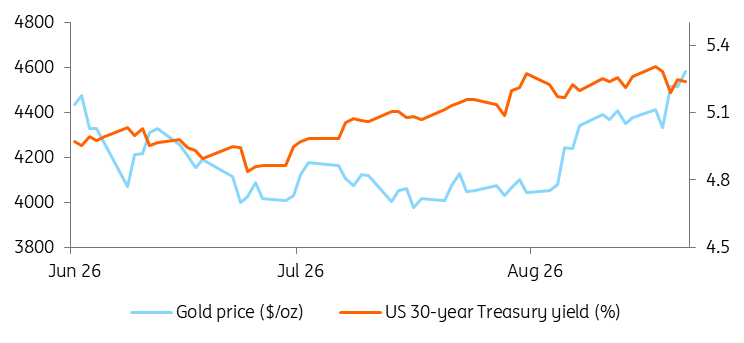
Gold has climbed from around $4,000/oz in mid-July to around $4,600/oz, returning to levels last seen in May.
The latest move followed the US Treasury’s decision to increase its purchases of longer-dated government debt. The maximum size of buyback operations in the 10-to-30-year segment will rise from $2bn to at least $4bn, with Treasury Secretary Scott Bessent signalling that the programme could be expanded further.
The bond-market impact proved short-lived, with long-term yields subsequently recovering much of their decline. Gold, however, continued to strengthen.
In our view, gold's resilience suggests that the rally is not simply a response to lower yields. The prospect of larger Treasury buybacks has refocused attention on government borrowing and fiscal credibility. It has also revived concerns about currency debasement, reinforcing gold's appeal as a store of value.
Gold rebounds despite elevated long-term yields
Source: Refinitiv, ING Research
A weaker dollar and lower short-term yields have helped gold rebound after prices found support around $4,000/oz in mid-July. Softer US data have also revived expectations that the Fed could begin easing policy in 2027.
Investment demand is recovering
The improvement in ETF demand is another positive signal. Global gold-backed ETFs attracted $3bn in July, lifting their holdings by 23 tonnes, according to the World Gold Council.
Gold ETF inflows return
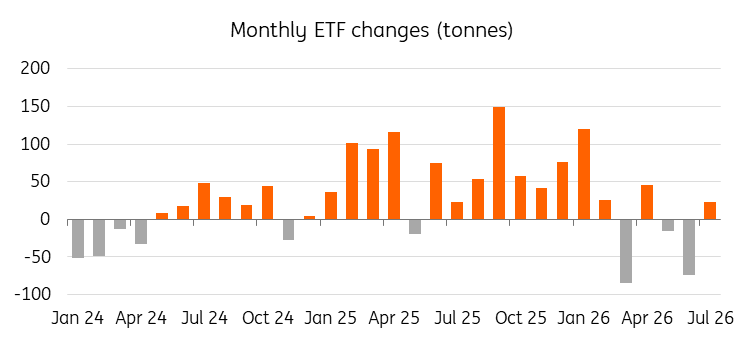
The recovery has continued into August. Funds tracked by Bloomberg added around 18 tonnes on Thursday alone, their strongest daily accumulation in almost a year.
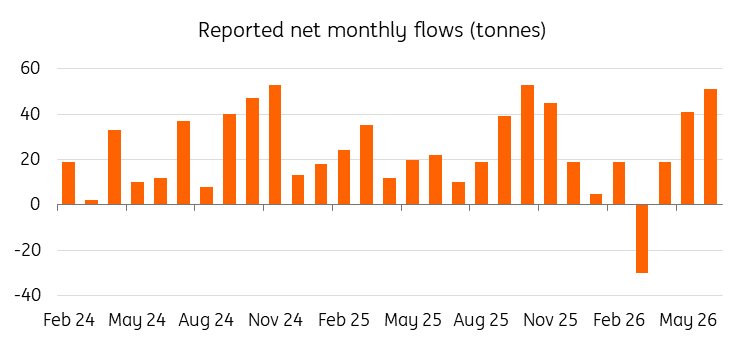
Central banks also remain a significant source of demand. Reported net purchases reached 51 tonnes in June, taking the first-half total to 102 tonnes, with Poland and China leading the buying. We expect official-sector buying to continue supporting the market, but further gains will increasingly depend on whether Western investors maintain their renewed interest in gold.
Central bank purchases rebound
Inflation remains the main headwind
The rally still faces headwinds. Rising energy prices are adding to US price pressures and could keep monetary policy restrictive for longer.
Minutes from the Fed’s July meeting showed that some policymakers favoured an immediate rate increase, while others were prepared to support further tightening if inflation remained elevated.
The Fed’s annual Jackson Hole symposium from 27 to 29 August will be closely watched. Any indication that policymakers are becoming more willing to raise rates would risk lifting yields and the dollar. A greater focus on growth or financial stability would be more supportive for gold.
Upside risks to our outlook are growing
Our forecast of $4,150/oz for the fourth quarter (average price) assumes that persistent inflation keeps US monetary policy restrictive and prevents a sustained fall in yields. However, renewed ETF buying, a weaker dollar and mounting fiscal concerns are creating increasingly clear upside risks to our outlook.
Gold’s correction appears to have found a floor. Renewed ETF buying and its resilience despite elevated yields suggest the recovery is on firmer footing, but further gains will depend on whether investment demand continues to build and how the Fed responds to persistent inflation.



Comments
Log in or sign up to join the conversation.