


History suggests that the euro’s correlation with eurozone spread widening can pick up rapidly. Today’s budget announcement in France leaves OATs at risk of further underperformance, and a so far resilient EUR/USD may be looking at material downside risks if things don’t improve. EUR/CHF is facing similar depreciation potential
FX spillover from France is starting
This morning's market chatter is increasingly focused on widening eurozone spreads finally spilling over into the euro, with the French-German 10-year spread reaching 130bp.
Both EUR/USD and EUR/CHF have moved lower today. The latter is providing the clearest signal that bond market stress is feeding into FX. The dollar continues to benefit from broad-based support, driven by tighter global financial conditions, elevated energy prices and a hawkish Fed. Instead, the Swiss franc’s momentum was bearish until this morning, with a dovish surprise last week by the Swiss National Bank weighing on the currency.
Our colleagues analyse today’s budget announcement in France in this note. ING’s view is that this budget buys some time but fails to solve structural deficit issues. Markets still have little incentive to price fiscal premia out of OATs, and with no party having presented a sufficiently detailed spending cut plan, the upcoming elections are adding to the uncertainty. Our rates team believes 150bp may be the next step for the 10yr OAT-Bund spread.
That creates material downside risks for the euro. Rising yield volatility and the prospect of wider spreads are pushing the market back into an environment where the euro becomes much more sensitive to the fiscal and bond narrative. We have seen similar episodes before, often centred on Italy. Yet the euro's response has so far been remarkably muted compared with those earlier periods.
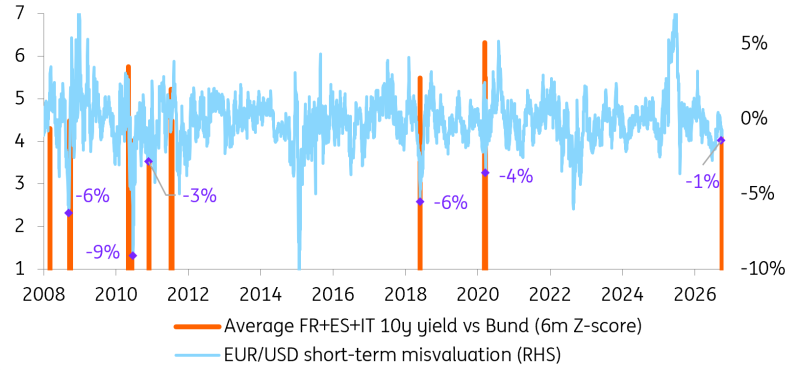
In the chart below, we highlight (orange bars) episodes when the average 10-year spread of France, Spain and Italy versus Germany widened by at least four standard deviations relative to its six-month mean. The light blue line shows the deviation of EUR/USD from its short-term fair value, i.e. the risk premium on the euro. In most of the other instances of sharp spread-widening, the euro suffered from much more idiosyncratic pressure. For now, that undervaluation is at a modest 1%.
The euro's reaction has been contained compared to past episodes
EUR downside risks increasing
That is mostly bad news for EUR/USD, with a couple of caveats. The negative aspect is that there is still plenty of room to catch up with the fiscal story. The chart above suggests a 3% risk premium buildup on the euro would be entirely in line with previous history, meaning a move to 1.110 is a possibility in a scenario of further spread widening, even if not extreme.
The positive caveat is that the limited EUR reaction may suggest that markets are not as concerned as they were about the Italian fiscal trajectory. The US is admittedly facing its own deal of fiscal scrutiny on top of that, and part of the French spread widening has surely followed higher energy prices, which as we know can fall quite rapidly in an improved geopolitical landscape.
EUR/CHF is historically the cleanest way to hedge the eurozone fiscal risk, and we could see further downside there too. Still, the franc’s idiosyncratic fragilities may get in the way, meaning we don’t expect CHF to outperform USD materially purely on the back of the French story. A drop to 1.110 in EUR/USD could equal a move to roughly 0.920-0.925 in EUR/CHF.


Comments
Log in or sign up to join the conversation.