


Headline Roulette
Monday’s market chaos did not emerge out of nowhere. The entire session was driven by rapidly shifting headlines tied to the ongoing US-Iran standoff around the Strait of Hormuz, the narrow energy chokepoint that handles roughly a fifth of global oil flows. Over the past several weeks, the situation escalated into a broader military and economic confrontation after Iran restricted shipping traffic through the strait following joint US and Israeli pressure tied to Tehran’s nuclear program and regional military activity. Since then, oil markets have been trading every rumour, military signal, diplomatic leak, and ceasefire whisper like life or death because the entire global inflation outlook now effectively runs through that narrow strip of water.
What hit markets Monday was a sudden wave of conflicting reports suggesting the situation could either spiral toward renewed military escalation or temporarily de-escalate through negotiations. Early in the session, traders reacted to reports that Iran had floated a revised peace proposal through Pakistani mediators, which included discussions about reopening the Strait of Hormuz and easing tensions in exchange for sanctions relief and limits on military operations. But almost immediately, counter-headlines emerged, saying Washington viewed the offer as inadequate, while Iran simultaneously rejected US demands as unacceptable.
That uncertainty turned into outright volatility when President Donald Trump posted that he had called off a planned military strike on Iran scheduled for Tuesday because “serious negotiations” were now taking place. Importantly, this was the first time markets even learned such a strike had been planned, which explains why oil immediately reversed lower while equities violently ripped higher into the close. The market was effectively repricing an escalation event that traders did not even know existed an hour earlier. At the same time, Trump warned that military action could resume “at a moment’s notice” if talks fail, leaving traders trapped between diplomacy optimism and renewed war risk.
Monday’s session felt like the market suddenly waking up from an AI-induced sugar high and realizing the macro furniture in the room had been quietly catching fire the entire time. Once OpEx cleared the calendar and Nvidia (NVDA) earnings moved into the forward window, the tape lost one of the mechanical pillars that had been suppressing volatility, and traders were forced to reconnect with the old macro plumbing that still ultimately drives every asset class. Oil ripped higher, long-end yields pushed back toward cycle highs, momentum stocks lost altitude, crypto got flushed, and the entire market started trading like a giant crowded positioning trade searching for liquidity all at once.
The Iran headlines simply became the ignition source for a move that was already structurally vulnerable. Markets spent the entire day jerking violently between escalation fears around Hormuz and whispers of diplomacy, sanctions relief, or military stand-downs. Then came the late session headline that President Donald Trump had called off a planned strike because negotiations were underway, instantly sending crude lower and equities screaming higher into the close. That type of price action tells you everything about the market’s current condition. This is no longer a fundamentally anchored tape. It is a reflexive liquidity-driven market where every geopolitical headline creates an immediate VaR shock across crowded positions.
What really changed over the past forty-eight hours is that traders finally rediscovered the old macro equation the market had been trying to ignore during the AI melt-up. Higher oil plus higher yields eventually becomes a valuation problem. For months, the AI complex traded as it existed above the economic cycle, as though semiconductor demand and hyperscaler spending somehow insulated the Nasdaq from energy inflation, term premium, or tightening financial conditions. But the minute Brent pushes north of $110 and the 30-year Treasury yield starts threatening another breakout above 5%, the entire duration trade inside equities suddenly starts wobbling.
The broader market internals are already flashing caution. Technology remains one of the only sectors still trading near relative highs while most sectors continue bleeding lower beneath the surface. Tech and energy are effectively carrying the entire index structure while everything else struggles to maintain trend support. That is classic late-cycle narrowing leadership. The index still looks healthy from thirty thousand feet, but underneath the hood, participation is thinning out rapidly. When rallies become dependent on fewer and fewer generals while the broader army retreats, the tape becomes increasingly fragile to any external macro shock.
The oil market itself still looks dangerously underpriced relative to the geopolitical reality. Hormuz remains effectively constrained, with commercial traffic reduced to minimal flows, and the emergency waiver allowing already loaded Russian crude cargoes to move again tells you policymakers are trying to stabilize the physical market before inventory stress intensifies further. The issue now is not just geopolitics. It is physical tightness layered on top of geopolitical uncertainty. There simply is not much slack left in the system. Every new disruption forces the market to reprice risk far more aggressively because spare capacity is trapped behind the same geopolitical bottleneck.
Oil futures climbed on Monday, getting a boost after President Donald Trump warned that the “clock is ticking” on Iran. Yet a loss of buffers that cushioned supply disruptions in recent weeks could spark the next significant move higher for prices.
The oil market may need to see evidence of current supply buffers running out before traders finally trigger another big move higher, said Stephen Innes, managing partner at SPI Asset Management.
Such proof could come with the Strait of Hormuz staying shut through peak summer demand, Innes said. It also might emerge in visible diesel shortages or from renewed attacks on Persian Gulf infrastructure. Oil inventories also could fall faster than expected or the U.S. could restart military attacks that “could reignite the regional tinderbox.” (MarketWatch)
That is why bonds continue trading poorly despite every equity wobble. In a normal risk-off environment, Treasuries would absorb the stress cleanly. Instead, the long end continues to act heavy because traders increasingly view energy-driven inflation as structurally sticky rather than transitory. The 30-year yield pushing back above 5.15% matters psychologically because once yields move into that zone, duration holders stop behaving like long-term investors and start behaving like risk managers. Conviction weakens. Positioning gets tighter. Every additional basis-point rise forces reallocations across every major portfolio structure.
The market is also slowly starting to accept that the old “Fed cuts solve everything” framework may no longer fit this cycle. If oil-driven inflation remains elevated while labour markets stay relatively firm, the central bank’s flexibility becomes extremely limited. The bond market is beginning to smell that reality long before equity traders fully price it. Historically, the Fed does not aggressively cut when short-term Treasury yields remain well above policy rates unless the economy is already sliding into a genuine crisis. That is what makes the current setup so dangerous for the momentum crowd. The market still wants to believe an easier policy will eventually arrive to support valuations, but the inflation impulse coming through energy markets keeps delaying that outcome.
At the same time, higher long-end yields are finally creating real competition for equities again. For most of the AI melt-up, investors had little alternative but to chase momentum because fixed income returns were unattractive relative to the explosive earnings narrative around semiconductors and artificial intelligence infrastructure. But once the long bond starts offering meaningful yield above 5%, capital allocation math changes quickly. Investors suddenly have options again, and that becomes a problem for stretched equity multiples dependent on perpetual inflows.
That flow dynamic is already showing up in crypto. Bitcoin (BTC.X) traded like a leveraged liquidity proxy all session, getting battered lower before finding support near its 200-day moving average around $76,000. More importantly, traders are suddenly focusing on downside technical levels again rather than reflexively buying every dip. That subtle psychological shift matters. It tells you speculative appetite is no longer operating with unlimited confidence.
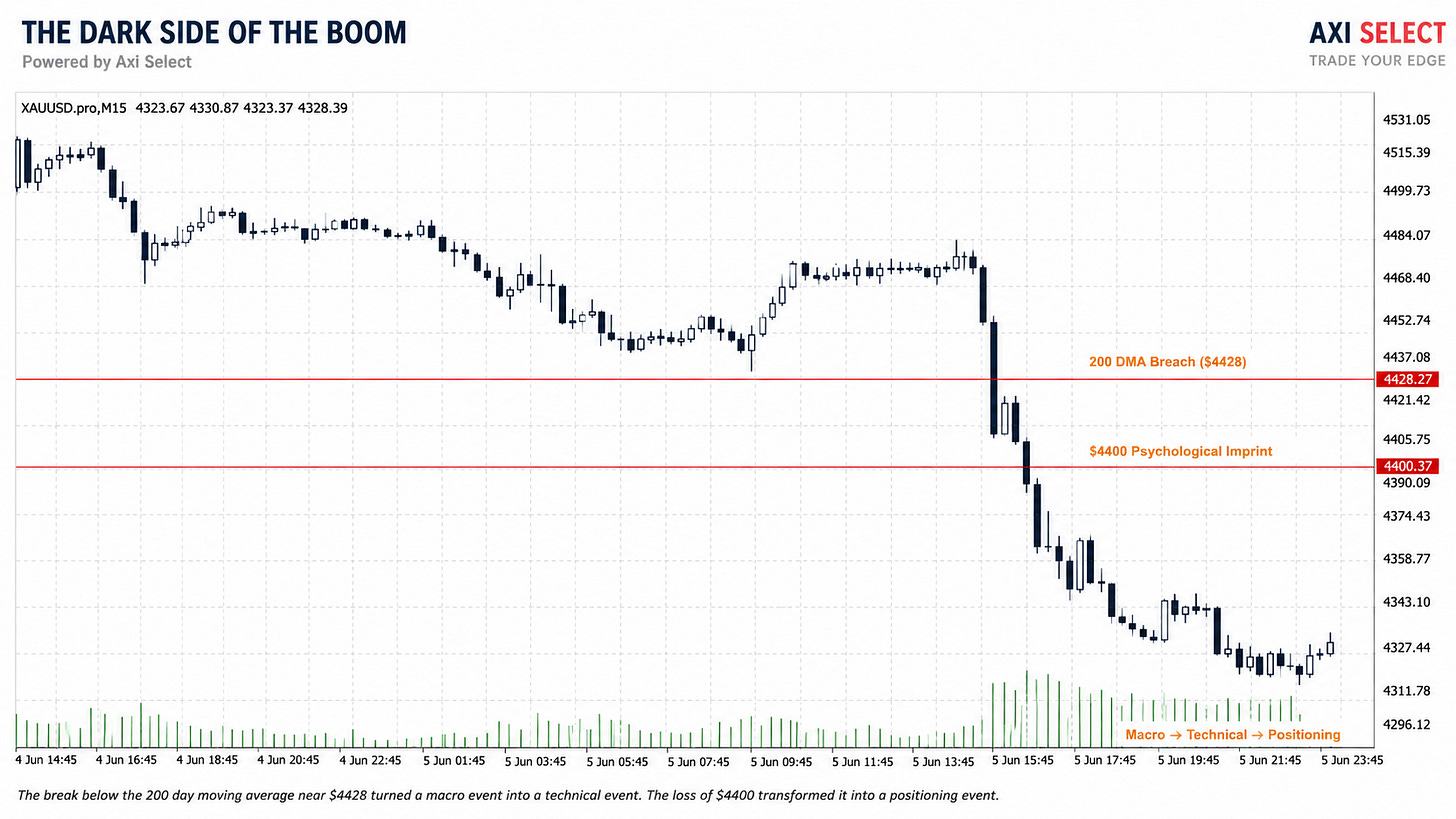
Even gold’s inability to meaningfully rally despite geopolitical chaos and a softer dollar says something important about the current macro regime. Real yields remain elevated enough to suppress aggressive defensive positioning, while silver and platinum continue reflecting a market increasingly uncertain about future industrial demand conditions. Meanwhile, the dollar's weakening alongside rising yields reinforces how disorderly the cross-asset picture has become. This is no longer a clean inflation trade or a clean risk-off trade. It is a market struggling to simultaneously digest tighter financial conditions, geopolitical instability, and a momentum complex that has become dangerously crowded.
To me, Monday felt like the first real crack in the illusion that the AI boom could indefinitely overpower macro gravity. The story itself remains powerful. The capex cycle remains enormous. The earnings momentum remains real. But the market is now colliding with the reality that oil shocks and rising term premiums eventually leak into every valuation model, no matter how exciting the narrative becomes.
The AI trade is still the locomotive pulling the train, but the macro landscape ahead suddenly looks a lot less like a straight track and a lot more like a tightening mountain pass.


Comments
Log in or sign up to join the conversation.