

The old adage, “you pays your money, you takes your choice” aptly describes today’s investment world. Investors must decide between two asset classes and must accept the results of that decision. Mohamed A. El-Erian of Bloomberg put this choice succinctly:
With asset prices where they are now, the two competing sets of policy influences on stocks -- the set that theoretically offer the prospects of healthy reflation (such as tax reform, infrastructure and de-regulation) versus the one that would increase the risk of stagflation (particularly trade protectionism of the type that triggers retaliatory actions from other countries) -- are much more tenuously balanced now. As a result, any particular policy move is likely to have a more marked price impact.[1]
A similar expression of two quite different outcomes comes from Laurence Fink, the CEO of BlackRock Inc. He said that “the 10-year Treasury could fall below 2 per cent or rise above 4 per cent.”He dubs this situation as a “bipolar world” and goes on to say that the markets could see both pole happening[2].
One glaring example of bipolar behaviour has already occurred this month with the decoupling of the Treasury 10-year yield from equity prices (see chart). As the stock indices continue to climb to new heights, bond yields remain in a very tight trading range. This is a signal that bond investors believe there is a real probability that the rate will get to at least 2 per cent. That 4 per cent rate is not on anyone’s radar screen.
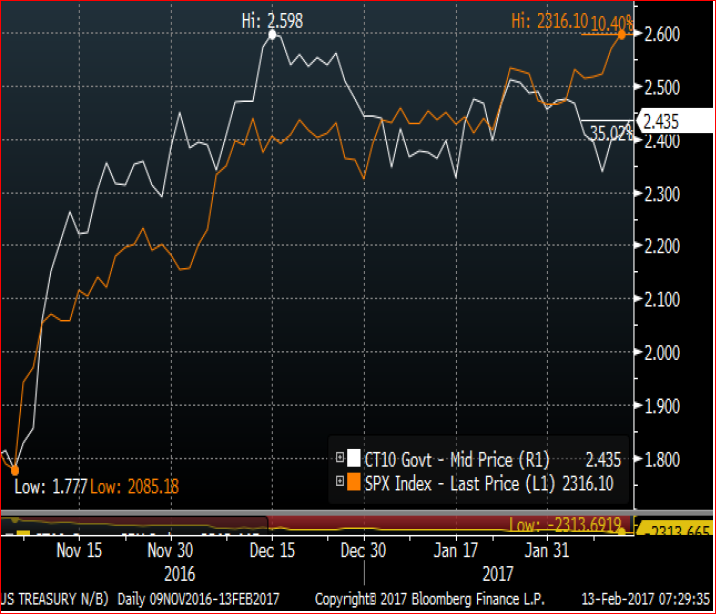
For Treasury yields to move up significantly there needs to be firm evidence that the President and Congress agree on the shape and size of a fiscal package, including tax reform and infrastructure spending. Without that assurance, Treasury yields will likely continue to trade in a narrow range. In the meantime, bond investors are far from convinced that the Trump`s chaotic governing style will produce any meaningful legislation this year. Should the United States allow protectionist policies to take hold, we can expect stagnation that will place further downward pressure on bond yields.
There appears to be no such hesitation on the part of stock investors who continue to anticipate pro-growth policies from Congress in the near future, supported by a dovish Federal Reserve. These investors see no policy impediments to another leg up in this market. Moreover, they anticipate relatively high rates of economic expansion supporting the current P/E ratios in the 20+ range.
El-Erian, rightly concludes, that we should expect more volatility as these two opposing forces --- reflation (stock market) and stagnation (bond market) —compete for the investor’s attention. Right now, the bets have been made by both sides, but the outcome is far from certain.


Comments
Log in or sign up to join the conversation.