Investors usually hate when a company issues more stock. Expanding the share count slices the ownership pie into smaller pieces. But when a company is trying to fund the massive capital needs of semiconductor manufacturing, selling equity can be safer than adding more debt. Intel just priced a massive stock offering that is expected to bring in about $19.7 billion after fees when it closes. The base deal will dilute existing owners by about 4%, but it gives Intel more room to fund capital spending and working capital while supporting its goal of maintaining an investment grade credit rating. The question now is whether management can turn that added financial flexibility into enough profitable growth to justify the dilution.
Next earnings date: Intel is scheduled to report third-quarter 2026 financial results after the market close on 29 October 2026. |
The Cost of Catching Up in Chip Manufacturing |
|
 |
Verdict: Intel is diluting existing shareholders by about 4% in the base deal to raise $20 billion before fees, or roughly $19.7 billion after fees. The dilution could rise to about 4.6% if the underwriters exercise their full option. The trade off is straightforward: current owners will hold a smaller percentage of Intel, but the company gains significant financial flexibility without adding more debt while it funds a capital heavy turnaround.
|
Intel priced an upsized stock offering of 210.5 million shares at $95 each, increasing the gross deal size to $20 billion from an initial $15 billion. The offering is expected to close Wednesday, August 12. After fees, Intel expects about $19.7 billion in net proceeds. Bloomberg reported that investor orders exceeded $100 billion, which helps explain why the company was able to increase the size of the deal.
|
Intel has not committed all of the money to specific factories or artificial intelligence processors. The company says the proceeds are for general corporate purposes, including capital expenditures and working capital. The underwriters also have a 30 day option to buy another 31.6 million shares, which would increase the gross deal by roughly $3 billion. |
|
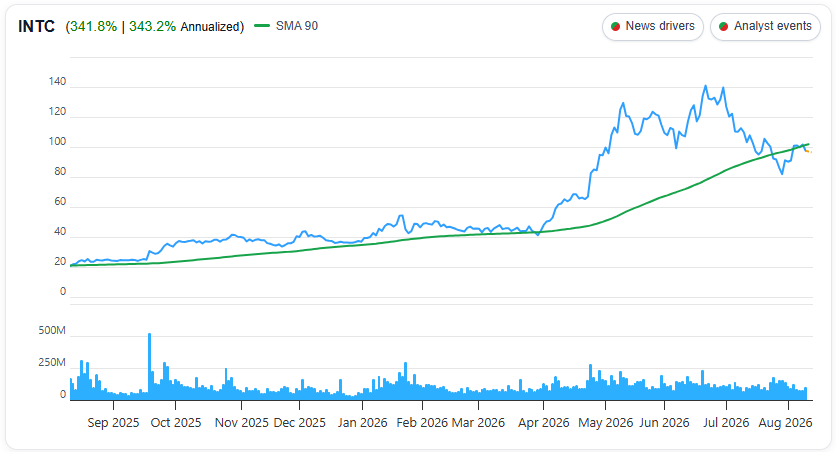 |
Intel (INTC) 1 Year Chart
|
Building leading edge semiconductor factories requires enormous amounts of cash. Intel Foundry lost $2.1 billion in the second quarter of 2026, although that improved from a $3.2 billion loss a year earlier. Higher cost wafers produced during the early Intel 18A ramp remained a drag on the business. Intel ended the quarter with $29.7 billion in cash and short term investments and $50.5 billion of total debt. The company also had $10 billion of unused credit facilities, which is how management got to roughly $40 billion of total liquidity. Raising equity instead of issuing more debt gives Intel additional financial room, but shareholders pay for that flexibility through dilution.
|
What changed in the thesis
|
The investment story is not a pure infrastructure play. Intel’s product businesses still do most of the economic heavy lifting, generating $15.1 billion of segment revenue and $4.8 billion of segment operating income in the second quarter, while Intel Foundry lost $2.1 billion. The equity raise makes the thesis more dependent on two things at once: continued strength in Intel’s product business and proof that 14A, advanced packaging and external wafer services can eventually become profitable.
|
Intel Foundry reported $293 million of external revenue in the quarter, but most of the increase came from Altera becoming an external customer after Intel sold control of the business. That number should not be treated as clean evidence that major outside chip designers are already moving production to Intel.
|
What the market may be missing
|
The cleanest reason this bet could be wrong is that capital does not automatically create customers. Even if Intel builds the best factories in the world, the logistical barriers to switching foundries are severe. Porting a chip design from a competitor to Intel takes up to two years and costs millions of dollars in new engineering and mask sets. Fabless chip designers will not switch just because Intel has new capacity.
|
Valuation and expectations
|
The valuation must now absorb a larger share count. Based on the share count Intel used in the prospectus, the base offering increases shares outstanding by about 4.2% and reduces each existing shareholder’s percentage ownership by about 4%. If the underwriters exercise their full option, the ownership dilution rises to roughly 4.6%. That dilution is real, even if the cash improves the balance sheet. The stock is trading on whether stronger product demand and future foundry wins can eventually produce enough earnings and free cash flow to offset the larger share count. |
|
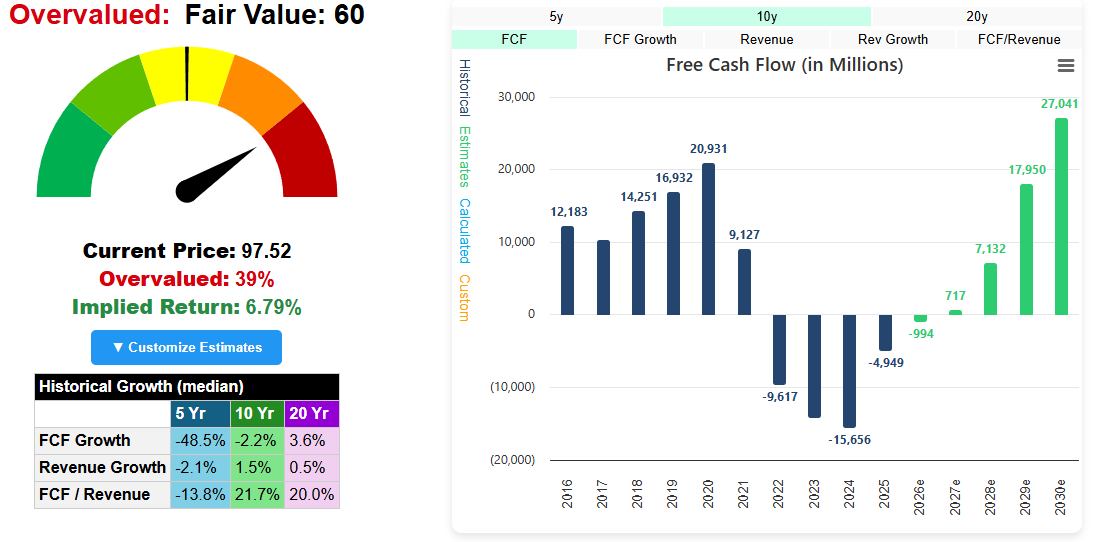 |
Intel (INTC) DCF Fair Value
|
Intel is buying financial flexibility, not guaranteed customers or profitable capacity. The offering should strengthen liquidity once it closes, but it does not remove the balance sheet or execution risks. The outcome will depend on product demand, manufacturing yields, customer commitments, foundry margins and management’s ability to earn an adequate return on the new capital.
|
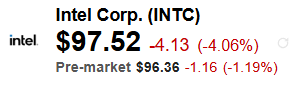
Intel shares closed at $97.52 on Monday, down 4.1% after the company announced its initial $15 billion stock offering. Overnight, Intel priced 210.5 million new shares at $95 and increased the base offering to $20 billion. Bloomberg reported that investor orders exceeded $100 billion. Intel traded about 1% lower before the opening bell. U.S. stock futures were little changed, while Brent crude rose more than 2% toward $90 per barrel as U.S. Iran talks remained stalled.
Why it matters this morning
|
The larger order book shows strong demand for Intel stock at $95, but that price is not a floor. The shares were sold at a discount to Monday’s close and the stock can still trade below the offering price. What the deal does show is that Intel can access the equity market at enormous scale without adding another round of debt. It does not prove that the factories will earn an adequate return or that all of the money will go into artificial intelligence infrastructure.
|
Taiwan Semiconductor Manufacturing Company (TSM)
|
TSMC raised its 2026 capital spending plan to between $60 billion and $64 billion. That level of spending shows the scale required to stay at the leading edge, but its pricing power comes from technology leadership, yields, execution, customer trust and a mature design ecosystem, not spending alone.
|
Advanced Micro Devices (AMD)
|
AMD uses third party foundries for all of its wafers and relies on TSMC for its leading edge microprocessor and graphics processor wafers. A credible Intel foundry could eventually create another option, but switching would require long qualification work and Intel still has to prove it can compete on technology, cost, yields and reliability.
|
Nvidia Corporation (NVDA)
|
Nvidia's data center growth confirms strong demand for NVIDIA’s artificial intelligence systems, but it does not prove demand for Intel’s foundry capacity. Intel still needs customers to choose its manufacturing technology and advanced packaging services.
|
The size of Intel’s capital raise is a clear reminder that leading edge chip manufacturing is incredibly expensive. That capital intensity creates a steep barrier to entry, but owning factories is not a moat by itself. The lasting advantage comes from process technology, yields, utilization, customer commitments and the ability to earn an adequate return on the factories.
|
Watch for Intel confirmed volume commitments and deal economics for 14A, especially beyond Tesla (TSLA)’s publicly stated plan to use the process. Track cash from operations, capital expenditures, free cash flow, cash and short term investments, and net debt. Total debt alone cannot show where the new cash went. Track 2027 capital expenditure guidance and whether new spending is tied to signed customer demand rather than speculative capacity. Look for Intel Foundry’s operating margin to improve from negative 36% in the second quarter and for external revenue growth that is not mainly explained by Altera.
Intel has priced a large financing to keep investing, but the deal does not solve the hard part. Management still has to turn roughly $19.7 billion of expected net proceeds into stronger product economics, better foundry margins and enough future earnings to offset the dilution. |
|





Comments
Log in or sign up to join the conversation.