

If you’re looking to buy a new car today, it will cost on average just under $50,000. That’s a 145 percent increase from $20,360, the average price in 2000. But the Consumer Price Index (CPI) shows an increase in the average new car price of just 25 percent over this period.
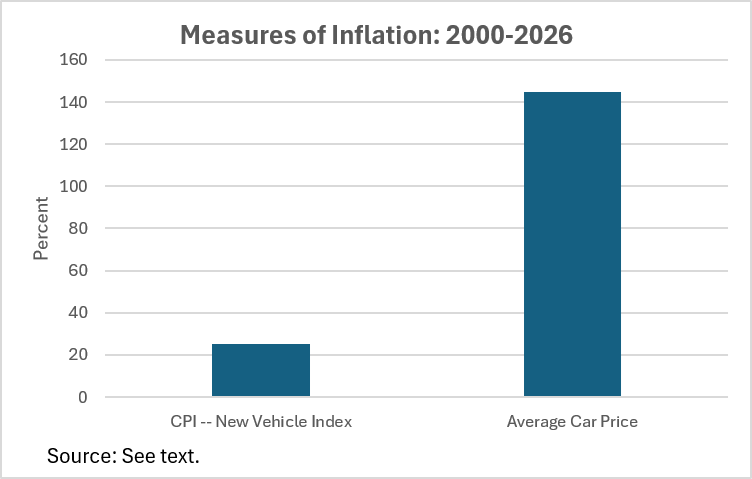
If that gap seems hard to understand, then you need to learn about quality adjustments in the CPI. I know that probably doesn’t sound very exciting, but it does matter.
In comparing prices over time, the Bureau of Labor Statistics (BLS) tries to adjust for quality changes. The reason is that they don’t want the index to show a surge in inflation when the main reason items cost more is that they have gotten better over time.
Cars are a good example. A new car sold in 2026 is substantially better in many ways than a new car sold in 2000. Most obviously, it is likely to last longer and require fewer costly repairs. It is also likely to be safer (fatalities in accidents have fallen sharply). And it is likely to have various self-driving features like parking assist.
People will value these improvements differently, and it is entirely possible that many will not see the quality improvements in cars as being worth anything like the price increases over the last 26 years. But it would be misleading to treat the 2026 car as being the same as the 2000 car.
The BLS has a variety of procedures for trying to measure the value of quality improvements. (Here’s a quick run-down for those of you who are gluttons for punishment.) They are surely not perfect, but it is necessary to try to separate out the extent to which price changes are due to quality changes (which could be in either direction, say a box cereal gets smaller) from price changes that are genuine inflation. This is another reason why the prices that people see when they buy things at the supermarket or elsewhere may not be the same as the rate of inflation measured by the CPI.
To be clear, I am quite confident that no one at BLS is trying to cook the books to make inflation look like less of a problem than it is. They are doing their best to deal with a difficult issue and inevitably they will get it wrong sometimes.
And for some people they surely get it wrong. I want my smartphone for e-mails, phone calls, and surfing the web. All the “improvements” they’ve made over the last 15 years mean zero to me, but I’m certain they are counted as big quality gains. And that may not be wrong, because surely some people value a better camera, better sound quality, and whatever else they have done to the thing over this period.
Anyhow, file this one under “inflation is not as simple as it seems.” There are differences between how you see prices and how the CPI sees them.



Comments
Log in or sign up to join the conversation.