

Palantir Technologies Inc stock may be near a bottom. I previously discussed this in a recent article on Feb. 18, 2026.
The stock is now down $135.24 per share, as of Friday, Feb. 20. That's down $58.93 from the recent peak of $194.17 on Dec. 24, 2025, demonstrating a 30% drop in just two months. I showed in my previous article why I believe Palantir is worth between $189 and $245 per share, or between 40% to 81% more.
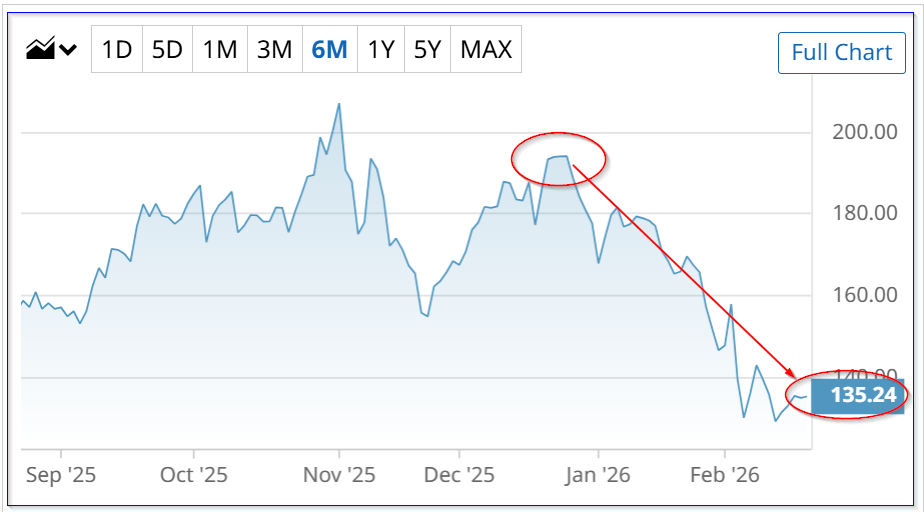
Image Source: Barchart - Palantir stock over the last six months, as of Feb. 20, 2026
As usual, trend traders have pushed up put options in Palantir stock, even for out-of-the-money (OTM) put exercise prices. That makes them attractive to short-sellers, especially if Palantir is near a bottom.
Shorting One-Month OTM Puts
For example, selling short a Palantir put option at an exercise price 7% lower than today's price yields over 3.6% over the next month. And a 11% lower strike has a 2.77% yield.
That can be seen in the following option chain for the period ending March 27, which is just over one month away.
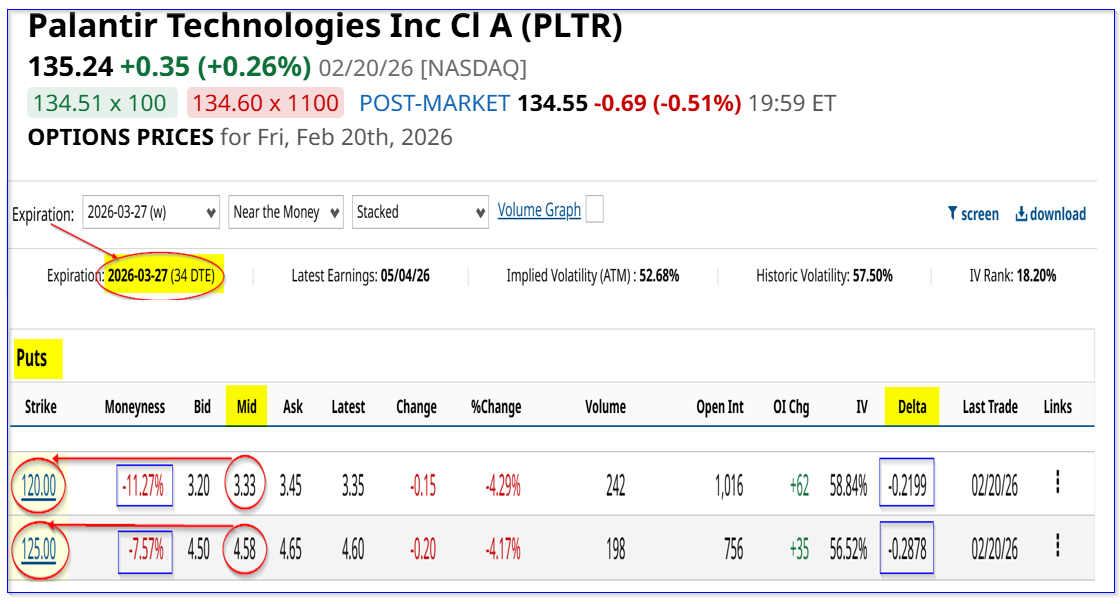
Image Source: Barchart - Palantir put options expiring March 27, as of Feb. 20, 2026
It shows that the $125.00 strike price put, which is 7.6% lower than Friday's close, has a midpoint premium of $4.58. That means a short seller of this put contract can make $458 after securing $12,500 in collateral. That works out to a one-month yield of 3.66%:
$458/$12,500 = 0.0366
Moreover, for more risk-averse investors, shorting the $120.00 strike price contract, over 11% lower than Friday's close, yields 2.78%:
$333/12,000 = 0.02775
That is after securing $12,000 in collateral with the investor's brokerage firm.
Note that there is a large volume of put contracts at the $120 strike price, over 1,000. That could be an indication that many traders still think Palantir stock is going to sink another 11%.
Downside Risks
For potential investors in the stock who short out-of-the-money (OTM) puts, the worst that can happen is that your account will buy Palantir shares.
But that only happens if Palantir falls 7% or 11% to $125 or $120 on or before March 27. The collateral already secured will then be assigned to buy 100 shares at the strike price.
However, if Palantir ends up lower than that strike price, it could result in an unrealized loss. That downside risk could force the investor to keep holding shares, or sell them at a potential loss (only if they want to). But all is not lost. Here are some beneficial or mitigating factors to consider.
Mitigating Factors and Plays
First, the investor has already received the short-put income. That effectively lowers the actual breakeven purchase point:
$125-$4.58 = $120.42 breakeven (i.e., 11% lower)
$120-$3.33 = $11.67 breakeven (i.e., -13.7% lower)
These breakeven points are between 11% and almost 14% lower than Friday's close at $135.24. Effectively, an investor is getting paid to wait to buy at significantly lower prices.
And for existing investors, it's a way to lower your average buy-in cost - either from the income received or from the lower buy-in if the puts are assigned.
Second, the delta ratios are low. That effectively implies that there is a low probability, based on past trading volatility, that Palantir will fall to these strike prices.
For example, the delta ratio for the $120 strike price, where there are over 1,000 contracts outstanding, is less than 22% (i.e., -0.2199). That means there is just over a 1 in 5 chance that Palantir will drop 11% to $120 by March 27. That is why this 2.77% yield with the $120 strike price short-put play is so attractive.
Third, don't forget, the worst that can happen with a short-put play is you own Palantir shares. I have shown that the stock is worth significantly more. So, a buy-and-hold strategy has a good chance of working out.
Lastly, less risk-averse investors can buy in-the-money (ITM) call options in longer-dated periods, using this short-put income. I will write on this in a new article.
The bottom line is that Palantir's put option yields are now very high, making them attractive to short-sellers and potential value buyers in the stock.



Comments
Log in or sign up to join the conversation.