

Chevron Corp (CVX) stock rose Friday on strong Q2 results, including $22.6 billion in operating cash flow, up from $8.6 billion last year. If oil and gas prices stay elevated, CVX stock could be undervalued. Shorting out-of-the-money (OTM) puts and calls is an attractive play here.
CVX rose 2.35% to $196.83 after Chevron released its Q2 earnings before the market opened on Friday, July 31. Moreover, it's up +19% from a recent trough price of $165.69 on July 1.
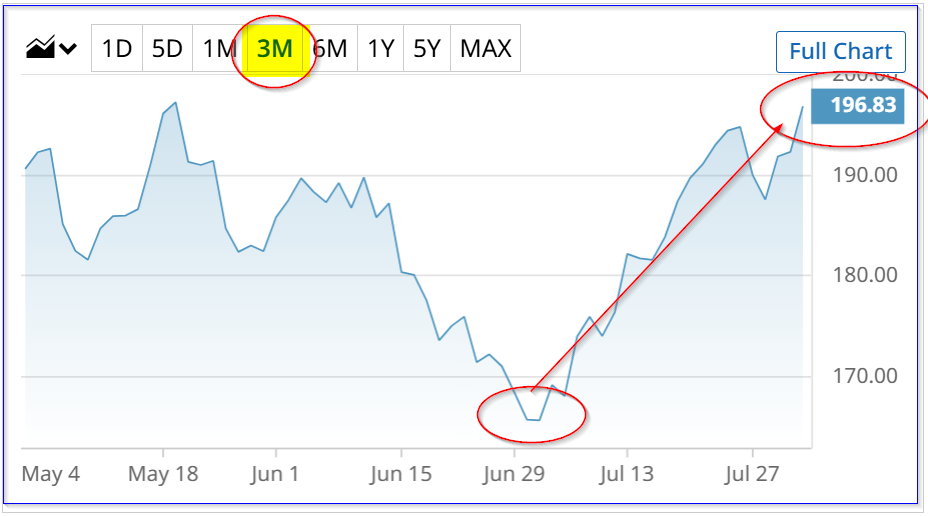
CVX stock - last 3 months - Barchart - July 31, 2026
Strong Cash Flow
The table below from Chevron shows just how strong its Q2 cash flow really was. The $22.6 billion in Q2 cash flow from operations (CFFO) and $25.1 billion in H1 CFFO, which is before capex, absolutely dwarfed the prior period's performance.
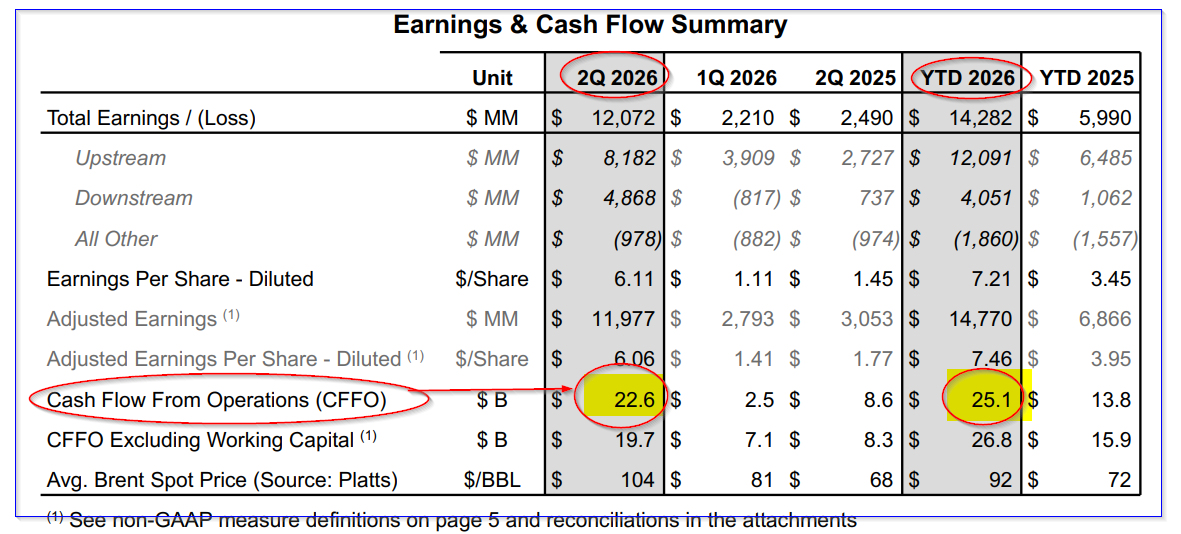
Chevron results - Q2 earnings release - July 31, 2026
Moreover, as the table below shows from page 2 of the earnings release, most of the CFFO converted into free cash flow (FCF). For example, in the first half, it generated almost $20 billion in adjusted FCF.
At this pace, it could produce almost $40 billion in FCF for the year. Obviously, that would require oil and gas prices to stay elevated, which may be a function of the U.S.-Iran conflict
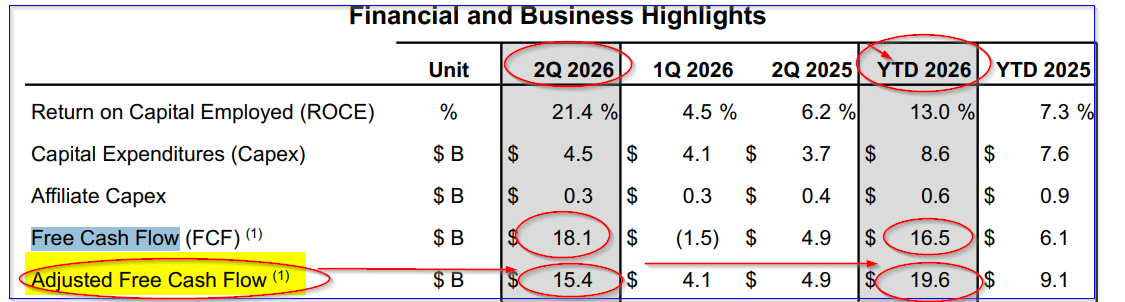
Chevron free cash flow (FCF) - Q2 earnings release, page 2- July 31, 2026
But, so far, there seems to be no end to that war. That could have huge implications for CVX's valuation and price targets. Here's why.
So far this year it has paid out $7.03 billion in dividends and bought back $5.689 billion worth of shares, as seen in its cash flow statements (page 9 of earnings release). That combined total of $12.719b is well below the $19.6 billion in adjusted FCF in the first half.
$19.6b - $12.719b = $6.881 billion
This implies the company can easily afford to both raise its dividends and buy back more shares. For example, the dividend portion is only 35.9% of its adj. FCF. It could easily afford to increase that ratio to 40%.
CVX Potential Dividend Increase
As of Friday, CVX stock had a market cap of $392 billion, according to Yahoo! Finance. That implies that if Chevron generates $40 billion in FCF, its FCF yield is very high, over 10%:
$40b / $392b = 0.102 = 10.2% FCF yield
If Chevron decided to pay out 40% of its adj. FCF, or $7.84 billion, the stock would have a theoretical dividend yield of over 4.0%:
$40b x 0.40 = $16 billion annual dividends
$16.0 b / $392 b mkt cap = 0.0408 = 4.08% dividend yield
This implies that the annual dividend per share would increase by 13.8%. Here is why:
$7.03b dividends paid H1 x 2 = $14.06 billion annual rate
$16.0b projected dividends / 14.06b = 1.138 -1 = +13.8% potential increase.
In other words, the dividend per share (DPS) could rise from $7.12 to $8.10 (i.e., $2.225 quarterly). (Chevron is likely to increase the DPS after its next $1.78 quarterly announcement.)
That means its dividend yield at today's price would be 4.115% (i.e., $8.10/$196.83 = 0.04115).
But, historically, CVX has had a much lower yield. For example, Morningstar reports that its five-year average has been 3.93%.
That implies that CVX could rise to $206.11 per share:
$8.10 / 0.0393 = $206.11 (price target) +4.7% upside
That is +4.7% higher than Friday's close of $196.83.
Higher Analyst Price Targets
Analysts agree that CVX is undervalued. For example, Yahoo! Finance's survey of 25 analysts is $215.00, or +9.2% higher.
Similarly, Barchart's survey PT is $213.70, and AnaChart's average price target from 19 analysts is $202.06.
However, given CVX's recent rise, some investors might want to play this more conservatively. Two less risky plays, especially for existing shareholders, are to short out-of-the-money puts and calls.
Shorting OTM CVX Puts and Calls
For example, the Sept. 11 expiry period, just over one month from now, shows that the covered call yield at a strike price over 9.2% higher is almost 1.0%.
This is because the $215.00 call option (Sept. 11 expiry) has a midpoint premium of $1.90. So, an investor can potentially make $190 after buying 100 shares at $196.83:
$190 / $19,683 = 0.9653%
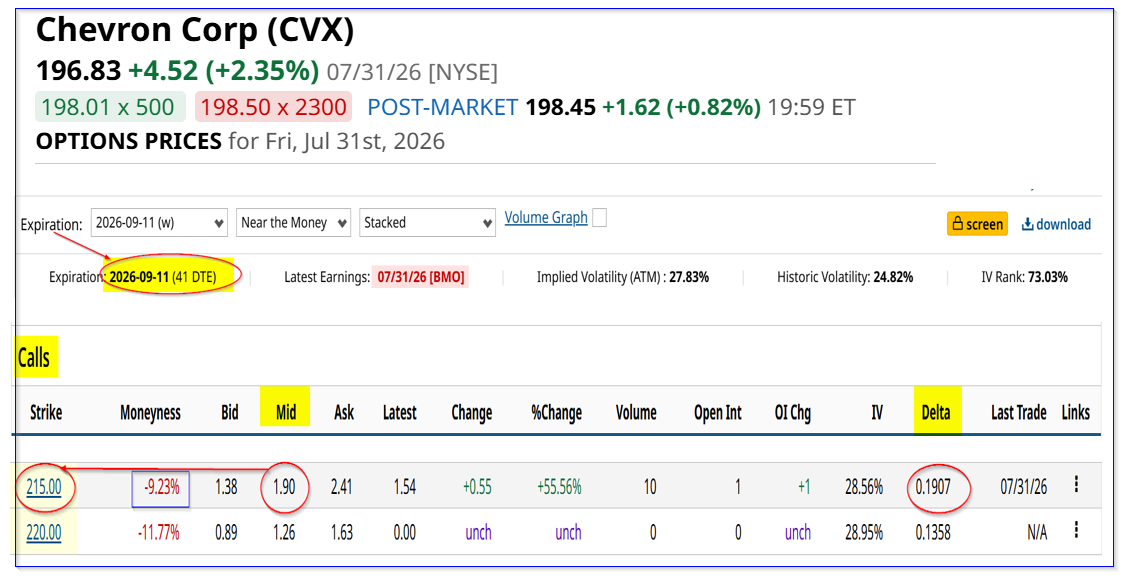
CVX call expiring Sept. 11 - Barchart - As of July 31, 2026
Moreover, if CVX rises to $215.00, the potential expected return (ER) is over 10%:
$215.00 + $1.90 = $216.90 / $196.83 = 1.102 = 10.2% upside
More conservative investors can sell short out-of-the-money (OTM) puts. The same Sept. 11 expiry period at the $180 strike price also has the same $1.90 midpoint premium.
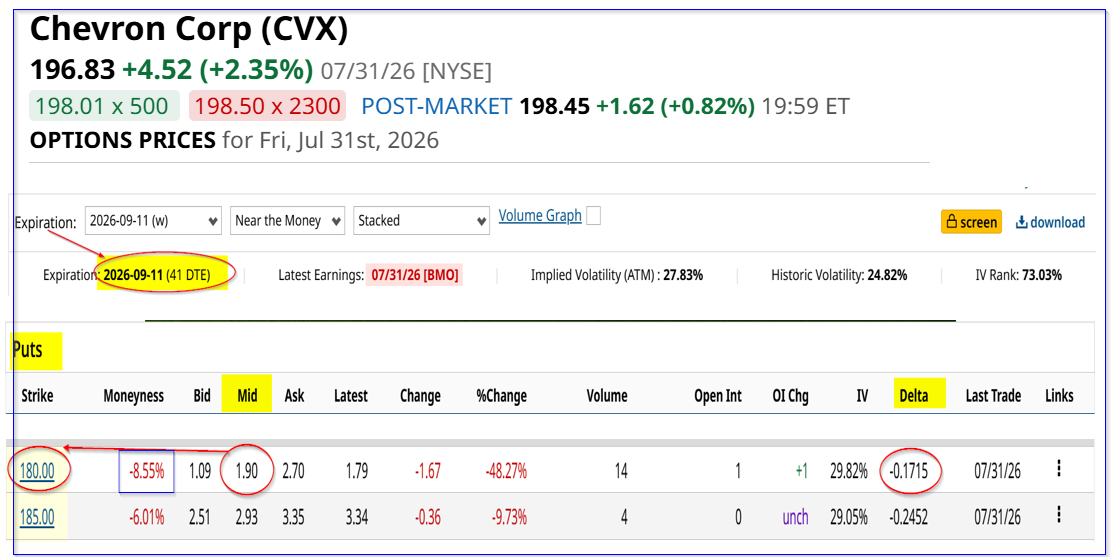
CVX puts expiring Sept. 11 - Barchart - As of July 11, 2026
As a result, an investor who posts $18,000 (much less than buying 100 shares at $196.83 for $19.863), can earn $190, or 1.0556% (i.e., $190/$18,000).
Note that this strike price is roughly the same distance away from the trading price as the call option play, -8.55% (short-put play) vs. +9.2% (covered call). Moreover, both of these have delta ratios below 20% (i.e., 17.15% short put vs. 19% covered call).
As a result, there is a similar risk profile. The advantage for the covered call investor, despite the slightly lower yield, is that an investor can earn upside gains despite the higher outlay.
But doing both plays could be a way for value investors to play CVX stock. To be more defensive and to reduce risk, the investor could buy a higher-strike call and a lower-strike put. That is a more technical play and requires giving up some of the premiums earned.
The bottom line is that CVX looks cheap here, and shorting puts and calls could be an attractive play.


Comments
Log in or sign up to join the conversation.